
Related videos:
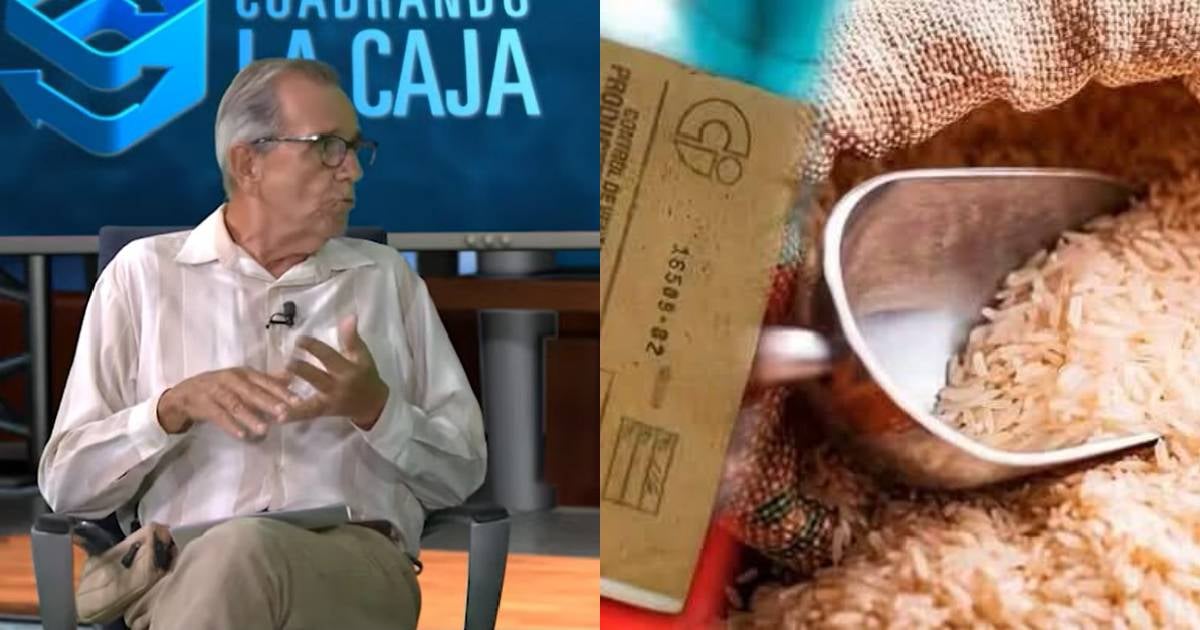
The Cuban economist Pedro Monreal dismantled this Saturday, using official data, the narrative that attributes the rice shortage to excessive consumption and claimed that the real problem is an economic system incapable of sustaining national production.
While criticizing one of the ideas about cereal consumption on the island, presented in the latest episode of Cuadrando la Caja on official television, Monreal condemned the substitution of empirical evidence with a “propaganda pamphlet” that blames the population for a shortage caused by structural failures of the system.
In his analysis, and using figures provided by the National Office of Statistics and Information, the expert stated that the total availability of rice for consumption has plummeted by 41.5% since the peak reached in 2005.
According to the data, of every 10 pounds available 18 years ago, only six were available in 2023, which refutes any argument about disproportionate consumption. “Which exaggerated consumption are they talking about?” she questioned.
The economist explained that the national production of paddy rice began to decline steadily starting in 2019, while imports, although relatively stable, have not been sufficient to offset the total supply deficit.
In his opinion, the problem lies in an agricultural policy excessively controlled by the State, unable to guarantee the operational framework required for an efficient productive system.
Monreal recalled that the rice sector underwent a radical transformation in land ownership between 1990 and 1997, with an increasing share of non-state producers.
However, after reaching a peak of nearly 189,000 cultivated hectares in 2009, the area under non-state ownership began a downward trend that worsened since 2019.
In 2023, that area represented only 13.1% of the maximum recorded 15 years earlier.
The analysis highlighted that the most significant reduction in cultivated area since 2020 occurred precisely among non-state producers, who had been the backbone of rice production in the extensive model following the "ordenamiento."
For Monreal, the focus of change should not be on the eating habits of Cubans, but rather on the economic system and the political structure that generate a permanent scarcity of food that could indeed be produced in the country.
The reactions to the publication reinforced the criticism of the official discourse. Some comments indicated that the delay in publishing agricultural statistics is due to the fact that they contradict the government narrative.
Others pointed out that the relative increase in rice consumption is explained by the absence of alternatives on the family table, while several users labeled the program Cuadrando la Caja as a platform designed to divert attention and evade responsibilities regarding the food crisis.
In a recent publication, Monreal himself expressed his regret that the Government is deliberately misinforming the public about the severity of the agricultural crisis through systematic delays in the publication of statistics and by substituting verifiable data with propaganda.
According to the specialist, the current agricultural crisis is "deeper and more prolonged" than that of the Special Period, but the State conceals it by combining a simplified narrative with an intensified statistical blackout.
During the most recent broadcast of the mentioned television program, the PhD in Sciences Roberto Caballero, a member of the National Executive Committee of the Cuban Association of Agricultural and Forestry Technicians, sparked controversy by criticizing the high rice consumption in Cuba.
He considered that one of the main obstacles to achieving what is known as food sovereignty is the eating habits of the population.
He also stated that Cuba "is not in a position to provide a nationwide solution" to the agricultural crisis due to economic shortcomings, and he advocated for partial local solutions.
Filed under: