
Related videos:
The United States Embassy in Cuba expressed its pride this Thursday for having contributed to the release of Sissi Abascal, the youngest Dama de Blanco in Cuba, while also acknowledging the painful nature of her situation: "While we welcome her to the United States, we understand how painful it is to be forced into exile."
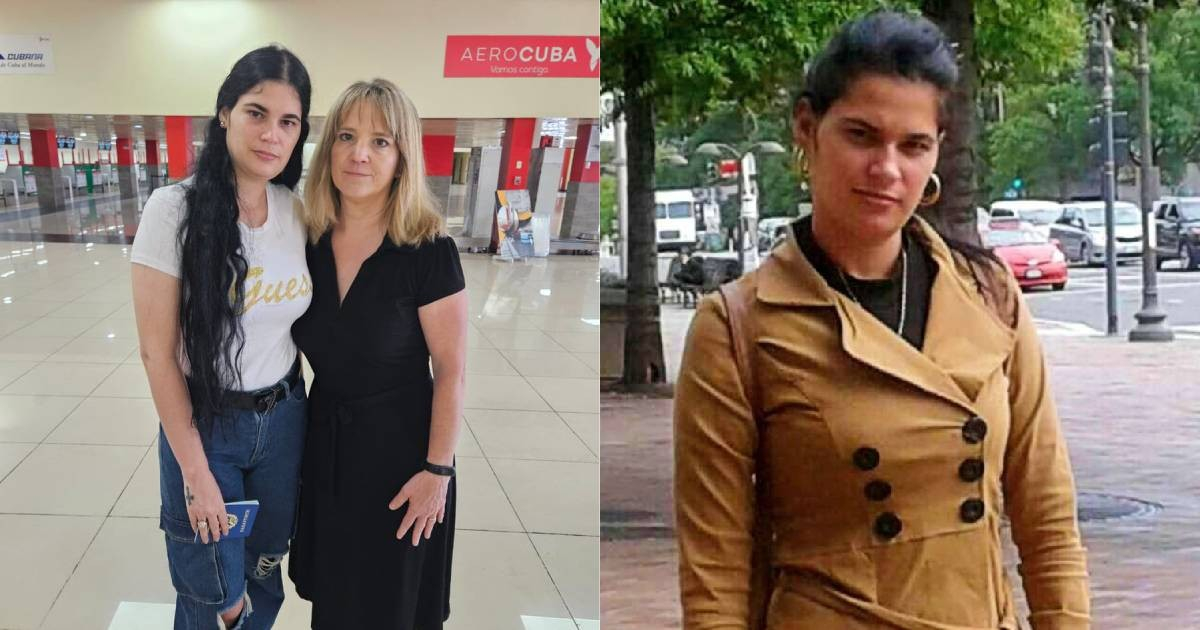
The message, published on X by the consular team of the embassy, was accompanied by a photograph of Abascal alongside a U.S. official at what appears to be José Martí International Airport in Havana, where the young woman was holding a blue passport.
Sissi Abascal Zamora, 27 years old, arrived in Miami on May 14 accompanied by her mother Annia Zamora —also a Lady in White and activist— and other family members, after nearly four and a half years in prison.
The Office of Western Hemisphere Affairs of the State Department also weighed in, describing her detention as "unjust" and reaffirming the Trump Administration's commitment to the release of all political prisoners in Cuba: "After years of unjust detention by the illegitimate Cuban regime, today we welcome the freedom fighter of the Ladies in White, Sissi Abascal, and her family, who have been forced into exile."
Abascal was arrested on November 3, 2021, in Carlos Rojas, a municipality of Jovellanos, in the province of Matanzas, for her participation in the protests of July 11, 2021.
The Municipal Court of Jovellanos sentenced her to six years in prison for contempt, assault, and public disorder, and she began serving her sentence on December 27, 2021, at the La Bellotex women's prison in Matanzas.
His sentence was set to expire on November 5, 2027, so he had approximately 14 months left at the time of his release.
Inside the prison, the authorities classified her as a "negative inmate" for refusing to participate in mandatory political activities, denied her at least seven times the change to a less severe prison regime —the last time in September 2025— and in October 2022, they prohibited her from receiving warm clothing for sleeping during the winter.
On August 28, 2025, she underwent emergency surgery for bartolinitis without the authorities notifying her family.
The exit was managed by the Legal Rescue Foundation, led by the activist and businessman Santiago Álvarez from Miami, through a humanitarian visa granted by the State Department, whose campaign "Unjustly Detained" had included his case in September 2025.
"After much work and patience, as it truly was a long road, we finally managed to get the Cuban dictatorship to release Sissi Abascal from prison so that she can address her health issues in the United States," stated Álvarez.
The organization Cubalex classified her departure as "freedom conditioned on exile," a common mechanism used by the regime to banish opponents without granting them prison benefits within Cuba.
The release of Abascal occurs in a context of unprecedented repression: according to Prisoners Defenders, in April 2026 Cuba recorded 1,260 political prisoners, a new historical record, including 35 minors and 142 women, of which 358 were imprisoned for participating in the protests on July 11th.
Filed under: