
Related videos:
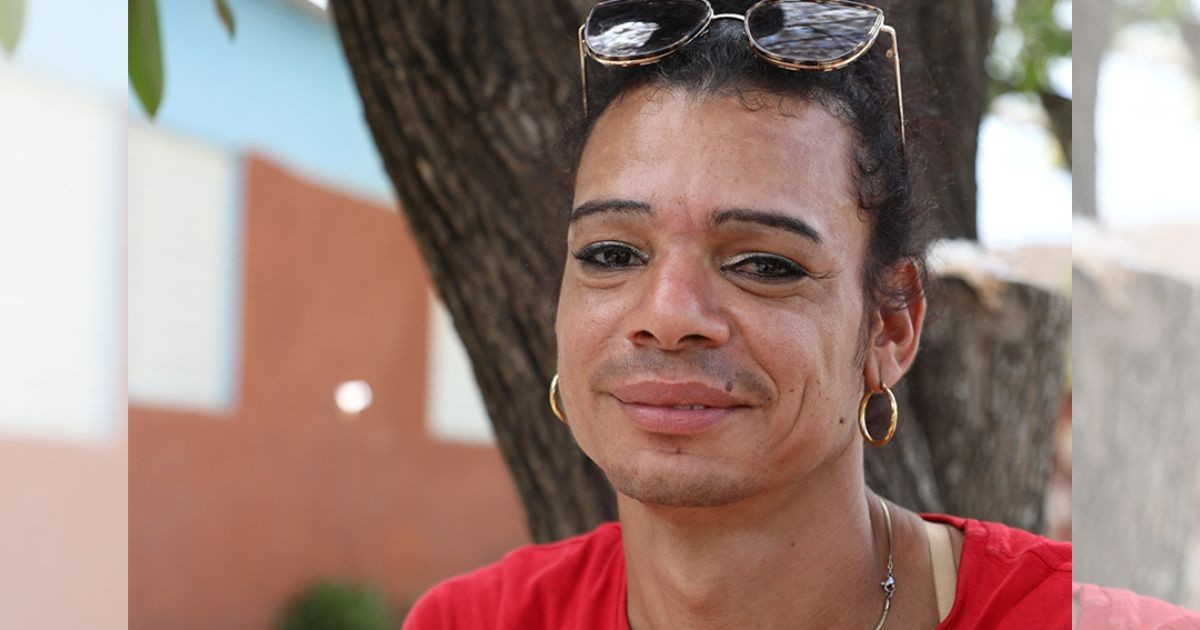
On the International Day Against Homophobia, Transphobia, and Biphobia, a trans woman from Las Tunas shared her story of family rejection, fleeing from home, and searching for identity in a testimony that reflects the reality still faced by many trans individuals in Cuba.
Susel, 32 years old, recounted to the Periódico 26 of Las Tunas that for 22 years, the world knew her as Yosbel, a boy from the Las Minervas neighborhood in San Antonio, Jobabo.
"My name is Susel. For the world, for 22 years I was Yosbel, a country boy. But that person was never really me," he said.
The violence started at home. Her father refused to accept her identity and physically pursued her.
"My father watched over me, chased me with a machete, wanted to kill me for being who I am. I had no other option: I left home, running away to save my life," Susel recounted.
Forcibly displaced from her home, she also had to interrupt her studies. She graduated as a Junior Technician in Food Preparation, but did not continue her education.
He spent two years cleaning a park in Comunales de Jobabo, a period he describes as very challenging.
The turning point came when she moved to Guayaban, in the municipality of Amancio, where she met other trans people.
"I got tired of dressing like a man and started living as a woman full-time. It was my rebirth," she said.
Today, Susel has been 10 years fully embracing her identity as a woman and works as a general service assistant and hall secretary at the Guevara Hospital in Las Tunas.
"There I feel like part of the family, there is no discrimination, everyone calls me Susel. It's wonderful," she stated. She also worked at the provincial station Radio Victoria, a time she remembers fondly.
She chose the name herself. She liked how it sounded and, upon searching for it, discovered that it means "peace."
He is currently undergoing legal proceedings to change only his first name on official documents, while keeping both parents' surnames.
Her relationship with her family remains, in her own words, "bittersweet." Her mother accepts her and calls her Susel. Her father does not.
"When visitors arrive and ask about Susel, my dad jumps in: 'No, it's Yosbel, my son,'" he recounted.
The psychologist Raydel Bejerano Balmaceda, from the provincial technical team for STIs-HIV-AIDS and hepatitis in Las Tunas, noted that personal acceptance is the first step.
"First, there must be personal acceptance for society to accept and respect you as you are. This relates to self-worth, self-esteem, and self-concept," he explained.
Bejerano mentioned that in Las Tunas there are support resources available: a trans-provincial coordinator, municipal counseling promoters, the "Tuna ayuda" hotline, and a friendly space behind the Provincial Center of Hygiene that operates from four in the afternoon.
Cuba has made progress in its legal framework: the 2019 Constitution prohibits discrimination based on sexual orientation and gender identity, the Family Code was approved in a referendum in September 2022, and in July 2025, the National Assembly approved a new Civil Registry Law that allows transgender individuals to amend the registered sex without requiring surgery or a court order.
However, Cuban activists point out in 2026 that the gap between law and daily practice remains wide, and that effective implementation in workplaces, schools, and health services is the main priority.
The case of Brenda Díaz, a trans woman imprisoned for the protests on July 11 in 2021, held in a men's prison and sentenced to 14 years before being released in January 2025, remains the most prominent example of institutional violence against trans individuals on the island.
The International Day Against Homophobia, Transphobia, and Biphobia is commemorated every May 17 in remembrance of the fact that the World Health Organization removed homosexuality from its list of mental disorders on that same date in 1990.
Filed under: