
Related videos:
There are journeys that cannot be confined to a single label. That of Raúl Lora is one of them: a creator who has seamlessly navigated between acting, music, and animation, never losing the spiritual root that sustains him, Yemayá, the deity that guides his spiritual path within the Yoruba religion.
From his childhood in Niquero, Granma, to his establishment on Cuban television and stages, his life is a reflection of an artistic vocation nourished by discipline, sensitivity, and a deep connection with his cultural and religious identity. In every project, Raúl not only portrays characters or songs, but also shares fragments of his own essence.
Raulito, I've known you since you were almost a child, and I'm very glad that you agreed to this talk. What are you up to now?
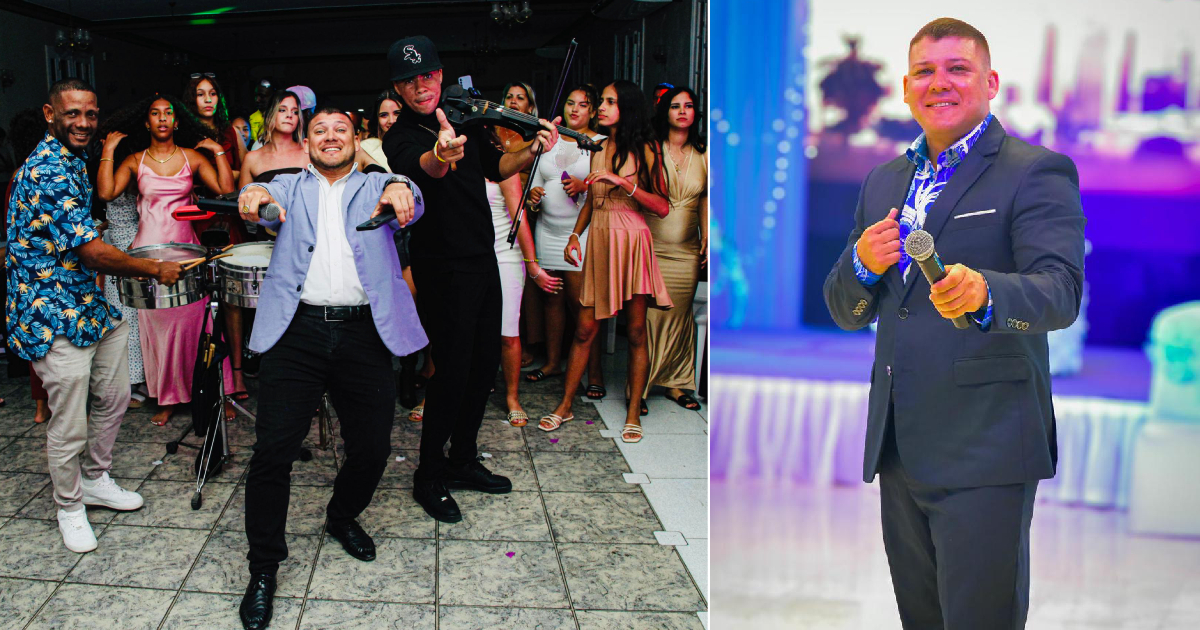
Julita, it’s a pleasure to talk with you. It’s been a long time since we last did. I want to share that I have been a host and entertainer for four years on the second show of Tropicana in Cuba. I have a segment in the evenings. Additionally, every Saturday from 2 to 7 p.m., I star in "Sábado Diferente con Raúl Lora y su gente," which is a wonderful program where I have the chance to showcase various forms of art: singing, presenting, entertaining, and staying in tune with current times; always featuring a special guest and good friends in comedy. Also, from Thursday to Sunday, I am at the Vitrola Social Club restaurant and bar.
You always talked about your hometown Niquero. Which moments from your childhood do you consider had the greatest impact on your artistic sensitivity?
Well, yes, on October 17, 1983, I was born in Niquero, Granma; that municipality which I continue to defend with so much love and affection, wherever I go.
And of course Niquero influenced me! My neighborhood, my family, a good education, a childhood filled with games with other kids. It's a pity that today, due to technology, children don't have a top or a toy car and everything revolves around mobile phones, tablets, and laptops.
In fact, the song where I sing to Niquero is called "I’m Sure I’ll Be Back," and there I talk about the spinning top, the toy cart, the kite, and the neighborhood. I was an extremely happy child. There was no adventure that I wasn't having or pretending to have.
At what moment did you discover that you wanted to pursue a career in art, and how did your family react to that decision?
I have been an artist since I was little. Whenever there was a neighborhood party, some story, or a parade, Raúl Lora was also there. In fact, I started as part of the actors in the dramatized performances at the Casa de la Cultura, and later at Radio Portada de la Libertad when it was founded.
Radio Portada is the municipal station of Niquero, featuring a schedule that includes news, programs, and magazines, and has earned national recognition in Cuban radio. I take pride in being one of its founders.
And I always received family support; it's nice to acknowledge that. I cherish fond memories from that time.
Your time at the National School of Art was crucial. When did you arrive in Havana?
In 1998, I came to Havana to study at the National School of Art. I had to complete or sign a document stating that I had to return to strengthen the talent pool of the province I came from.
At the ENA, I had the opportunity to grow as a human being, as an artist, and as a person.
Learning about the essence of the dramatic aspect from all those great playwrights, Stanislavski among many others. And of course, sharing it with students from across the island. It was something very interesting, along with international students who were going to be there to learn and grow in the art.
Upon graduating, I returned to my hometown and spent some time doing my social service, but... the country boy had already tasted Havana! So I went back to the capital. I had worked on television projects such as the soap opera "Doble juego," directed by Rudy Mora, and the musical program "Colorama."
Then I was drafted into the military service and had to go back to Niquero. And well, then back to Havana again.
Talking about dramatic art and acting, the character of "Lizardo" in the telenovela "Oh, La Habana" gave you great visibility. What did that role mean for your career, and what challenges did it leave you after having worked with Enrique Almirante?
Uff! What can I say about sharing the screen with Enrique Almirante? It was a continuous lesson in professionalism, acting, and humanity. Enrique was a special human being; I learned a lot from him and, of course, I had to experience what it's like to be in the ring.
It was a very special audition that I had to go through to portray "Lizardo Camacho" in "Oh, La Habana," a character that gave me great visibility. I had to train for eight months in boxing at the Rafael Trejo gym in Old Havana. It wasn’t easy, Julita! You, who have spent so many years with Cuban boxers in competitions and training, know what I'm talking about. I had to convince myself that I was a boxer, and I think I did pretty well, right? Hahahahaha...
I can say that that character marked a turning point in my life. In fact, nowadays everyone has remained connected to Lizardo, the young boxer guided by a hardworking and loving coach, as portrayed by the great Enrique Almirante.
Alongside my acting career, I pursue my musical passion, first with the group Suena Cubano and later with Los Ángeles de La Habana. While with Los Ángeles de La Habana, I had to take a break for about a year to return to dramatic arts.
I have made three Cuban telenovelas: "Doble Juego," directed by Rudy Mora; "Oh, La Habana" under the direction of Charles Medina, where I play the character of Lizardo, the boxer; and "Añorado encuentro," where I have a negative role, the antagonist.
Besides novels, what other roles have you taken on?
After "Beloved Encounter," came "In Their Footsteps," in which everything, in a certain way, worked on the acting side. Given this, there was a moment when I had to take a pause because, honestly, some tremendously talented actors were not living a life that matched their quality, and I did not want to see myself in that mirror.
Could it be said that this is the reason why you distanced yourself from dramatic productions?
Well, yes. I didn't see a future in acting, especially considering the times ahead (life has proven me right). And let it be known that I'm not closed off to television or acting, but the music world and the world of animation do provide me with a financial foundation that supports my current life, the life I lead as a father, as a human being, as an everyday Cuban who continues to live on this beautiful Caribbean island, you understand?
I completely understand you. In music, you have explored genres such as reggaeton, cumbia, son, and tropical music... How do you define your musical identity within that diversity?
Good one! I like everything, or almost everything. I define myself as a musical "jack-of-all-trades": I’ve sung reggaeton, cumbia, I’ve been in the tropical genre, salsa, merengue, bachata, among many others, and the traditional son, which I love; a very special mention goes to the Santiago septet Moneda Nacional, who writes many of my songs.
I eventually had a small format group, but I had to interrupt it because "the pitching got tough," to speak in baseball terms: the pitching was tight, a bit low, and there came a moment when I was practically working more for the musicians than for myself, so I decided to pursue my career solo.
In fact, I have visited several countries: Canada, Lebanon, Russia, Spain, Poland, Germany, and it has been because I was alone. I have had the freedom to travel solo, and so, whenever a job opportunity arises, I’m ready to go.
Always accompanied by the mother of all orishas?
My spiritual life, of course, I am a child of Yemayá, I have the Holy Virgin of Regla crowned, settled in my lerí.
Yemayá is the holy mistress of the world. I am devoted to Yemayá, accompanied by Changó, that is, oní oní. I love my religious side, where of course I ask all my deities to give me the opportunity every day to keep moving forward and fighting.
Raulito, you are still very young, but how would you like to be remembered?
The legacy I would like to pass on to the new generations is to do everything with love, not to stop dreaming; but to keep their feet on the ground and, above all, in these challenging times. Be practical and a fighter, but never lose humility.
The ego brings nothing good; money is necessary, but it is not the goal of life, because one day we come into this world and one day we leave it. I am a Mason, my brothers recognize me as such, I am Afro-Cuban, I am Cuban, which is the most important; so many blessings.
Raúl Lora bids farewell with the tranquility of someone who has learned to inhabit different worlds without losing his own. Between television, music, and the stages where he continues his work as a presenter and artist, he makes it clear that his journey has not been linear, but it is coherent with who he is.
His story is that of a man who has known how to reinvent himself without betraying his principles, holding onto his faith, his roots, and his love for art. And in that blend of experiences, one certainty remains: his voice, in all its forms, continues to be a bridge between what was, what is, and what is yet to be created.
Filed under: