
Related videos:
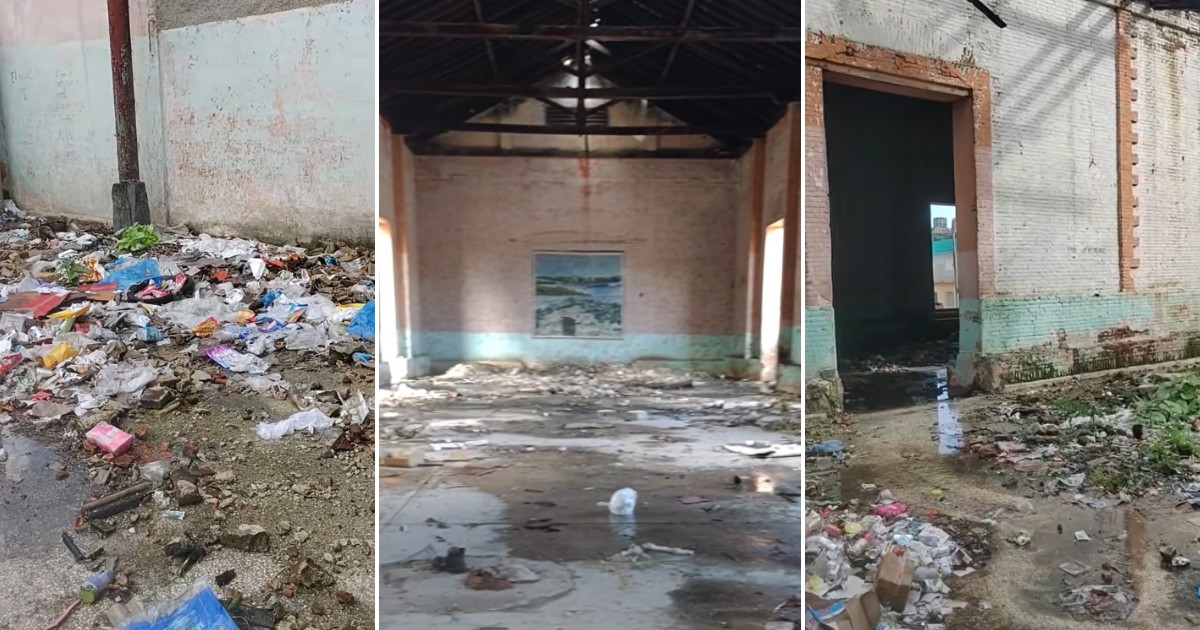
The former Holguín-Gibara Railway Terminal, inaugurated on April 4, 1893, in the Zayas neighborhood of Holguín, is now a dumping ground for debris, mosquitoes, and rodents, according to a report by Cubanet that collects testimonies from local residents who directly blame the authorities for the collapse.
The colonial building —with a large pediment, two spacious lateral corridors supported by wooden posts, and a gabled roof— served for 65 years, until 1958, when it became inactive following acts of sabotage during the armed struggle.
After the railway closure, the building operated as a modeling and sculpture workshop and later as an agricultural market known as the "Mambí Market," partially supplied by the Youth Labor Army (EJT), the productive branch of the Revolutionary Armed Forces.
Today, in front of the crumbling facade, the Cuban State displays a sign that reads "The Rebirth of the Mambí" with the EJT logo, an irony that the neighbors openly denounce.
"The only thing here is ruin and neglect, what was reborn?" asks Luis López from Holguín upon reading the sign.
"Leaving the poster in this crumbling and dirty place is an offense to the memory of the mambises who fought and died for the freedom of this country," adds López.
The neighbor Félix Borrero directly points to official negligence: "With part of the money from agricultural sales, they could have repaired it, and this situation could have been avoided."
"Due to the negligence of the authorities, we lost a part of the history of Holguín," concludes Borrero.
This is not the first time the condition of the building has been reported. Last April, another testimony about the deterioration of the station had already sparked reactions on social media.
The Provincial Center for Cultural Heritage of Holguín, established on April 1, 1990, with the explicit mission to "rescue, preserve, investigate, and promote the cultural and natural heritage of the Nation," has not taken action to halt the deterioration, according to residents.
"No one up top cares about heritage," denounces Jorge Góngora, who walks daily through the nearby streets. "The government talks a lot about culture and history, but then they let historical places fall apart," he adds.
Abandonment also poses a tangible health threat: the trash accumulated under the deteriorated roof and the stagnant rainwater create favorable conditions for the proliferation of disease-carrying vectors, in a province that already reported cases of dengue and chikungunya in almost all of its 14 municipalities in October 2025.
The case of the station is not isolated. The iconic sculpture of the Holguín boulevard collapsed on May 16 after six weeks without any preventive measures, and the old children's park Los Caballitos was turned into a debris-filled lot with no rehabilitation plan.
Isabel Pérez, a resident of the area, summarizes what could have been: "That place could have been a cultural center, a museum, something for the youth, but they let it die, and that’s how we lose our history through neglect."
"We have gotten used to seeing this place as a dumping ground, and it seems normal to us, and that is what worries me the most," concludes Elena Torres, another resident who is also demanding accountability: "What did the Provincial Heritage Center and the Government do to prevent this?"
Filed under: