
Related videos:
The Trump administration announced on Friday a new immigration policy that requires foreigners in the U.S. with temporary visas to return to their home country in order to apply for permanent residency, in a change that reverses more than half a century of established immigration practice.
The U.S. Citizenship and Immigration Services (USCIS) issued memorandum PM-602-0199, which states that the adjustment of status—the process that allows one to obtain a Green Card without leaving the U.S.—will only be approved under "extraordinary circumstances," according to the agency's official statement.
The measure affects a wide range of individuals: holders of tourist visas, students, temporary workers, doctors and professionals with work visas, holders of religious visas, and immigrants with humanitarian protection, among others.
"Non-immigrants, such as students, temporary workers, and individuals with tourist visas, come to the United States for a short period and for a specific reason. Our system is designed for them to return to their home country once their visit is over and for their visit not to serve as the first step toward obtaining a green card," USCIS stated in its announcement.
Approximately 600,000 people already in the U.S. apply for a Green Card each year, according to Doug Rand, former senior advisor at USCIS during the Biden administration.
"The goal of this policy is very explicit. High officials in this administration have repeatedly stated that they want fewer people to obtain permanent residency because permanent residency is a pathway to citizenship, and they want to block that pathway for as many people as possible," Rand stated.
The agency did not specify when the change would come into effect, whether it would affect pending cases, or if applicants would need to remain abroad for the entire process.
In a statement sent to the AP agency, USCIS indicated that individuals who provide an "economic benefit" or are of "national interest" could remain in the U.S. while processing their residency, while others would need to do so from abroad.
Immigration lawyers and aid organizations rejected the measure. Shev Dalal-Dheini, senior director of government relations at the American Immigration Lawyers Association, warned that the change "applies very broadly to anyone seeking a Green Card" and that in some U.S. consulates, the waiting times for a visa appointment can exceed a year.
The humanitarian organization World Relief alerted about a deadlock situation for families whose countries have suspended visas or closed embassies. "If families are told that the non-citizen member must return to their country of origin to process their immigrant visa, but immigrant visas are not being processed there, it's a trap with no escape. These policies will effectively create an indefinite separation of families," the organization wrote.
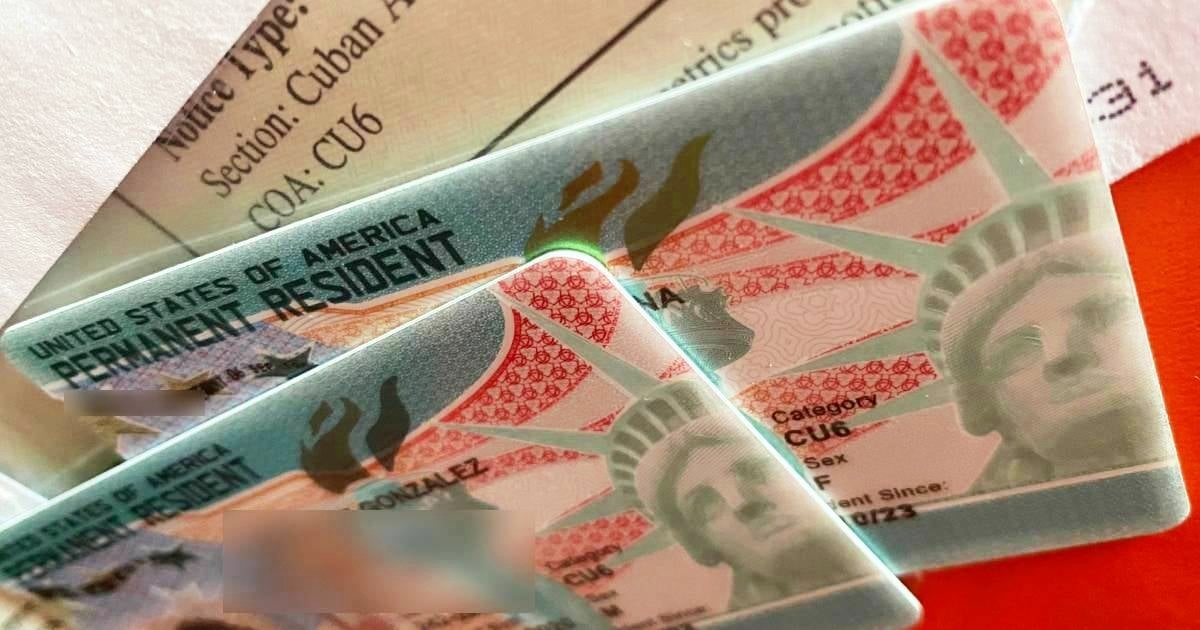
The immigration lawyer Liudmila Marcelo described the measure as a "bombshell" and pointed out that, so far, the Cuban Adjustment Act is not directly affected, as it requires physical presence in U.S. territory for at least one year and one day, a requirement that is incompatible with any exit demands.
However, Marcelo warned about the risk for those who accumulated illegal presence while waiting inside the country: a mandatory exit could trigger that count and require a pardon to return.
This new blow to legal immigration comes in the context of a historic collapse of approved residencies for Cubans: according to the Cato Institute, the approvals of Green Cards for Cubans fell by 99.8% between February 2025 and January 2026, dropping from 10,984 monthly approvals to just 15.
"These are very bad news, very bad news like every Friday when it's not the day," Marcelo summarized.
Filed under: