
Related videos:
The administration of Donald Trump has been building a strategy of military, political, and psychological pressure that is increasingly visible on the regime in Havana for months, but the government of Miguel Díaz-Canel does not seem to have any intentions of conceding to reach an agreement through peaceful means.
The presence of the USS Nimitz aircraft carrier strike group in the Caribbean, accompanied by destroyers, surveillance aircraft, and amphibious units, has raised regional tensions. The United States is sending a clear message of operational capability and strategic readiness.
The report from Politico, written by journalist Paul McLeary, confirms that the Pentagon keeps forces ready to act quickly if ordered by President Donald Trump.
Analysts consulted by the media believe that the deployment has a strong deterrent component, although it also provides real capacity for executing precision military operations.
The statements made by Secretary of State Marco Rubio reinforced that perception. During a cabinet meeting this Wednesday, Rubio stated that “Cuba is in serious trouble” and described the Cuban regime as a threat to the national security of the United States due to the political and economic deterioration of the island.
The context also includes recent political and judicial movements against the leadership of the Cuban regime. The formal accusation against Raúl Castro for the downing of the Brothers to the Rescue planes in 1996 was interpreted by several analysts as part of a sustained pressure strategy from Washington.
Unlike other periods of bilateral tension, the current combination of naval deployments, political messages, and demonstrations of strength seems to be part of a much broader and coordinated regional architecture.
Training in the jungle, amphibious operations, and deployments in the Caribbean
The report from Politico also aligns with months of intensive training for the U.S. Army and Marines in geographical and climatic scenarios very similar to those of Cuba.
Since early 2026, U.S. forces have been conducting exercises in rainforests, rivers, swamps, and Caribbean waters under the coordination of Southern Command. One of the main operational centers is the Cristóbal Colón Naval Air Base in Panama, where the Jungle Operations Course (JOTC-P) is held.
The training conditions replicate environments such as the Zapata Swamp and mountainous areas of eastern Cuba. The maneuvers include jungle survival, river crossing, combat in extreme conditions, and amphibious operations.
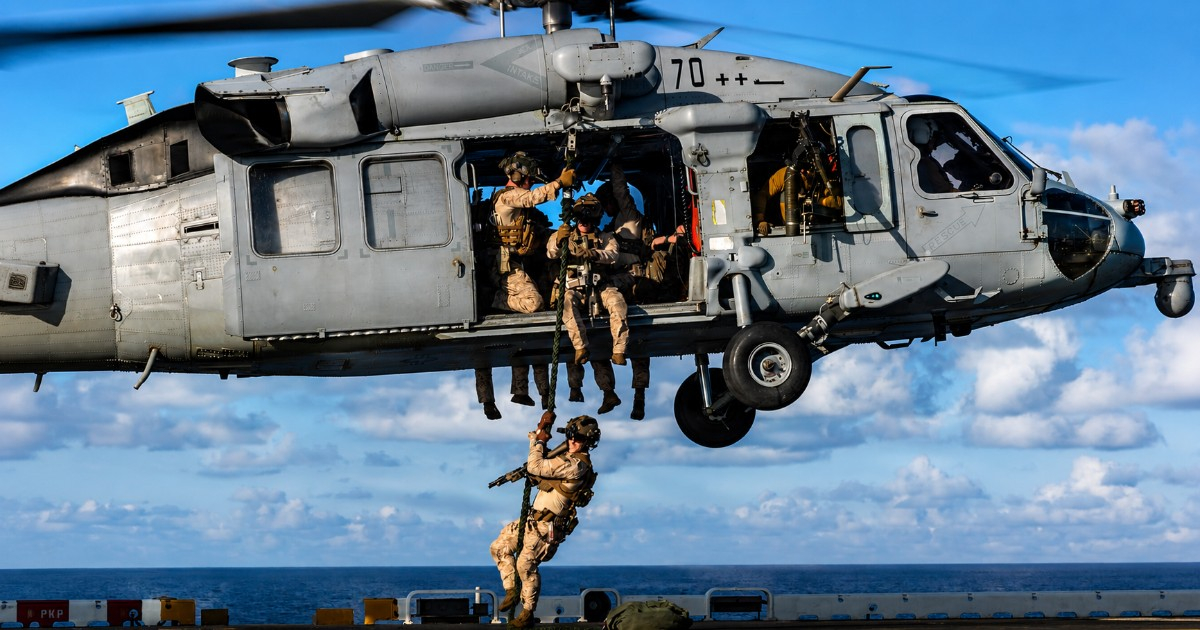
In parallel, expeditionary units of Marines have conducted landing exercises, airborne insertion, and fast rope descents from helicopters onto ships deployed in the Caribbean.
These capabilities are designed for rapid force projection operations from the sea to coastal territory, including control of strategic infrastructures, air support, and tactical troop insertion.
The arrival of the USS Nimitz in the Caribbean on May 20 further reinforced that perception. South Command itself described the deployment as a demonstration of “unmatched readiness, reach, and lethality.”
The reaction of the Cuban government
The National Assembly of People's Power of Cuba issued a statement this Wednesday warning of what the regime describes as a "real and dangerous threat of direct military aggression by the Government of the United States."
On several occasions, the regime has reiterated that Cuba "does not threaten any country" and that the government of the island is willing to engage in dialogue with the United States "based on respect for our sovereignty, our political system, our self-determination, and the principles of International Law."
They declared 2026 as the "year of preparation for defense" and continue systematic military exercises under the doctrine of the "war of the entire people".
The White House has not publicly confirmed military action plans against Cuba. However, the accumulation of political signals, naval deployments, and specialized training suggests that the U.S. is trying to make it clear that its presence in the Caribbean is no longer solely aimed at combating drug trafficking, which fuels speculation about additional strategic objectives.
Filed under: