
Related videos:
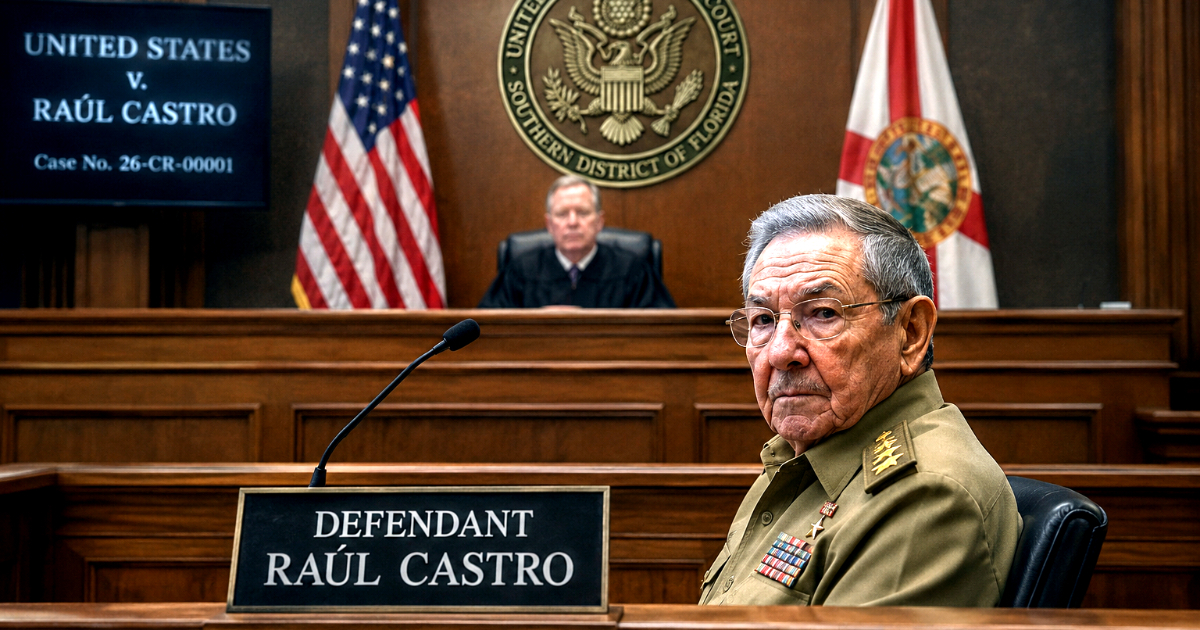
The reaction of the Cuban regime to the formal charges filed in the United States against Raúl Castro for the shooting down of the planes of Brothers to the Rescue is revealing something more interesting than the former dictator's own defense.
The truly innovative aspect is the language chosen to articulate that defense.
For decades, the official narrative regarding the events of February 24, 1996, relied on predictable political arguments: the defense of national sovereignty, provocations from the Cuban exile community, the activities of José Basulto, and Washington's hostility towards Havana.
However, the two recent programs from La Bitácora Nocturna, broadcasted by the program Razones de Cuba —hosted by presenter Humberto López and directed by the regime's Counterintelligence— exhibit a striking change in tone.
It's no longer just about political slogans.
Now terms such as "forensic investigation," "scientific methodology," "kinematics," "coordinate analysis," "expert audit," "radar data," "satellite images," "evidence," "jurisdiction," "chain of custody," and "classified files" are emerging.
More than a piece of traditional propaganda, the program seems an attempt to present a technical and legal defense of Raúl Castro.
A defense that speaks like an expert
The novelty is evident from the very first minutes.
The program host introduces the main guest as "an independent researcher" (one Santiago Montez) who is said to have crafted "the first rigorous forensic report on this case," applying the methodology of Annex 13 of the International Civil Aviation Organization (ICAO), the internationally recognized standard for investigating aviation accidents and incidents.
From that point on, the entire staging abandons the usual language of political propaganda.
There is no talk of revolutionary heroism or imperialist aggression. Instead, there is discussion of calculations, margins of error, aircraft speed, ocean currents, optics, procedural documentation, and investigation procedures.
"Nothing about politics: data, calculations, and verifiable primary sources," asserts the program at the beginning.
The phrase is particularly striking given that it concerns a space specifically designed to defend the political positions of the regime.
Science as a new authority
Another significant aspect is the shift in the source of authority.
Traditionally, the official Cuban narrative based its legitimacy on the history of the so-called "revolution," national sovereignty, or the political authority of its leaders.
In this instance, the authority presents itself as scientific. " Physics does not allow for another interpretation," asserts the supposed researcher while defending his reconstruction of the events.
It's not a minor detail.
The intention seems to be to shift the discussion from the ideological realm to the technical realm, where the conclusions present an appearance of objectivity that is difficult for the general public to challenge.
The problem of invoking the ICAO to question the ICAO
Perhaps the most interesting contradiction of the program lies in its relationship with the International Civil Aviation Organization.
Throughout the broadcast, it is emphasized that the analysis utilizes the ICAO methodology because it represents the most prestigious international standard in the field of aviation research.
However, the same methodology is used to challenge one of the main conclusions reached by ICAO itself in 1996.
The international organization concluded that the shootdowns occurred in international airspace and not within the twelve nautical miles of Cuban sovereignty.
Reasons of Cuba now argues that the physical data actually supports the opposite.
In other words, the program invokes the technical authority of ICAO to discredit one of the most important conclusions reached by ICAO.
The researcher who supports the entire thesis
Another striking element is the centrality of the figure of the supposed independent researcher. A large part of the program's intended credibility relies on this figure.
However, the space does not provide detailed information about their professional background, academic publications, accredited experience in aeronautical research, or institutional connections.
The matter is not insignificant.
If the aim is to present a technical review of an international research conducted three decades ago, the identity, experience, and credentials of the person leading that review become crucial for assessing the weight of their conclusions.
The risk of entering the realm of testing
The strategy chosen by Razones de Cuba also has an inevitable consequence.
When the declassification of American radars, North American satellite images, and Pentagon documents is demanded, an uncomfortable question arises: what happens to the Cuban files?
The program demands transparency from Washington, but does not make a similar request regarding the documents held by the Cuban state itself.
If the pursuit of truth requires accessing all available information, it would also be reasonable to know:
- The complete radar records from the Cuban stations.
- The communications between the MiG pilots and the command centers.
- The operational orders issued that day.
- The internal documentation of the Revolutionary Armed Forces related to the operation.
- The records of the chain of command that led to the downing.
Transparency, to be credible, should operate in both directions.
The Soviet example and the limits of sovereignty
The second part of the post attempts to strengthen its argument by referencing the shooting down of Korean Air Lines flight KAL 007 by the Soviet Union in 1983.
According to Razones de Cuba, Ronald Reagan condemned that event, but he never tried to bring the Soviet leaders to justice.
From that point on, the program suggests that the accusation against Raúl Castro would lack legal legitimacy. However, the argument overlooks an important part of the subsequent evolution of international law.
Cases like Iran Air Flight 655, shot down by U.S. forces in 1988, or Malaysia Airlines Flight MH17, destroyed over Ukraine in 2014, illustrate a growing trend to investigate specific responsibilities when state actions result in civilian deaths.
The modern discussion is no longer limited to determining whether there was a violation of airspace. The questions are different now: who made the decision, what information was available, what alternatives existed, and whether the response was proportional.
The mere invocation of national sovereignty no longer automatically closes the debate.
A response thought out for history
Beyond the legal controversy, Razones de Cuba seems to pursue a broader objective.
Raúl Castro is facing today the first major international criminal accusation directly against him regarding the events of 1996.
Havana understands that the process will likely have a historically significant dimension far greater than its immediate practical consequences.
For this reason, the new strategy seems aimed at establishing a specific idea: that the accusation is built on incomplete evidence, hidden documents, and debatable conclusions.
It's not so much about conclusively proving Raúl Castro's innocence as it is about casting doubt on the strength of the accusation.
It is a more sophisticated defense than those traditionally used by official propaganda. It is also riskier.
Because once the realm of slogans is abandoned and we enter the territory of evidence, questions no longer flow in one direction. Furthermore, if they are so convinced of their evidence, arguments, and their innocence, logic suggests that it would be advisable to present them before a judge.
Razones de Cuba demands the opening of the Washington archives, but it inevitably leads to questioning what information remains hidden in the archives of Havana and, above all, to proving the innocence of the former dictator in court.
Filed under: