
Related videos:
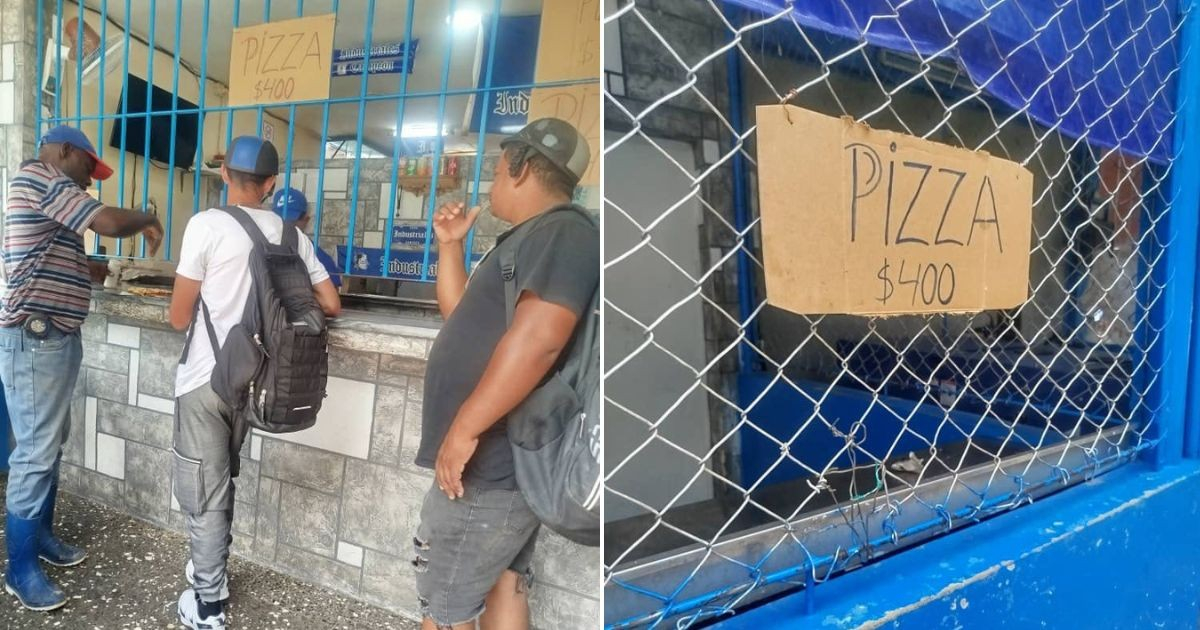
A street stall at the Playa Bus Terminal in Havana sparked a debate on social media after displaying a hand-written sign stating a price of 400 Cuban pesos per pizza, which led to hundreds of comments split between those criticizing the vendor and those pointing directly at the regime and GAESA as the real culprits behind the price increase.
The Facebook user Joshua Suarez posted images of the poster and reported that the price had climbed "by increments of 100" until reaching that level, with "the same cheese and the same flour; the same seller."
By the end of 2025, those same pizzas were selling for 250 pesos; the jump to 400 represents an increase of 150 pesos —60%— in less than three months.
The most forceful response came from commentator Yoel Cruz, who shifted the focus of the criticism: "The issue is the current price of flour. When it comes to criticizing individuals and gossiping, Cubans are number one. Now GAESA has hit us with a giant refrigerator while half of Havana is suffering, and not a peep is said."
The reference to the "giant refrigerator" alludes to the massive blackouts that plague the capital.
This Thursday, neighbors in Havana achieved the restoration of electricity following protests and a heavy police presence. On May 25, the city experienced a blackout lasting 23 hours and 11 minutes, and on May 13, a record deficit of 2,153 MW was recorded.
Several commentators supported Cruz's reading with concrete data. Roli Garcia, who identifies as a sweet vendor, wrote: "Go protest to the government. I am a sweet vendor, and a sack of flour is costing up to 40,000 pesos, sugar is through the roof, and so is oil."
Claudia Sabina raised the figure even further: "Or do people not know that a bag of flour costs 45,000 pesos?"
The currency backdrop exacerbates everything. The dollar in the Cuban informal market reached a historic record of 600 pesos per unit this Thursday, according to elToque, while the official exchange rate set by the Central Bank was 524 pesos per dollar.
As Melisa González pointed out: "The dollar rose to 600. You didn't see that, did you?"
Tocororo Cubano summed up the chain of causation with a precise image: "Domino effect, gas prices go up and so do pizza prices, even if the pizza maker doesn't have a car."
Langerhans Marmol Rodriguez added, "To search for coal, flour, sugar, tomatoes, salt, and yeast, fuel is necessary, and that increases the cost of raw materials."
Lenier Tur asked to look beyond the price of the poster: "I'm sure the local would sell it for 100 pesos if the materials were cheap."
The regional contrast illustrates that the problem lies more with Havana than with the vendor: in Camagüey, pizzas are sold for between 180 and 200 pesos, and in Ciego de Ávila, for 200, according to commentators from those provinces.
GAESA, the military conglomerate that controls between 40% and 70% of the Cuban economy formally and 95% of foreign currency transactions, dominates import channels, retail, and banking.
Furthermore, he has been pointed out on numerous occasions as the main responsible party for the crisis in Cuba.
The economist Pavel Vidal called for reducing GAESA's monopoly control as a condition for any credible economic reform, with an estimated actual inflation rate close to 70% year-on-year.
The regime broke its silence about GAESA last Tuesday, defending the conglomerate and accusing the United States of attacking it, while Senator Marco Rubio renewed his criticism of GAESA in the Senate on the same day.
The pizza vendor in Playa is not the source of the problem; he is the last link in a chain that begins with state policies and the military monopoly over the economy.
Filed under: