
Related videos:
There is a question that every Cuban should ask themselves: if Cuba is a socialist country where the means of production belong to the people, how is it possible for a military company to control 40% of the national economy, accumulate $14.5 billion in bank deposits, not publish financial statements, avoid paying taxes in foreign currency, and not be accountable to the National Assembly?
GAESA is a capitalist commercial enterprise that allows for total opacity regarding ownership, profits, and the allocation of funds.
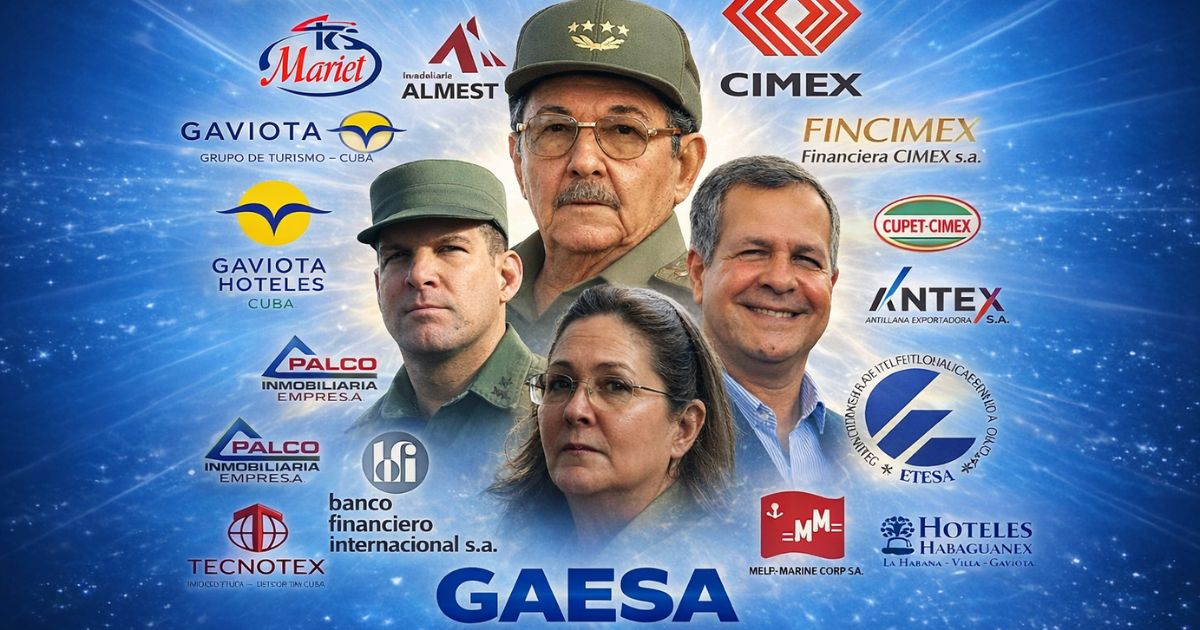
This company is called GAESA (Grupo de Administración Empresarial S.A.). The last two letters are key: S.A., Sociedad Anónima. It is the legal form adopted by large private corporations in the capitalist world — from Coca-Cola to Samsung — designed to give a company its own legal personality, distinct from its owners, with shareholders whose identities may remain hidden. "Anonymous" means exactly that: the real holders and the percentage each one owns are not publicly known. In any market economy, an S.A. is a legitimate instrument of business organization. In a country that proclaims itself socialist, where supposedly the means of production belong to the people and private ownership of strategic sectors is prohibited, it is an ideological aberration. And yet, there it is: the Cuban military has organized the largest economic conglomerate in the country — tourism, banking, commerce, ports, telecommunications, fuels — not as a state-owned enterprise subject to public control, but as a sociedad anónima. A capitalist commercial entity that allows total opacity regarding ownership, profits, and the allocation of funds. GAESA does not account to the Cuban people because its legal form was precisely designed not to do so. Cubans are not shareholders, do not have representation on its board, do not receive dividends, and cannot even audit its books. They are, in practice, the exploited workers of a private corporation whose profits go to a military caste.
GAESA was created by Raúl Castro, led for 26 years by his son-in-law, and is currently overseen by his grandson. It operated for decades within a state that claims to be socialist, consolidating under that management model, which is entirely foreign to socialism, at least 40% of the Cuban GDP. Today, with the 2026 crisis, its empire is crumbling — but its legal structure remains intact, and its offshore accounts, as far as is known, do as well.
The internal documents of GAESA leaked in 2025 — analyzed by the Miami Herald and economist Pavel Vidal from the Cuba Capacity Building Project at Columbia University — provided concrete numbers to what many had suspected: GAESA controlled 95% of financial transactions in foreign currency in the country. Its total income was 3.2 times greater than the annual revenue of the State Budget. And Cuba's international reserves were not in the Central Bank — they were in GAESA's accounts.
Vidal summarized it like this: "I have not been able to find a similar example of a conglomerate with such a large share in a country's economy. It even surpasses the significance of Ecopetrol in Colombia, Petrobras in Brazil, or PDVSA in Venezuela."
How the monster was born
GAESA did not emerge out of nowhere. It was born from the Special Period of the 1990s, when the collapse of the Soviet Union eliminated between $4 billion and $6 billion annually in subsidies. Cuba was left without money, without oil, and without food. The people suffered from hunger. However, Raúl Castro, then Minister of the Armed Forces, did not devise a plan to feed the population: he designed a plan for the military to feed itself.
He tasked General Julio Casas Regueiro — an accountant by training who had fought alongside him in the Sierra Cristal — with the creation of a business holding to generate foreign currency for the Armed Forces. Gaviota, which had existed since 1988 as a vacation center for Cuban and Soviet military personnel, was transformed into a commercial enterprise. By the late 90s, GAESA's companies already accounted for 80% of the FAR's operating budget. The military had ceased to depend on the State. Soon, it would be the State that depended on the military.
The decisive leap was taken by General Luis Alberto Rodríguez López-Calleja, son-in-law of Raúl Castro, married to Deborah Castro Espín. López-Calleja led GAESA from approximately 1996 until his death on July 1, 2022, at the age of 62. During that quarter of a century, the conglomerate evolved from a modest currency operation to dominate entire sectors of the economy: tourism, retail, banking, port logistics, telecommunications, construction, import/export, and remittances. Bloomberg described him in 2015 as the man in charge of "the largest business empire in Cuba, a conglomerate of at least 57 companies."
What GAESA came to control: everything
The corporate map of GAESA is — or was, until the 2026 crisis — the map of the Cuban economy. It operated under the exclusive supervision of the V Department of the FAR, a secret unit whose existence was revealed by the leaks of 2025. It had its own parallel tax office — the OATFAR (Tax Administration Office of the FAR) — that managed its taxes outside the national system. In other words: GAESA did not even pay taxes through the same channels as the rest of the country.
Gaviota S.A. was the crown jewel: 121 hotels, 20 marinas, the airline Aerogaviota, the rental company Transgaviota, the agency Gaviota Tours, and the supplier AT Comercial. In the first quarter of 2024, Gaviota accounted for 72% of GAESA's total revenues, with a net profit margin of 42%—almost four times the global average for the sector. How were those margins achieved? By paying Cuban hotel workers 11 dollars a month. That is not socialism. That is labor exploitation on an industrial scale.
Inmobiliaria Almest, the hotel investment arm, has 56.5 billion pesos in assets but received 668 million from the state budget, paying only 2 million in taxes. In 2016, GAESA absorbed Habaguanex, the company that managed over 300 tourist facilities in Old Havana, taking it away from the Office of the Historian of the City. What Eusebio Leal built over decades, the generals appropriated with a single stroke.
CIMEX (CIMEX Corporation S.A., registered in Panama since 1979) is the largest commercial corporation in Cuba: more than 41 companies operating supermarkets, 668 Servicupet gas stations, currency exchange shops, and coffee brands like Cubita and Caracolillo through Kave Coffee S.A., also based in Panama. The leaked documents revealed astonishing figures: $3.4 billion in revenue and $1.2 billion in profit in a single quarter of 2024. TRD Caribe, the other hard currency store chain, reported deposits of $3.4 billion.
In 2016, GAESA delivered the final blow: it took control of the Banco Financiero Internacional (BFI), which processed 95% of the country's import/export flows. The think tank Cuba Siglo XXI referred to it as "the harshest blow against the Cuban state economy." With the BFI, GAESA was not only buying and selling: it controlled the money itself.
This was complemented by Almacenes Universales (ports, Mariel Zone), Tecnotex and Tecnoimport (civil-military dual-use technology), Corporación Antex (recruitment of doctors abroad and alleged intelligence coverage), DATYS (technology), GEOCUBA (mapping), and the equity participation in ETECSA, the telecommunications monopoly. When a Cuban recharged their phone, made purchases at an MLC store, filled up their gas tank, or connected to the internet, a portion of that money ended up with GAESA.
GAESA is a tool of dynastic power designed by Raúl Castro to ensure that his family controls the wealth of Cuba
The dynasty: from son-in-law to grandson
GAESA is not just a military conglomerate. It is a dynastic power instrument designed by Raúl Castro to ensure that his family controls the wealth of Cuba regardless of who occupies the presidency. Díaz-Canel may sit at the desk in the Palace of the Revolution. The real money is elsewhere.
After the death of López-Calleja, the executive presidency fell to Brigadier General Ania Guillermina Lastres Morera, born in 1968 in Marianao. Her appointment was never officially announced — it was only revealed in February 2023 when the list of candidates for the National Assembly identified her as "Executive President, Business Management Group." Investigations by La Prensa de Panamá and Martí Noticias revealed that Lastres appears as a director or secretary in at least six companies registered in Panama since the 1980s, linked to entities of López-Calleja's brother.
But the true guardian of the family interests within GAESA is Raúl Guillermo Rodríguez Castro, "El Cangrejo": 41 years old, lieutenant colonel, head of the General Directorate of Personal Security, grandson of Raúl Castro and son of the empire's founder. The man who decides who can access the 94-year-old army general is the same one who oversees the family financial machinery. Internal sources describe him as "the apple of Raúl Castro's eye."
A fact that cannot be a coincidence: Cuba recently removed the age limit of 60 years to become president. The change comes just as speculation arises about a generational shift within the elite — possibly led by members of the Castro family. The revolution that promised to end dynasties has built its own.
Among the executives of the subsidiaries, the pattern is repeated: General Luis Pérez Rospide presides over Gaviota; Colonel Héctor Oroza Busutil directs CIMEX. And Manuel Marrero Cruz, former president of Gaviota and former Minister of Tourism, currently holds the position of Prime Minister of Cuba. The man who led the tourism branch of GAESA now leads the government. The merger between the conglomerate and the State is complete.
Panama: the safe of Castroism
If someone wants to understand how Cuban "socialism" really works, they should not look at Havana. They should look at Panama.
A joint investigation by La Prensa de Panamá, elTOQUE, Martí Noticias, and the Venezuelan organization Armando.Info documented that "El Cangrejo" made at least 25 flights to Panama between 2024 and 2025 on private jets associated with the military leadership. The aircraft include a Dassault Falcon 900EX whose registration was changed from Venezuela to San Marino — a microstate without an airport that rents its aviation registry — to complicate international tracking.
On several of those flights, "El Cangrejo" was accompanied by the president of GAESA, General Lastres Morera herself. There are no immigration records for many of these trips in Panama, only the flight manifests. The joint presence of the executive president of the conglomerate and the guardian of family interests on these flights suggests that it is not a matter of personal tourism but rather corporate operations of GAESA channeled through Panama.
Panama is not a casual destination. Since the 1980s, GAESA has established key companies there: CIMEX (1979), FINCIMEX (1984), Kave Coffee. General Lastres Morera appears in several Panamanian companies, some of which own real estate. Guillermo Faustino Rodríguez López-Calleja, brother of the late president of GAESA, owns nearly a dozen Panamanian companies affiliated with the conglomerate. The Havana–Caracas–Panama route functions as a logistical and financial corridor that enables the movement of capital, goods, and services beyond the reach of international oversight.
The network of contacts of "El Cangrejo" in Panama includes figures directly linked to the Cuban power abroad, such as Jorge Javier Rodríguez Cabrera, a former Cuban foreign relations official, later arrested by ICE in the United States and associated with Gran Azul LLC, a company focused on shipping, logistics, and tourism to Cuba.
A detail that reveals the nature of the system: "El Cangrejo" travels with a diplomatic passport that grants him international immunity. "He has immunity, and that complicates knowing his movements or activities abroad," Luis Domínguez, a researcher at the Foundation for Human Rights in Cuba, explained to Martí Noticias. Between 2012 and 2016, he entered New York several times under the cover of the Cuban mission to the UN. The trips of the heir of GAESA are not personal whims: they are operations of the conglomerate channeled through the family structure.
While the executives of GAESA move capital through Panama with diplomatic immunity, the average Cuban does not have access to an affordable passport.
How GAESA captured every dollar you sent to your family
If you are a Cuban abroad and have sent money to your family in recent years, you need to know this: GAESA designed a system to keep your dollars.
Before 2020, FINCIMEX operated 407 payment points and processed 93% of the $794.6 million transferred by Western Union. The mechanism was extractive: remittances were sent in dollars, but recipients received MLC (Freely Convertible Currency). The actual dollars remained in the hands of GAESA. When the United States sanctioned FINCIMEX in 2020, the regime created Orbit S.A., presenting it as an independent civil entity. However, investigations by the Miami Herald showed that Orbit shared servers, offices, and direct oversight with CIMEX. Orbit was also sanctioned in January 2025.
With formal remittances collapsed by 70% compared to 2019, GAESA found a more direct solution: it opened over 85 stores that exclusively accept cash dollars in all provinces, with profit margins exceeding 240% and prices up to four times higher than a Walmart in the United States. The Classic Card, issued by FINCIMEX without bank association, channels deposits directly into GAESA's financial system.
The design was brilliant in its wickedness: every dollar that the Cuban diaspora sent to their families ultimately ended up, one way or another, in the accounts of GAESA. It didn't matter whether it was through formal remittances, by card, or in cash at an MLC store. The final destination was the same. Meanwhile, the regime was asking in international forums for the embargo to be lifted because "the Cuban people are suffering." The people do suffer. But not due to a lack of money entering the country; rather, because that money was seized by a military conglomerate that answers to no one.
International partners: who does business with the generals
GAESA did not operate alone. It had foreign partners that provided legitimacy, infrastructure, and access to international markets.
Meliá Hotels International (Spain) is the largest foreign operator in Cuba, with between 33 and 38 Gaviota hotels under management contracts of 25-30 years. Its CEO, Gabriel Escarrer, is banned from entering the U.S. under Title IV of the Helms-Burton Act, along with about 20 executives. Iberostar operates 20 hotels and is driving the Torre K project in Vedado: a 42-story skyscraper costing €200 million. Blue Diamond Resorts (Canada) manages 36 properties and more than 10,000 rooms. These chains pay GAESA to operate hotels built with resources from the Cuban state, on confiscated land, with workers earning $11 a month. Tourists staying in these hotels directly fund the military apparatus.
Sherritt International (Canada) is the largest foreign direct investor: it operates the Moa nickel joint venture and Energas S.A. (506 MW), supplying 10-15% of the national electricity. It uses subsidiaries in Barbados to evade sanctions and has between $100 and $154 million in overdue receivables from Cuba.
But the most troubling case is that of Habanos S.A. When Imperial Brands sold its cigar business for $1.4 billion in 2020, Chinese entrepreneur Chen Zhi secretly acquired 28.55% of Habanos through shell companies in Spain, Hong Kong, the Virgin Islands, and the Cayman Islands. Chen was indicted by the U.S. Department of Justice in October 2025 for massive crypto fraud and money laundering, with $15 billion in Bitcoin seized. He was arrested in Cambodia and deported to China. The Cuban dictatorship said nothing.
And then there is the Mariel Special Development Zone: $862 million from the Brazilian bank BNDES, built by Odebrecht, and an absolute failure. Only 44 out of 64 approved companies are operational, the port operates at 40% capacity, and Cuba rejects more than 90% of investment proposals. The generals prefer total control over economic development.
Empty hotels, hospitals without medicine
The figures of Cuban public investment tell the story of a country whose priorities are determined by a military corporation, not by the needs of its population.
Between 2021 and 2023, 36% of all government investment was allocated to hotel construction. Agriculture received 2.9%. Health received 1.9%. Education received 1.3%. Over 15 years, GAESA invested $24.2 billion in hotels — 13.8 times more than the $1.75 billion allocated to public health. Gaviota reports $4.261 billion in hotel assets — a figure that triples the annual health budget.
But hotel investment is not just a matter of distorted priorities. As Cuban analysts have pointed out, the construction of hotels also serves as a money laundering mechanism: contracts are inflated, public resources are diverted, and the people's capital ends up "laundered" in real estate that only belongs to the military. Each empty hotel — and Cuba is full of them — represents a completed operation. The money has already moved, the contracts have already been paid. Whether the hotel has guests or not is irrelevant to the actual purpose of the investment.
The leaked documents revealed that GAESA does not pay any taxes in foreign currency. In August 2024, it owed only 920 million pesos in national taxes — less than 1% of its domestic sales of 100 billion pesos — while simultaneously receiving 9.26 billion pesos from the state budget as "investment". Ten times what it paid in taxes. The comptroller Gladys Bejerano was dismissed after publicly stating that she had no jurisdiction over GAESA.
The Government Program presented by Cuban authorities in October 2025 proposes a fiscal and monetary adjustment to reduce inflation and the deficit. However, as Pavel Vidal points out, the program does not mention GAESA nor does it consider its role in the national economy. This means that the burden of adjustment falls on state-owned enterprises, small and medium-sized enterprises, and households — which do pay taxes — while the conglomerate that controls 40% of GDP is exempt from any fiscal obligation. The Cuban people are bearing the adjustment. GAESA is not.
This is complemented by a revealing fact from the economist Emilio Morales and confirmed by Juan Antonio Blanco's analysis for the Real Instituto Elcano: 60% of the oil that Cuba received from Venezuela between 2024 and 2025 was not used for electricity generation or transportation. It was re-exported to Asian markets by Cubametales, the GAESA corporation, and the proceeds from those sales ended up in bank accounts in tax havens. Only the remaining 40% stayed in Cuba, prioritizing the needs of the repressive apparatus and GAESA's tourism sector.
To transport that oil, GAESA operated for more than a decade a dark fleet of at least nine tankers, registered under shell companies in Cyprus, Panama, and Liberia — Caroil Transport Marine Ltd., Trocana World Inc., Tovase Development Corp., Bluelane Overseas — designed to evade international sanctions. The same structure of opaque companies that GAESA used for its land businesses was replicated at sea. That fleet now lies anchored in the bay of Matanzas, empty, turned into a floating warehouse for the regime's last reserves. The circulatory system of the empire has come to a halt.
February 2026: the empire cracks
In February 2026, the GAESA model collided with reality. The nine international airports in Cuba closed due to a lack of Jet A-1 fuel following the cut in Venezuelan oil supply, a direct consequence of Maduro's fall. Tourism — the backbone of Gaviota — was paralyzed. Meliá closed three hotels and its stock fell by 8.5% on the Madrid Stock Exchange, evaporating about €130 million. The main Canadian airline suspended flights to Cuba until May. Canada is the island's top tourism market.
The leaked documents already showed the decline: Gaviota had lost $5.8 billion in deposits between March and August 2024, decreasing from $8.5 billion to $2.7 billion. Cuba received only 2.2 million tourists in 2024 — the worst figure in 17 years.
The economist Emilio Morales was direct in an interview with CubaNet: "I don't think it will last until summer. We are in the final stage of the regime." The firm Kpler estimated in early February that Cuba had between 15 and 20 days of oil reserves. A country in darkness cannot produce or export. It cannot generate income.
Meanwhile, according to Axios, Secretary of State Marco Rubio is holding secret talks with "El Cangrejo" about a possible transition in Cuba, bypassing official channels with Díaz-Canel. The Trump administration views him as a representative of "young, entrepreneurial-minded Cubans." As CiberCuba warns: what Washington calls "entrepreneurial mindset" could simply be the military elite’s ability to seize business opportunities while the majority of Cubans do not have access to the same. The Cuban regime denied any contact between Rubio and the Castro family.
An analysis by the Real Instituto Elcano, published in February 2026 by analyst Juan Antonio Blanco, places GAESA at the center of the equation: "The business conglomerate GAESA, theoretically controlled by the FAR but actually in the hands of the Castro family, has allowed for a constant drain of resources outside the realm of public policy." Blanco points out that the FAR could play an essential role in a transition — but without the presence of the Castro family. The geopolitical fragility of Russia and the economic weakness of China severely limit their capacity to support Cuba. Moscow and Beijing did not lift a finger for Maduro. They will not do so for Díaz-Canel.
In the streets of Cuba, garbage accumulates because the garbage trucks have no fuel. Hospitals are operating at half capacity. Nine viruses are circulating simultaneously without medications to treat them. Nicaragua has canceled visa-free travel for Cubans—one of the last escape routes—probably due to pressure from Washington. And GAESA, the conglomerate that has amassed more money than the state, has not contributed a single cent of its reserves to alleviate the crisis affecting the population that supposedly justified its existence.
The siege of sanctions
The United States has built a progressive framework of sanctions against GAESA. In 2017, Trump created the Cuba Restricted List. In 2019, he activated Title III of the Helms-Burton Act for the first time, allowing lawsuits over confiscated properties — 25 were filed against more than 51 companies. In 2020, GAESA, FINCIMEX, and Kave Coffee were added to the OFAC SDN List. Biden maintained most of the restrictions. Upon assuming his second term, Trump published an expanded list of 237 entities that includes ministries, subsidiaries, hotels by name, marinas, and diving centers.
The European Union, for its part, does not impose sanctions against Cuba and has invoked its Blocking Statute to protect European companies such as Meliá and Iberostar.
Socialism for the people, capitalism for the military elite
This is the story that the Cuban dictatorship does not want you to know. Not the one of a socialist country blockaded by the United States that heroically fights for its people. But rather the story of a military conglomerate that seized the economy of an entire nation, that did not pay taxes, that invested 13 times more in empty hotels than in hospitals, that channeled its financial operations through companies in Panama, that re-exported the oil that should have provided light to Cuban homes, and that sent its executives to operate offshore businesses with diplomatic immunity while the population survived with 18-hour blackouts.
The official discourse continues to blame the American embargo for all of Cuba's ills. The embargo exists and has a real impact. But no embargo forced GAESA to invest $24.2 billion in hotels and $1.75 billion in health care. No embargo compelled the re-export of 60% of Venezuelan oil to Asian markets while Cubans lived in darkness. No embargo required the conglomerate to channel its financial operations through offshore companies in Panama while there were no medicines or food in Cuba. Those were decisions made by the owners of GAESA—capitalist decisions made by an elite that claimed to be socialist.
GAESA is not a state secret. It is — or was — the state itself. And the question that remains on the table in February 2026, with closed airports, a paralyzed economy, and the regime secretly negotiating with Washington, is no longer whether this model can survive. It can no longer do so. The question is whether what comes next will be different, or if the same generals who built GAESA will simply change the label on the jar.
Filed under: