
Related videos:
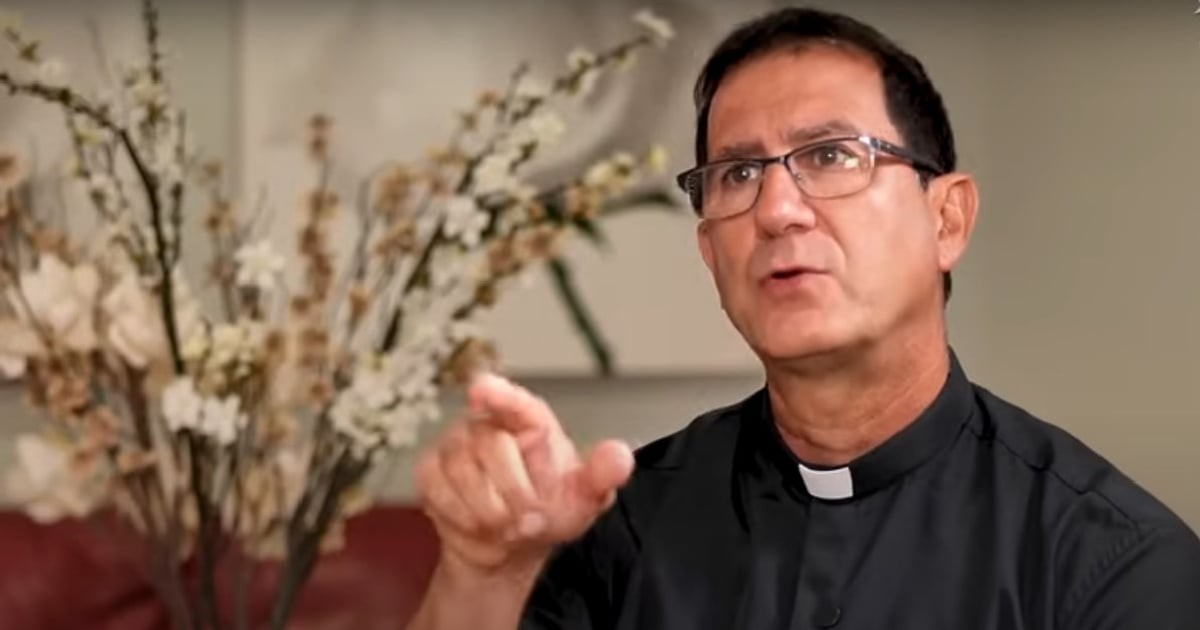
The Cuban priest Alberto Reyes, parish priest of Esmeralda (Camagüey) and one of the most challenging religious voices for the regime, expressed cautious optimism about the future of the Island in an extensive interview granted to the Spanish magazine Aceprensa during a visit to Madrid.
"Cubans will have to learn to live in democracy: it won't be easy, but we will learn," affirmed the priest, who returned to Cuba carrying suitcases filled with medicine for his humble parish, a gesture that illustrates the severe humanitarian crisis facing the Island.
Reyes described how he grew up in Camagüey in the 1970s under systematic harassment of Christianity, when textbooks indoctrinated against religion, and Christians were labeled as "religious" with the pejorative connotation of "ignorant."
That hostility did not remain in the past. State Security has summoned him twice to deliver warning notices, threatening judicial proceedings if he continues his public criticisms.
The regime accuses him, along with others like Father Jorge Luis Pérez Soto, Father Kenny, and Friar Lester, of being "promoters of hatred." "When we say that Cubans should be able to defend their rights and express themselves, they see it as a subversive discourse," he denounced.
Her series of posts on Facebook, "I've been thinking...", has become a platform for denunciation that makes the State Security nervous.
Regarding the role of the Church, Reyes rejected the idea that "priests do not get involved in politics." He distinguished between partisan politics— which is not the domain of the Church— and politics in a broader sense, understood as a concern for the well-being of society.
"When someone says: I am apolitical, what they are really saying is I don't care about my society: if there are people who are hungry; if there are no medicines; if the streets have become a dumping ground, I don't care. That is being apolitical," he stated.
The parish priest asserts that the Church is called to engage in politics in a broad sense, seeking by all means the well-being of society.
"How can I preach a God who is a Father, who makes us brothers, who desires our well-being, and then, when I leave the church, if there is someone who is hungry or lacks medication, I turn a blind eye? That would be a contradiction. A betrayal of the Gospel."
Regarding how the dismantling of the communist system would occur, he admitted that he is very concerned about violence, something he sees as a real possibility after decades of accumulated frustration.
"If there is no controlled transition and a power vacuum occurs, there could be an overflow of wounds that devastates and leads us into a spiral of vengeance. I fear that will happen in Cuba. That a lack of control leads to retaliatory violence," he lamented.
However, he made an important distinction between justice and revenge. He defended the necessity for those who have committed abuses or crimes to be held accountable before the law in transparent processes, as a means to heal wounds.
"Those who have caused harm must face justice; otherwise, a transition will not occur. The wounds would fester, and we would never become a people capable of moving forward. Many people will need to be judged, and if they have done wrong, they must answer for it. It is called transitional justice," he detailed.
Regarding the growing support for a U.S. military intervention among certain sectors of the Cuban population, he stated that this phenomenon must be understood in the context of desperation.
"The Cuban is not caught up in the 'intervention yes, intervention no' dynamic. Their desire is different. It is the 'I want this to end now; I can't take it anymore: let it end no matter what, because we are desperate,'" he stated.
Another topic discussed was the immense challenge that Cuba would face after a political change.
Reyes believes that the country will need substantial international assistance to rebuild its institutions and social fabric.
Seven decades without political freedoms or a democratic culture have left scars on today’s society, which is deeply polarized and intolerant. "We will have to learn to live in freedom, in listening, in teamwork, in democracy," he expressed.
The priest also expressed concern about the power struggles that could arise in a post-communist scenario. He is worried that different groups and leaders might end up competing for prominence instead of focusing on national reconstruction.
"I am concerned that there is a war of egos, and that instead of focusing on a common goal—a new, plural, inclusive, happy, democratic, and free Cuba—we exhaust ourselves trying to see who raises their flag," he warned.
Despite these difficulties, they believe that in a free society, new leadership will emerge, currently invisible due to fear of repression. "It will be complicated, but we will learn. We will be able to achieve it."
In their opinion, there are clear signs of transformation in Cuban society. The regime is facing increasing pressure not only from abroad but also from within the country.
"People are becoming freer to speak, and have started to dream, which is an important point. People are seeing change as something possible. Something is happening, and it will solidify into a deeper change," he emphasized.
"I want to believe that in three to five years, Cuba will be a completely different country; a nation that has moved beyond stagnation. Yes, I am very optimistic about everything we are experiencing," he concluded.
Filed under: