
Related videos:
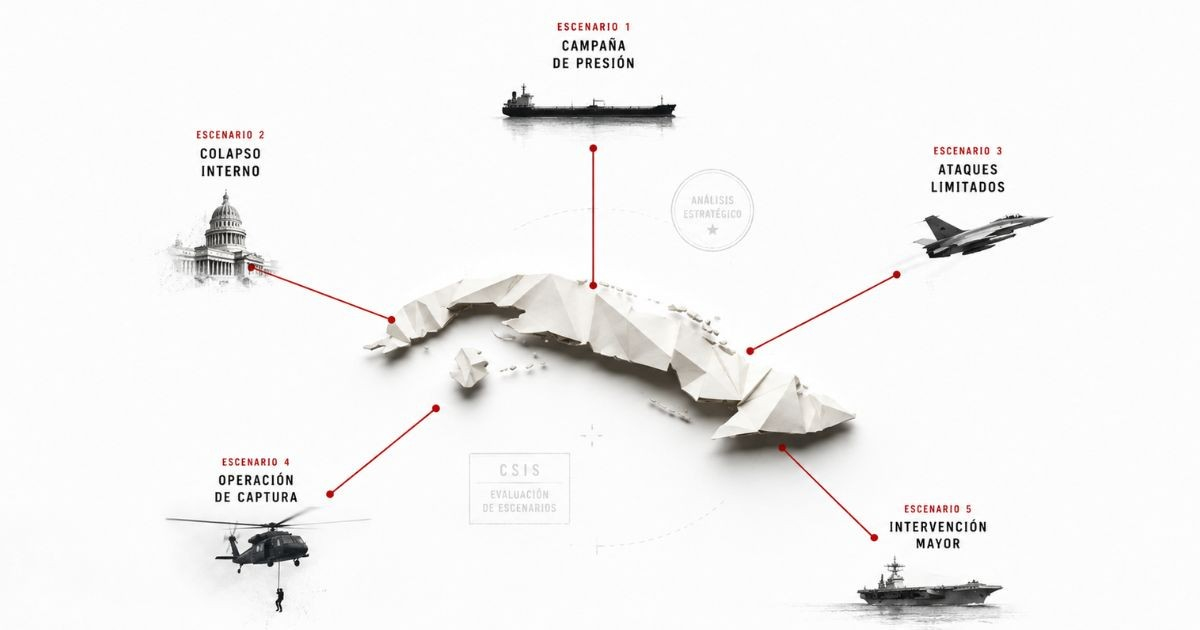
The Center for Strategic and International Studies (CSIS) published an analysis that examines five possible scenarios for U.S. military force against Cuba, in the context of unprecedented pressure escalation from the Trump administration on the Havana regime.
The document, signed by Christopher Hernández-Roy, Mark F. Cancian, and Henry Ziemer, starts with a central fact: five months after U.S. forces captured the Venezuelan dictator Nicolás Maduro in Caracas —during the so-called Operation Absolute Resolve— tensions in the Caribbean have shifted to Cuba.
The five scenarios analyzed by CSIS are: a sustained pressure campaign through energy restrictions; an internal collapse in Cuba leading to humanitarian intervention; the decapitation of leadership through a special forces operation or kinetic attack against Raúl Castro and/or Díaz-Canel; a limited air offensive against military and intelligence facilities; and an uncontrolled escalation due to an unforeseen incident.
Regarding the third scenario, the analysis warns that "Cuba is not Venezuela" and that the Cuban Communist Party is "much better institutionalized than the Venezuelan kleptocratic regime," therefore the removal of a high-level figure would not lead to the collapse of the system.
The most likely response would be a hardened reaction led by the Party, the FAR, the intelligence services, and the economic-military conglomerate GAESA.
The scenario of a large-scale ground invasion is deemed the least likely. According to the CSIS, occupying Cuba would require an external force of at least 100,000 personnel, months of visible preparation, and regional support that the international community has proven unable to articulate, as evidenced by the failure of the multinational mission in Haiti.
The Cuban regime has reactivated the doctrine of “total people’s war” and warned that an aggression would lead to a “bloodbath,” while it tries to buy time until the U.S. midterm elections, when a shift in Congress could ease the pressure.
The analysis concludes with a direct warning: "In the worst-case scenario, the U.S. could be drawn into a military confrontation that would exhaust its forces and endanger the lives of both American personnel and ordinary Cubans, without a clear path toward democratization or economic recovery."
The analysis indicates that the signs of escalation are concrete and cumulative. The aircraft carrier USS Nimitz and its strike group entered the Caribbean in May.
The 1,300 Marines of the 24th Marine Expeditionary Unit relieved the 22nd MEU, which had been present in the region since January. The U.S. also intensified military surveillance flights over the island to gather intelligence on the Revolutionary Armed Forces (FAR).
At the end of May, the CIA director, John Ratcliffe, visited Havana bringing with him a paramilitary officer who participated in the capture of Maduro and the death of Cuban soldiers who were guarding the Venezuelan leader, in what the CSIS describes as a deliberate signal of what could happen if negotiations fail.
The Department of Justice also declassified a formal indictment against Raúl Castro and other officials of the regime for the shooting down of the planes belonging to Brothers to the Rescue on February 24, 1996, which resulted in the deaths of four Cuban-Americans.
This legal framework mirrors the legal pattern used to justify Maduro's capture: extraterritorial application of domestic law, without formal military intervention.
Filed under: