
Related videos:
Madelaine Hernández García, president of the Municipal Assembly of the People's Power of Manicaragua, in the province of Villa Clara, asserted this Friday on Facebook that in that municipality "no one dies of hunger" and that the state market is "packed with food at affordable prices," citing rice at 190 pesos per pound as an example of this supposed abundance.
The post unleashed a wave of criticism and ridicule from Cubans who contradicted the official's account point by point, accumulating over 1,500 reactions and 1,453 comments in just a few hours.
"While the imperial enemy lurks and attacks the people of Cuba, here in Manicaragua, it finds resistance from its people; no one is dying of hunger here. The state market is currently overflowing with food at affordable prices, such as rice at 190 pesos per pound," Hernández stated.
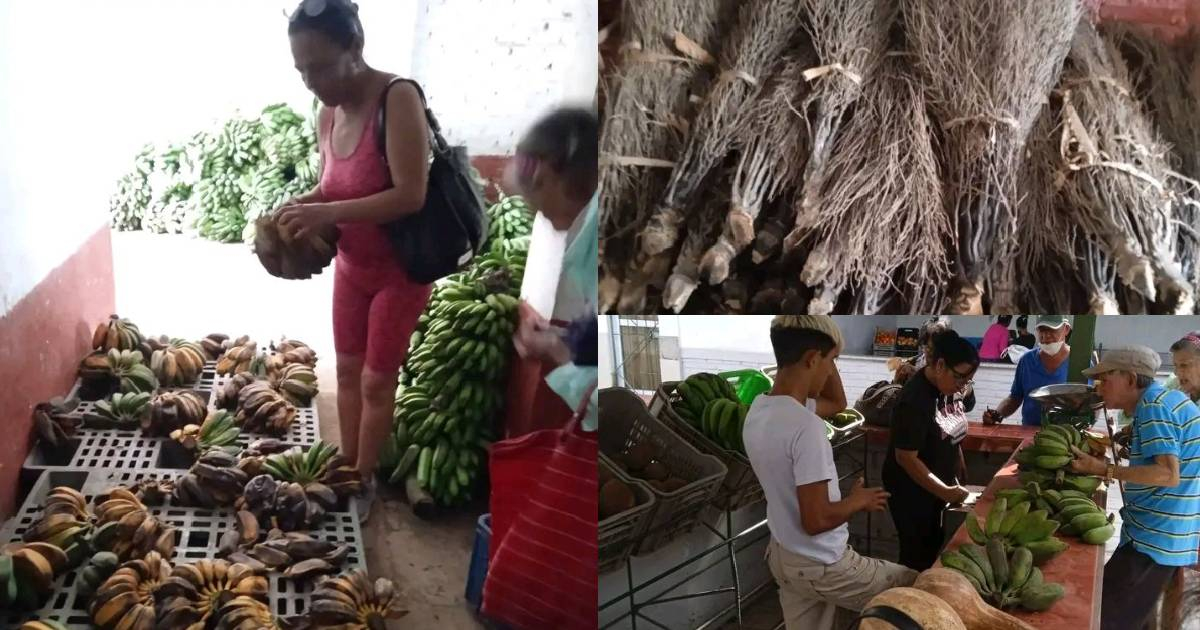
The images accompanying the publication mainly show green plantains, ripe plantains, brooms made from dry branches, and a scale with rice, which did not go unnoticed by the users.
The most popular comment, with 97 interactions, was from Daniel Rodriguez, who challenged: "A question... how do you eat a broom?"
Herlyn RG summed up what many saw in the photos: "Packed with plantains and palm broomsticks."
Mario Trujillo was more straightforward: "The appearance of people says more than your writing, they look tired; do you really think you can live on just green bananas?"
Mireya Tornés Alfonso asked the official not to "try to cover the sun with a finger." "There are many people who don't have a peso to buy even those products, which in fact are not a big deal. There are elderly people who have nothing to eat and children who haven't received their liter of milk that they are entitled to for a long time," she stated.
Aliuska Rodríguez Espinoza was even more emphatic: "The elderly are collapsing in the streets and dying from lack of food."
Elizabeth Guevara closed the debate with irony: "I’ll trade for Manicaragua."
The price of 190 pesos per pound of rice, which the official describes as "affordable," is devastating when compared to the Cuban minimum wage of 2,100 pesos per month, considering that a pound of rice represents nearly 9% of that monthly income.
This is not the first time that Hernández García has stirred controversy with such statements. On May 4th, the same official stated that the lack of bread in Manicaragua had "benefits" for health—reduction of blood pressure, fluid retention, and obesity—and praised cassava bread as a substitute, without providing any evidence.
Independent data radically contradicts the official narrative. A survey by the Food Monitor Program revealed that nearly 34% of Cuban households had at least one member who went to bed hungry, an increase of 9.3 points compared to 2024, and about 95% of respondents experienced some degree of reduced access to food purchases.
A report from the same organization presented to the UN in May states that GAESA, the conglomerate of the Cuban military elite, is directly responsible for the food crisis due to its monopoly over foreign currency, imports, and distribution, while agricultural production in Cuba has declined by 67% in the past five years.
Filed under: