
Related videos:
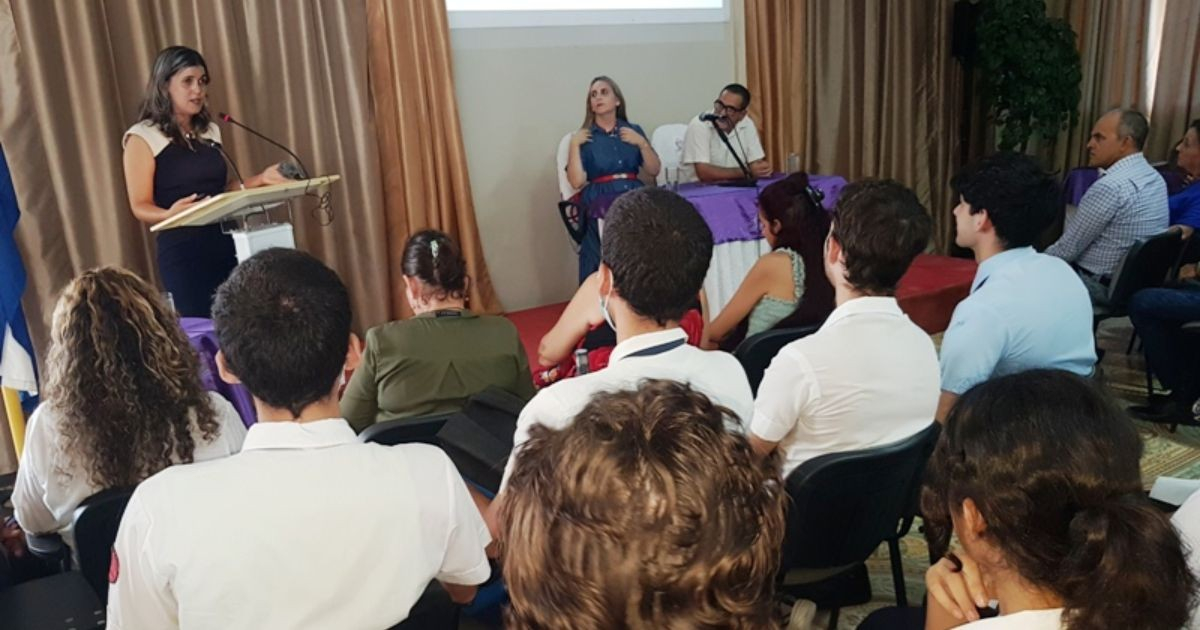
In Camagüey, the Software Development Group was established, integrated into the Intelligent Digital Transformation Project and coordinated by the Territorial Delegation of the Ministry of Science, Technology and Environment (CITMA) and the University of Camagüey Ignacio Agramonte Loynaz, as reported by Radio Rebelde this Friday.
The news comes at a time when Cuba is experiencing one of the worst electricity crises in its history: several times during May and into June, deficits exceeding 2,000 MW have been recorded.
The professor Ireimis Leguen de Varona from the University of Camagüey described the initiative as having "high impact" and explained that its purpose is "to build a digital, integrated, and intelligent ecosystem that addresses the issues of the strategic sectors in our province." Quite a task.
According to Leguen de Varona, in the initial phase, the group will focus on solutions for health, meteorology, smart industry, education, editorial management, and smart tourism. A digital ecosystem for a country where, in many municipalities, electricity lasts fewer hours than the shortest dreams of its inhabitants.
The project involves students from the Faculty of Computer Science and Exact Sciences at the University of Camagüey, the Máximo Gómez Báez Pre-University Vocational Institute of Exact Sciences, and the Polytechnic Institute of Computer Science, as well as the University of Medical Sciences and the Camagüey branch of the Union of Computer Scientists of Cuba (UIC). A whole battalion, but facing an "impossible mission."
Reynaldo Alonso Reyes, president of the UIC in the province, stated that the Digital Transformation dimension led by his organization "permeates all strategic sectors of the territory" and aims to "achieve ethics, equity, inclusion, and an explanation of the use of AI." Grandiose words for a province where power outages have exceeded 20 hours daily in some municipalities, and where the municipality of Minas recorded an average of 21.3 hours of daily power cuts, the highest in the country at that time, in 2024!
The academic Yailé Caballero Mota, presented as a global expert on the subject, inspired the young participants with a message that, in another context, would sound uplifting: "You are the ones who will carry out those implementations in artificial intelligence. I believe this is a successful example of integration, so that you can grow, so that you know how important you are," the source stated. What she didn't mention is how they will implement that artificial intelligence when there is no electricity to power a computer.
Previously, Caballero Mota announced that among the most advanced proposals is a database that, validated through a doctoral thesis, "will allow for the design of a predictive model to optimize the diagnosis and treatment of diseases." A promising medical advancement for the future in a healthcare system that currently lacks basic medications and operates with hospitals in the dark.
The contrast with reality is hard to ignore. The 65% of Cuba was left without electricity this past Saturday night, according to reports on the energy crisis. On May 14, a historic record for deficit was registered: 2,174 MW, with nearly 70% of the country without power simultaneously. The Minister of Energy and Mines, Vicente de la O Levy, acknowledged that Cuba operated without fuel reserves between December 2025 and May 2026.
Connectivity does not escape that collapse. During the national blackout on March 16, internet traffic in Cuba fell by 65%, and in May 2026, the country recorded only 7.21 Mbps on the global Speedtest index, placing it last in Latin America and among the slowest in the world. ETECSA acknowledged that its backup batteries only cover a few hours of outage, which means that blackouts leave millions of Cubans without signal or internet.
Cuba launched a National Artificial Intelligence Strategy in 2024 which, according to UNESCO, does not yet have specific legislation and faces structural challenges in governance, connectivity, and digital infrastructure. In this context, the regime promotes projects like the one in Camagüey that promise "citizen labs" and "minimum viable prototypes" in sectors where the first viable prototype that the population needs is simply to have electricity.
Filed under: