
Related videos:
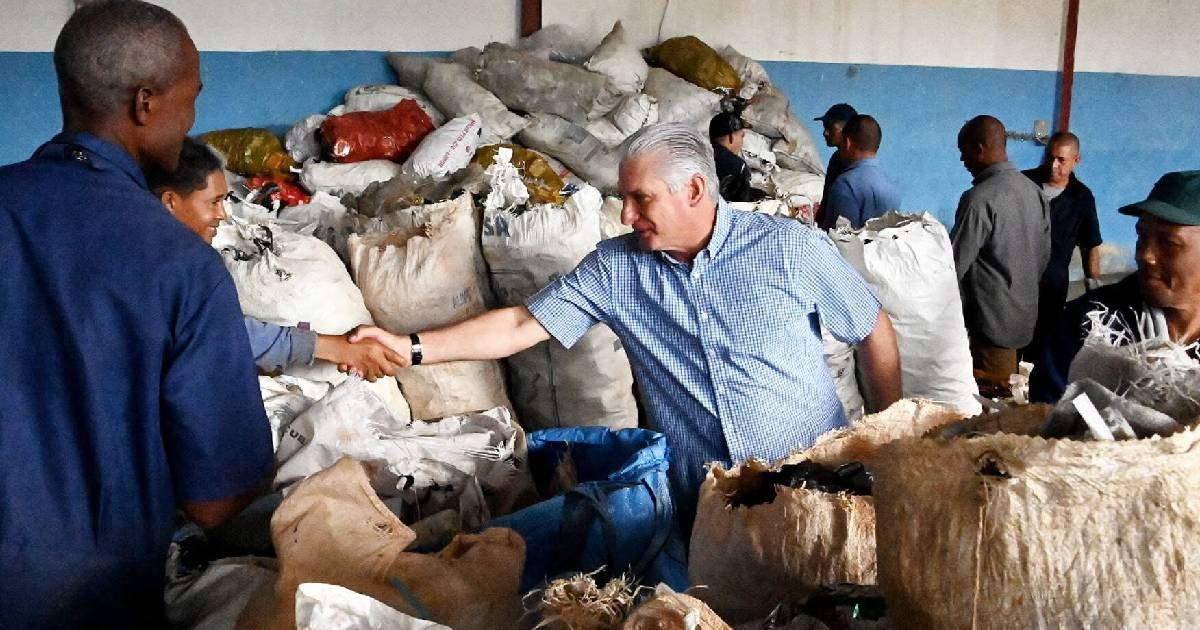
While Havana remains buried under tons of garbage accumulated in streets, parks, and public spaces, Miguel Díaz-Canel toured two entities of the Business Group for Recycling in the municipality of Regla, where he was presented with progress in exports and a new solid waste management system.
The contrast is hard to ignore: the Cuban capital generates between 24,000 and 30,000 cubic meters daily of waste, but in February of this year only 44 out of 106 collection trucks were operational due to a lack of diesel, and the city has only 10,000 containers when it needs between 20,000 and 30,000.
The minister in charge, Armando Rodríguez Batista, admitted in September 2025 that the situation was unsustainable: "It is not contained; it's spread all over Havana."
The accumulation has led to open-air burning in several municipalities, with associated health risks due to the proliferation of mosquitoes and diseases such as dengue and chikungunya.
Díaz-Canel first visited the Base Business Unit «Alfredo Ramonal», where non-ferrous waste is processed and classified, and then the company Desequip, which is responsible for import and export for the Ministry of Industries.
Her director, Sadie Jiménez Condés, explained that the entity has adapted its operations to the extended blackouts: "We have differentiated work schedules with electric transportation for the employees. Here, there are no fluctuations; rather, the workforce is always covered and they are very happy with their salary, which motivates them to continue."
The UEB reported an average salary of 40,000 pesos per worker and profits that exceeded 3,000,000 pesos by May.
Jiménez Condés also outlined improvement plans: "The copper will be crushed with a machine we have planned. We will provide electrical autonomy to the can processing plant."
At Desequip, the official received information about a new local waste management system, developed from studies by the Ministry of Science, Technology, and Environment, which aims to increase recovery without large investments or an increase in workforce.
Díaz-Canel emphasized that innovation "means turning waste into millions of dollars in income that the country’s economy needs" and called for greater organization at the neighborhood level so that individuals, companies, and institutions are aware of the disposal and collection points.
The visit follows the pattern of weekly tours that the regime uses as a political communication tool: in previous weeks, Díaz-Canel visited a Vietnamese company linked to rice production, where he stated that Cuba could become self-sufficient "in a short time," and the Granma Military Industrial Company, where wood stoves and water tanks are manufactured.
Meanwhile, residents from various neighborhoods in Havana have organized on their own to collect trash in the absence of state assistance, and the executives of the Recycling Business Group reported that the new management system is expected to be extended to the rest of the provinces in the country.
Filed under: