
Related videos:
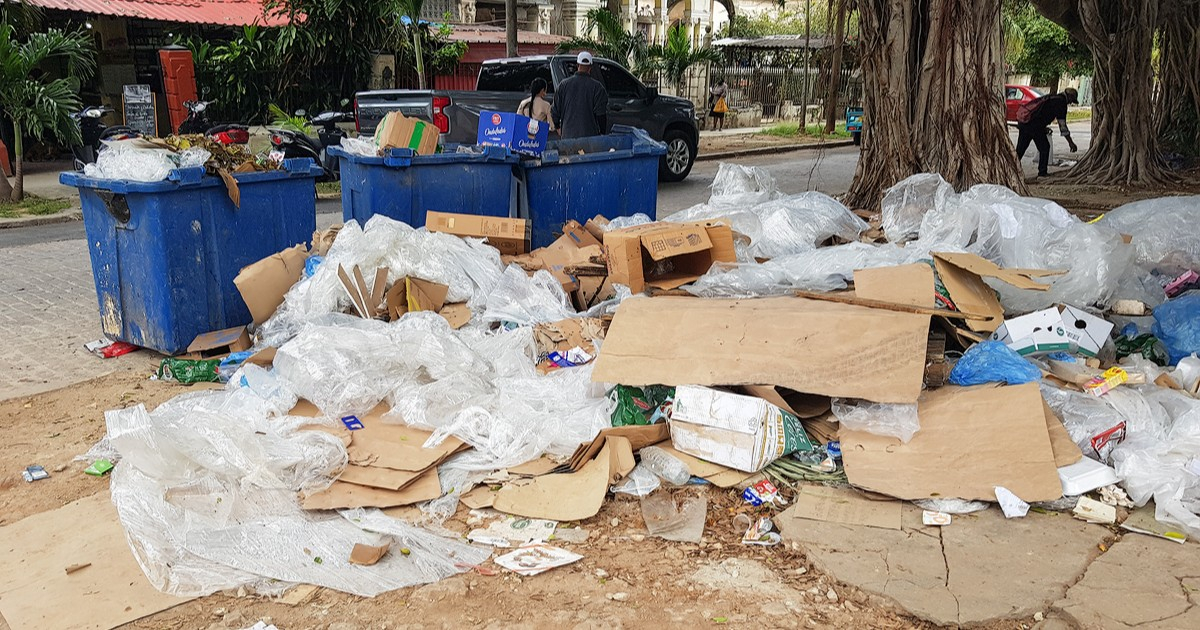
Amid a visible crisis on every corner of the country, with mountains of garbage piling up in streets, lots, and avenues, the Cuban government has started to present the issue as a potential source of income for the national economy.
This was reflected in a television program whose transcript was published by the state media Cubadebate, where several officials advocated for the idea of turning waste into a strategic resource.
The program "Cuadrando la Caja," aired on March 22 by Canal Caribe, brought together three officials to discuss how to turn urban solid waste into a source of foreign currency.
During the segment, the host introduced the topic with a perspective that seeks to shift the focus of the issue: "Beyond questioning why it is there, we should also ask ourselves why and what we should do with that solid waste, and how much the Cuban economy loses by not reusing it."
Odalys Goicoechea, the General Director of Environmental Affairs at the Ministry of Science, Technology, and the Environment (CITMA), pointed out that the language must change, avoiding terms like "garbage" or "waste" and using "urban solid waste" instead.
However, he had to acknowledge the rise of litter on the streets. "It’s no secret that these micro-dumps we have, which are no longer so micro, are mega dumps that we are primarily seeing in our cities, such as Havana, as they have a direct impact on the health of the population," he said.
Despite this recognition, the official argued that there is untapped economic potential in the piles of waste.
According to the explanation, the strategy involves reintroducing those materials into productive processes and "extending their lifespan," with both environmental and economic impact.
In that same vein, the dean of the Faculty of Mechanical Engineering at CUJAE, Deny Oliva, stated that the country needs to transform the current model into one based on material recovery and the circular economy.
According to his argument, Cuba has "buried" valuable resources in landfills for decades, which represents a significant economic loss.
The academic emphasized the need for legal changes, economic incentives, and greater involvement from private, economic, and community stakeholders to promote recycling.
"Behind urban solid waste, there is a hidden value that needs to be extracted," he stated.
Isabel Cristina Alfonso González, from the Recycling Business Group, provided figures to support this vision. "Last year, the group exported about 50 million dollars," she detailed.
Additionally, he pointed out that 90% of the recovered materials are allocated to the national economy, helping to substitute imports in sectors such as construction, health, and tourism.
The management defended the need for the population to participate in waste sorting from the source. "The one who generates the waste is responsible for taking care of it and storing it," they stated, and proposed that households separate materials such as plastics, containers, and cardboard to take them to recycling points.
All these proposals clash with a deeper structural problem: the system's inability to ensure something as fundamental as the systematic collection of waste.
In numerous cities, especially in Havana, improvised dumps have ceased to be small hotspots and have turned into large open-air garbage accumulations.
The smell of decomposition, the proliferation of flies, and the constant presence of rodents have created a health crisis that directly impacts public health.
The official discourse avoids delving into the underlying causes of the problem. The regime often attributes the crisis to external factors such as U.S. sanctions or the decline in fuel supply, but the accumulation of waste in Cuba is not a recent phenomenon. For decades, the lack of investment in infrastructure, the obsolescence of the vehicle fleet, and inefficiencies in public management have hindered a sustainable solution.
In that context, shifting some of the responsibility onto the population—encouraging them to sort waste at the source or actively participate in recycling—becomes hard to uphold when there are no minimum conditions to support such actions.
Most citizens face a daily crisis characterized by the shortage of food, medication, and basic services, which makes these proposals seem distant from their most urgent priorities.
The shortage of containers, irregularities in collection, and the lack of a functional system make these proposals seem more like theoretical aspirations than real solutions.
In that context, the idea of turning waste into an "economic opportunity" may seem disconnected from the everyday urgency of a population that, rather than seeking recycling plans, demands an efficient service that simply removes garbage from the streets.
Meanwhile, the crisis continues to worsen. Mountains of garbage keep growing in neighborhoods and avenues, becoming a visible symbol of a system that fails to meet basic needs.
The inefficiency of the vehicle fleet, the lack of investment in infrastructure, and the chronic shortage of containers—Havana needs between 20,000 and 30,000, but only has 10,000—have hindered a sustainable solution long before the current energy crisis.
In February of this year, only 44 out of 106 garbage trucks were operational in the capital, halted due to the diesel shortage.
The accumulation of waste directly impacts the quality of life for Cubans: desperate neighbors have chosen to burn the accumulated trash, generating toxic smoke and respiratory risks. The state telecommunications company ETECSA issued alerts for damage to its infrastructure caused by these fires.
In September 2025, the minister of CITMA, Armando Rodríguez Batista, admitted that the waste is not contained: it is spread all over Havana, and in December, Prime Minister Manuel Marrero acknowledged the failure of the institutions in the face of the crisis.
The official discourse attempts to reframe a health crisis as an economic opportunity, but for the Cuban population, the regime's promises are yet another indication of its disconnection from reality: while officials debate how to turn trash into wealth, Cubans continue to live alongside mountains of waste, the most visible symbol of the state's collapse.
Marrero acknowledged on March 12 that "we lost the fight", just days before the television program showcased these same scraps as a major "strategic opportunity".
Filed under: