
Related videos:
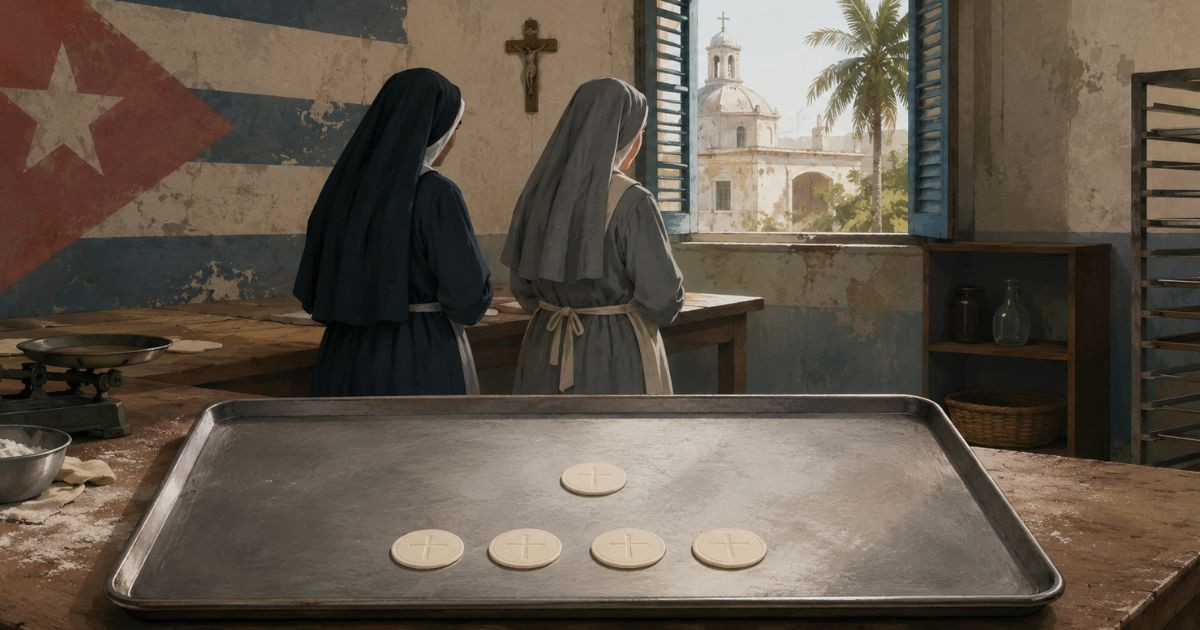
The discalced Carmelites of Havana announced that the lack of electricity prevents them from producing hosts for the mass, in a statement that began circulating on June 4 in private groups of the Cuban clergy and Catholic social networks.
"We inform you that, due to the power outage, it is impossible for us to prepare the communion wafers," wrote the nuns of the Monastery of Santa Teresa and San José, in El Vedado.
"The remaining reserve will be rationed so that it lasts a little for everyone," they added.
This is the second time in less than five years that this monastery —the sole provider of hosts for all Catholic churches in Cuba— has been forced to halt its production.
In November 2022, the cause was the lack of flour; now it is the electricity crisis, a structural issue that cannot be resolved with external solidarity as it was in that case.
The Discalced Carmelites, a contemplative order dedicated to a life of strict poverty, have been supplying wafers to all the parishes in the country for decades.
According to a documentary filmed in 2017 by Spanish filmmaker David Moncasi —secretly and defying the authorities' ban— the nuns produced monthly batches of up to 1,000,000 hosts.
The process requires electrical equipment: a large-format mixer to prepare the liquid dough and a mechanical press to shape the wafers into a circular form.
With only two hours of electricity per day —just like most Cubans— production has become unfeasible.
An anonymous priest close to the community, who did not reveal his identity for fear of reprisals, confirmed that the collection of wafers in Havana has already decreased to a third of its usual amount and that the "quota" will continue to decline.
Contacted through a priest intermediary, the nuns themselves declined to provide further details: "For now, we do not wish to publish any interview; we appreciate your interest."
The electricity generation deficit in Cuba reached a record of 2,174 MW on May 14, with cuts of up to 20 hours a day in some areas.
On June 3rd, one day before the nuns' statement, the Electric Union reported only 1,020 MW of availability against a demand of 2,570 MW.
Faced with the impossibility of solving the problem from within, many priests have asked people traveling abroad to bring back packages of wafers: in Spain, 500 wafers cost less than 10 euros; in the United States, a similar quantity is around 20 or 30 dollars.
The Spanish canonist José Luis Pueyo, consulted during the crisis of 2022, pointed out that the only immediate alternative is to break the host in half, a measure that will need to be implemented again.
Regarding the possibility of using regular bread, Pueyo was adamant: "That is impossible in Cuba."
In addition to Catholics, other denominations—evangelicals, Anglicans, and Orthodox—also sourced communion wafers from Cuban bishoprics, so the impact of the halt affects the entire Christian religious life on the island.
The Cuban Catholic Church is also navigating a diplomatically delicate position: Washington has designated it as the main channel for distributing humanitarian aid to Cuba—including an offer of 100 million dollars in 2026—without the regime's mediation, which strains its relationship with the authorities in Havana.
Filed under: