
Related videos:
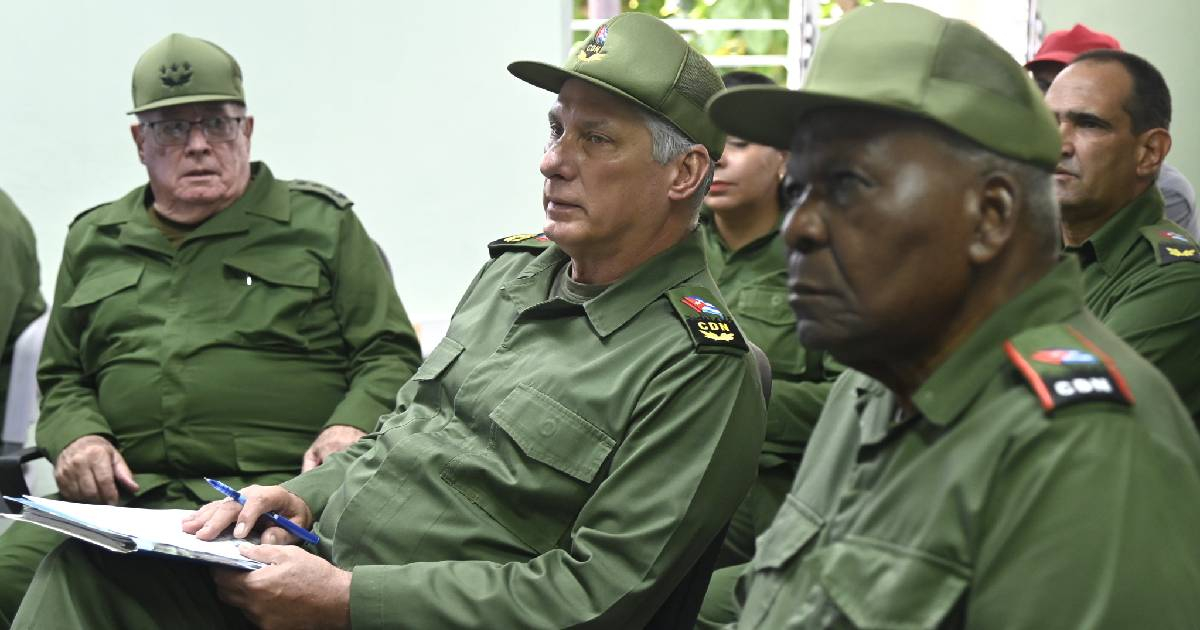
The leader Miguel Díaz-Canel announced new economic reforms this Friday and hours later supervised military exercises in the Santa Fe Defense Zone, in the municipality of Playa, Havana, a combination that summarizes the current priorities of the regime amid the worst economic crisis in decades and an increasingly confrontational external rhetoric.
The visit took place in the context of the so-called Year of Preparation for Defense, established by the authorities since the beginning of 2026, which includes weekly activities every Friday under the doctrine of the so-called People's Total War.
Alongside Díaz-Canel were the President of the National Assembly, Esteban Lazo Hernández; the Secretary of Organization of the Central Committee of the Communist Party, Roberto Morales Ojeda; and the Minister of the Revolutionary Armed Forces (FAR), Army Corps General Álvaro López Miera, the Presidency's account on X reported.
During the tour, the authorities reviewed the update of defensive plans and analyzed issues related to energy, food production, water supply, health services, and communications—specifically, some of the sectors hardest hit by the ongoing crisis in the country.
After receiving the reports, Díaz-Canel praised the work in the visited area and stated that it could serve as a reference for other similar structures.
Hours earlier, in an interview broadcast by the official television magazine the president introduced new economic measures included in the Economic and Social Program for 2026.
The initiatives cover six areas: economic management, municipal autonomy, business autonomy, agricultural recovery, foreign trade, and foreign investment.
Among the most significant announcements is the possibility for municipalities to directly manage import and export operations, oversee foreign currency revenues, and negotiate foreign investment projects, including initiatives with Cubans residing abroad.
Regarding state-owned enterprises, Díaz-Canel assured that they will have greater decision-making margins to manage their resources, retain part of the foreign currency obtained from exports, select suppliers and customers, and participate in the foreign exchange market.
The ruler also announced the unblocking of stagnant mipymes files and a reduction of activities banned for the private sector, measures that the government presents as part of a new economic easing, after years of controls, restrictions, and regulatory backtracking.
The combination of economic announcements and military exercises occurs in a context of rising political tension. In recent months, the government has intensified calls for defensive readiness while attempting to push through reforms to address the economic decline, characterized by blackouts, food shortages, falling production, and increased emigration.
The day before, the Cuban military leadership stood united with Díaz-Canel at the event for the 65th anniversary of the Western Army, to which Raúl Castro sent a message of support.
On June 6, during an event at the Karl Marx Theater, Díaz-Canel stated that Cuba would respond militarily to any external aggression and assured that, "if the homeland is attacked, we will respond in legitimate defense. And if they attempt to enter, there should be no doubt, there will be determined and firm combat," a rhetoric that has accompanied recent activities of the national defense system.
On Thursday, Pete Hegseth confirmed from Central Command in Tampa that a capture or elimination operation against Díaz-Canel "remains an option on the table."
Filed under: