
Related videos:
The authorities of Miami-Dade County have launched a prevention campaign in response to the risk of extreme heat during the matches of the warning residents and visitors to take safety precautions during the tournament events in the city.
According to an analysis by the World Weather Attribution organization, 26 out of the 104 matches in the tournament could take place under dangerous thermal stress conditions for the players, in accordance with the thresholds set by the International Federation of Professional Footballers.
Five of those encounters could reach a global wet bulb temperature of 28 degrees Celsius, the threshold at which experts recommend postponing the match.
This metric combines temperature, humidity, solar radiation, and wind to calculate the actual thermal stress on the body: an air temperature of 40 degrees with 30% humidity is equivalent to about 26 degrees of wet bulb temperature, the threshold at which players' performance begins to decline.
"Almost half of the matches in the World Cup have at least a 50% chance of experiencing heat that could impact performance, and 97 out of the 104 scheduled matches face a higher likelihood of limiting conditions due to climate change," detailed World Weather Attribution.
"It is not a coincidence, it is climate change," stated Simon Still, executive secretary of UN Climate Change.
Miami ranks among the venues most exposed to thermal risk of the tournament, with temperatures of 32 degrees and high humidity that can raise the heat index to as much as 43 degrees.
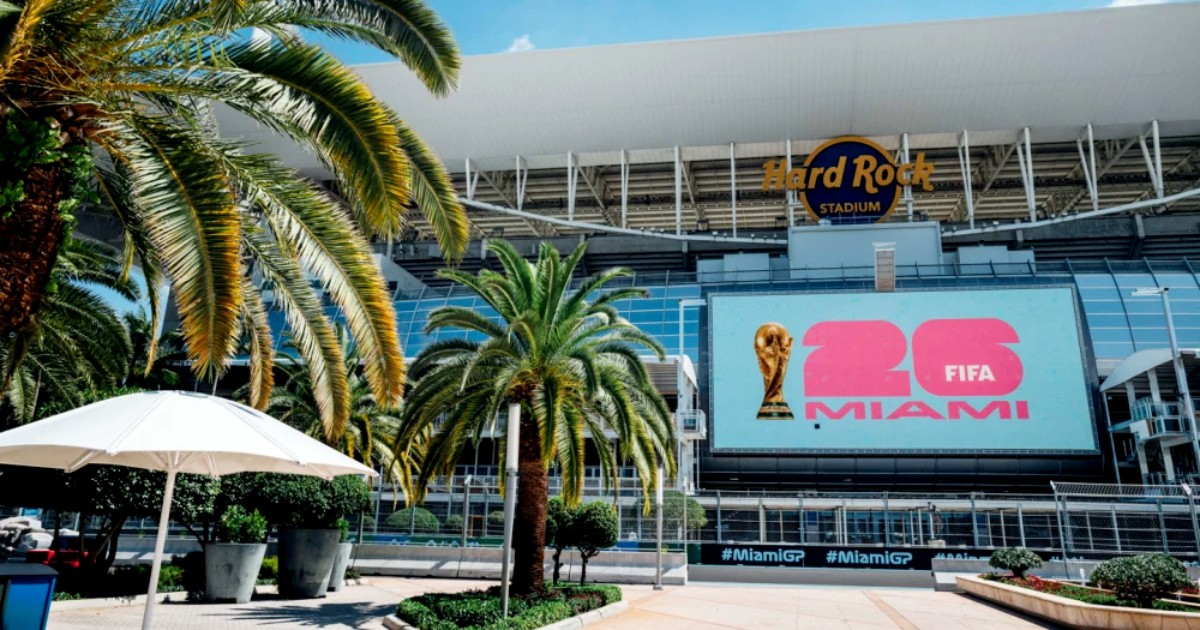
The Hard Rock Stadium, an open-air venue, will host seven matches of the 2026 World Cup, with the first scheduled for this Monday between Saudi Arabia and Uruguay.
The 2025 Club World Cup has already raised alarm bells: a peer-reviewed study analyzed 57 matches and 1,070 player observations, finding that in 31 of those games, the wet bulb temperature exceeded 28 degrees, resulting in fainting among journalists, fans, and one assistant referee.
In light of this situation, the Department of Environmental Resource Management and the Emergency Management Department of Miami-Dade are working with the stadium organizers and the Fan Fest to ensure access to cooling areas and free hydration stations.
The county will install four air-conditioned cooling stations at the Miami Stadium, two water trailers, and eight new cold water stations at transportation stops.
Additionally, a network of 60 libraries, parks, and government buildings will serve as cooling centers throughout the tournament, with their locations available on the official county website.
The FIFA Fan Festival, set up in Bayfront Park from last Friday until July 5, can accommodate up to 30,000 visitors daily in an outdoor space of 436,000 square feet, which amplifies the risk for the general public.
The mayor Daniella Levine Cava launched the campaign "The Heat is No Joke" with messages on social media and transportation centers, and she was direct in her warning: "Staying hydrated, seeking shade, and recognizing the symptoms of heat-related illnesses can make a difference."
FIFA, for its part, implemented mandatory three-minute hydration breaks at the 22nd minute of each half in all matches, and reversed an initial ban to allow the entry of sealed plastic bottles of up to 590 milliliters per person into the stadiums.
The long-term forecast exacerbates concerns: by 2050, 14 of the 16 venues for the 2026 World Cup could be unsafe without adaptation measures, according to UN Climate Change.
Filed under: