
Related videos:
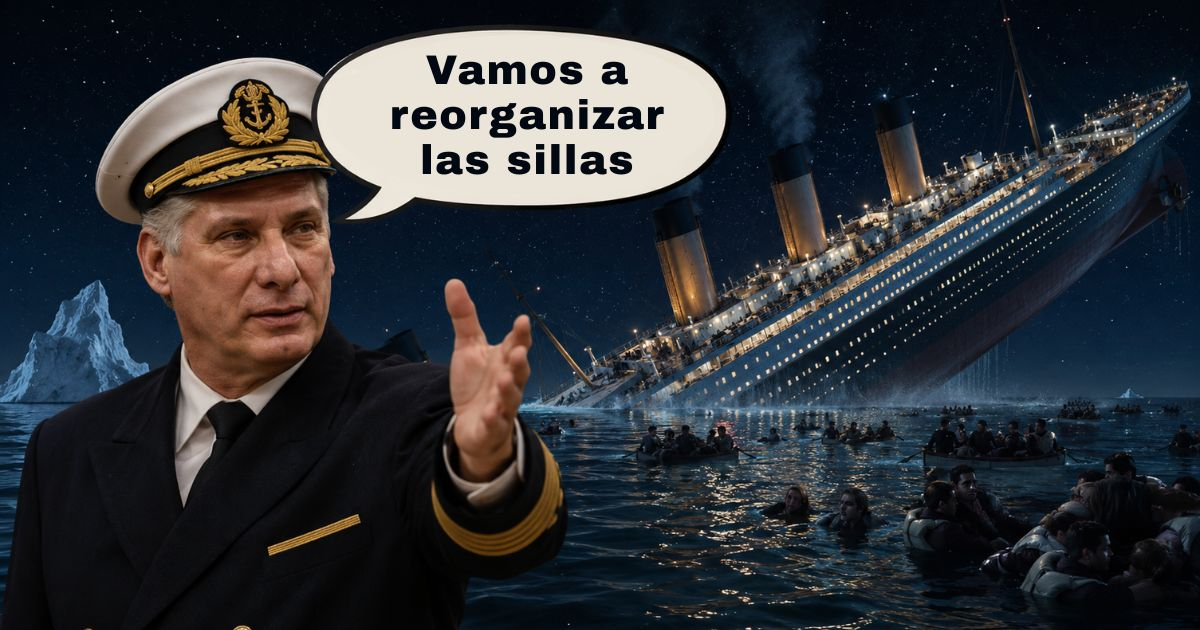
There is a phrase in English that English speakers use when someone makes minor adjustments in the face of an irreversible catastrophe: "rearranging the deck chairs on the Titanic". Rearranging the deck chairs on the Titanic. The ship is sinking, the water is rising, and someone is very busy making sure the deck chairs are neatly aligned.
That is exactly what Díaz-Canel did on June 12.
A model that was never an economy
The Cuban regime never built an economy. It created a system for capturing external rents: the oil from an ally, the wallet of a tourist, the salary of a slave doctor, the sacrifice of a family in exile. Four sources of foreign currency that it did not generate or deserve, upon which it built its survival for decades.
Today, the four are cut off. And underneath, there is no damaged productive fabric that can be recovered. There is the void that has always existed beneath. The void that the regime itself created over sixty years by destroying private initiative, property, and the ability of Cubans to generate value for themselves.
The trap of "reforms"
All the announced measures have an explicit limit that Díaz-Canel stated without hesitation: the reforms must be compatible with the preservation of the current political system.
But the current political system is the economic problem. It is not a factor. It is the cause.
A market that requires permission from the Party is not a market. A company that can be shut down by discretionary decree does not attract investment. A revocable opening at any time does not instill confidence. Economic actors understand this, and that is why the remaining Cuban capital continues to emigrate rather than invest in reforms.
What the regime calls transformation is actually a negotiation with itself: conceding the bare minimum necessary to survive without relinquishing the only thing that matters, which is power.
Reform Theater
Díaz-Canel is not governing. He is managing the appearance of governance. Each crisis produces a set of measures. Each set generates headlines. The headlines create a sense of movement. And nothing structural changes, because changing something structural would mean giving up power, and that the dictatorship will never do willingly.
Rearranging the deck chairs on the Titanic is, at its core, an act of conscious denial: someone who knows the ship is sinking but prefers to focus on the chairs because facing reality would mean giving in.
The problem is not that Díaz-Canel does not know what is happening. It is that his incentives point in only one direction: to buy time. To remain in power for as long as possible by announcing reforms that never arrive, promising changes that do not happen, while the water continues to rise.
The most important deck chair they are rearranging is not economic. It is time. And they are doing it at the expense of the Cuban people, who have been paying the price of a shipwreck that their captains refuse to acknowledge for decades.
Filed under:
Opinion article: Las declaraciones y opiniones expresadas en este artículo son de exclusiva responsabilidad de su autor y no representan necesariamente el punto de vista de CiberCuba.