
Related videos:
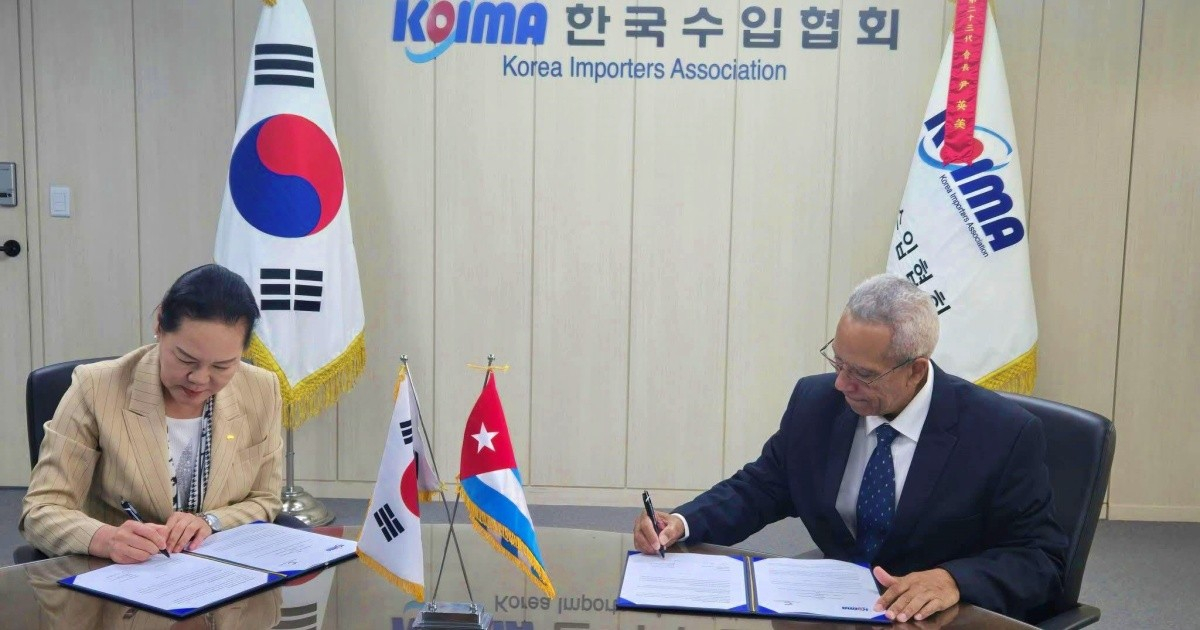
The Chamber of Commerce of the Republic of Cuba and the Association of Importers of the Republic of Korea (KOIMA) signed a commercial collaboration agreement in Seoul, as reported by the Cuban Chamber of Commerce on its Facebook profile.
The Cuban institution described the event as "an important step in bilateral relations," whose "main goal" is "the promotion of Cuban exportable products in the Asian country, opening the doors to mutual and closer collaboration."
Who signed the agreement?
The signing was led by Antonio Carricarte Corona, president of the Chamber of Commerce of Cuba, and Youn Young-mi, president of KOIMA, at the facilities of the South Korean association.
The Cuban ambassador to South Korea, Claudio Monzón, was also present, who days earlier had stated at the forum "Business Opportunities in Cuba," held in Seoul last Wednesday: "Cuba continues to be a land of opportunities and possibilities."
KOIMA, founded in 1970, is described by the Cuban Chamber of Commerce as "the main organization that connects foreign suppliers with buyers in the Republic of Korea."
The three strategic sectors of the agreement
During the meeting, Carricarte and Youn Young-mi discussed the "economic transformations of the Island" and business opportunities in three prioritized sectors:
- Agri-food sector.
- Renewable energy.
- Biopharmaceutical industry.
In the biopharmaceutical field, Cuba has the capacity to market over 300 products in 43 countries and has approximately 750 international health registrations, according to a 2025 study by ICEX.
In renewable energy, the official goal of the regime is to reach between 24% and 25% of electricity generation from renewable sources by 2030, although the daily reality on the island continues to be marked by severe blackouts.
The South Korean enthusiasm and the warnings of risk
The president of KOIMA highlighted "the great appeal and friendliness that Cuba generates in South Korean society" and expressed "a strong commitment to increasing the trade flow between both nations."
However, the agreement comes just four days after Carricarte himself led the forum "Business Opportunities in Cuba" in Seoul, where the South Korean counterpart issued significant warnings.
Lee Myung-joon, director of the Korea Trade-Investment Promotion Agency (KOTRA) in Havana, warned that "Korean companies with assets or financial ties in the United States must exercise a high degree of caution."
KOTRA officials were even more direct: "Cuba is not a market where companies can simply apply the standards they use for regular trade with other countries. Finance and logistics are the areas that require special caution."
A diplomatic connection that is still very recent
Cuba and South Korea restored their diplomatic relations on February 14, 2024, after more than six decades of estrangement caused by Fidel Castro, who severed ties in 1960 when establishing relations with North Korea.
The trade volume between the two countries was minimal prior to the rapprochement: only 21 million dollars in 2022, according to KOTRA data.
Since then, contacts have intensified. In December 2025, the South Korean government donated 24,600 tons of rice to Cuba through the World Food Programme, primarily aimed at vulnerable populations in the eastern part of the island.
Carricarte summarized the regime's gamble at the Seoul forum with a phrase that encapsulates Cuba's diplomatic strategy: "South Korea is a country we hope to add to our network of economic partners."
Between business promises and economic reality
Beyond the optimism expressed by Cuban authorities, the Island's actual capacity to attract investments and expand its foreign trade remains hindered by structural issues that have long been affecting the business environment.
The scarcity of foreign currency, delays in payments to foreign suppliers, logistical difficulties, and limited internal production capacity have repeatedly been identified by businesspeople and international institutions as obstacles to the development of sustainable trade relationships.
This is compounded by the contradiction between the official discourse on economic opportunities and the reality that citizens and state-owned enterprises face daily.
While the government promotes projects in strategic sectors such as renewable energy and food production, the country continues to experience frequent blackouts, shortages of basic products, and low levels of agricultural production.
This context raises questions about the speed and scope with which the announced agreements will translate into tangible benefits for the Cuban economy and for a population facing one of the deepest crises in recent decades.
Filed under: