
Related videos:
Behind improvised curtains made of sheets, between cardboard walls and under a zinc roof that turns the space into an oven, nine Cuban families have been surviving for three years in a boxing gym in Old Havana. Without running water, with children exposed to humidity and the constant noise of training, their reality illustrates one of the deepest and most persistent crises in Cuba: the lack of housing.
The portrait was obtained from a report by the agency AFP published this Tuesday, which depicts the daily struggle of families forced to turn a sports space into their home while waiting for a solution that never arrives.
Far from being an isolated case, the situation reflects a structural problem affecting hundreds of thousands of Cubans. The housing deficit on the island exceeds 900,000 homes, and according to official figures, more than a third of the residential properties in the country were already in critical or poor condition since 2020.
Among those experiencing the consequences of this deterioration is Marnie Estevez, a 43-year-old woman from Havana whose life changed when a storm caused the staircase of the building where she lived with her husband and daughters to collapse. The building is a neoclassical structure from the 1920s located in Central Havana.
Overnight, the family was trapped on the third floor.
"The firefighters had to bring my grandmother down with a crane," Estevez told AFP.
Her mother, Leodiska Canino, 64, and her grandmother, 97, have been living in a state shelter for seven years. They are among the thousands of Cubans evacuated from buildings deemed hazardous who are still waiting for permanent housing.
"Havana is falling apart," Canino lamented. "There is no money here to fix anything."
The same uncertainty affects Dayana García, 35, one of the mothers living in the boxing gym in Old Havana with her three children. There, surrounded by makeshift divisions of cardboard, they are trying to establish a routine amid precarious conditions.
According to what he reported to AFP, one of his sons developed a lung infection due to the humidity in the area.
"No one from the government comes here... not even to see how we are, whether we are alive or dead," she stated.
The housing crisis is occurring at a particularly complex time for the country. The prolonged power outages and resource shortages have further exacerbated the deterioration of buildings and hindered repair and construction efforts.
The figures illustrate the magnitude of the problem. Between 2000 and 2013, 3,856 buildings collapsed in Havana, averaging almost one structure falling each day, according to data from the Office of the Historian of the City. In 2025 alone, the collapses resulted in at least six fatalities in the capital, including a seven-year-old girl. Just this month, there was a new collapse of a building located in front of the Havana Malecón.
Meanwhile, the construction of new housing continues to fall far short of the country's actual needs. In 2024, only 7,427 houses were completed across the island. A year later, of the 10,795 homes planned by the authorities, only 2,382 were finished, which is equivalent to 22% of the plan.
In light of the impossibility of reversing the housing deficit, authorities have opted for temporary solutions. Among them is the conversion of more than 3,500 shipping containers into modular homes for Havana. The first two units were delivered last May, although experts have warned that these structures can reach extreme temperatures under the tropical climate and do not address the underlying causes of the crisis.
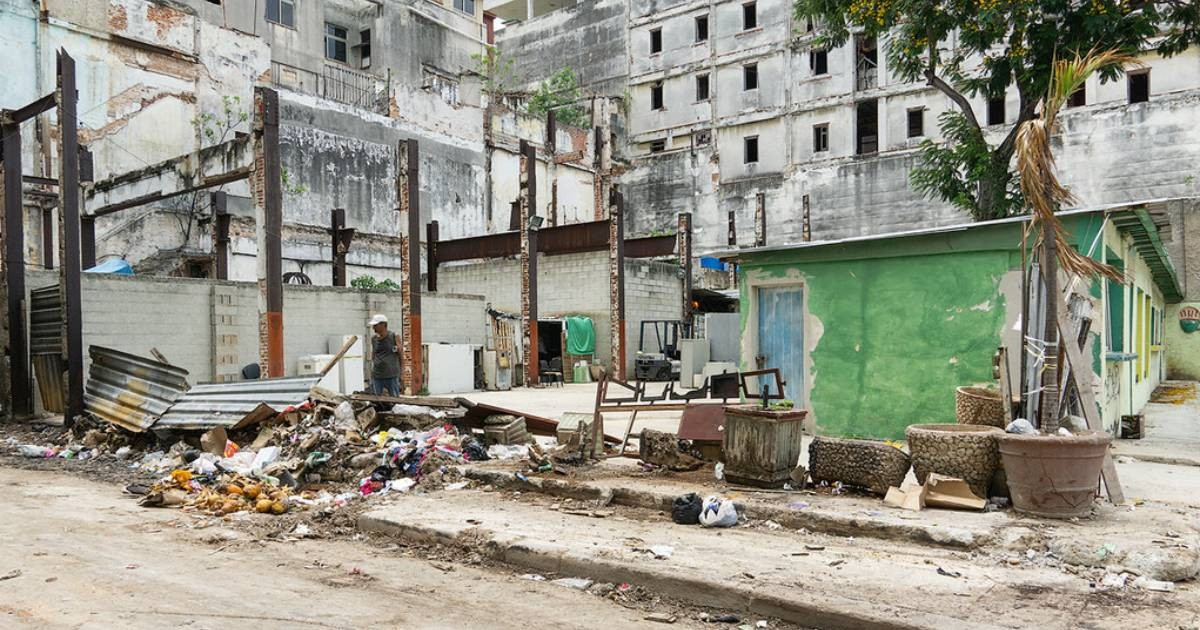
The situation is particularly evident in Old Havana, one of the municipalities most affected by urban deterioration. Declared a World Heritage Site by UNESCO in 1982, the area preserves hundreds of historical buildings, some of which were constructed in the 16th century. Many now display cracked facades, collapsed roofs, and structures so dilapidated that the sky can be seen through them.
For families that have been waiting for a solution for years, statistics and government plans hold little significance against the daily reality.
"This is not a life," summarized one of the mothers who survives with her children in the gym turned into a shelter.
Filed under: