
Related videos:
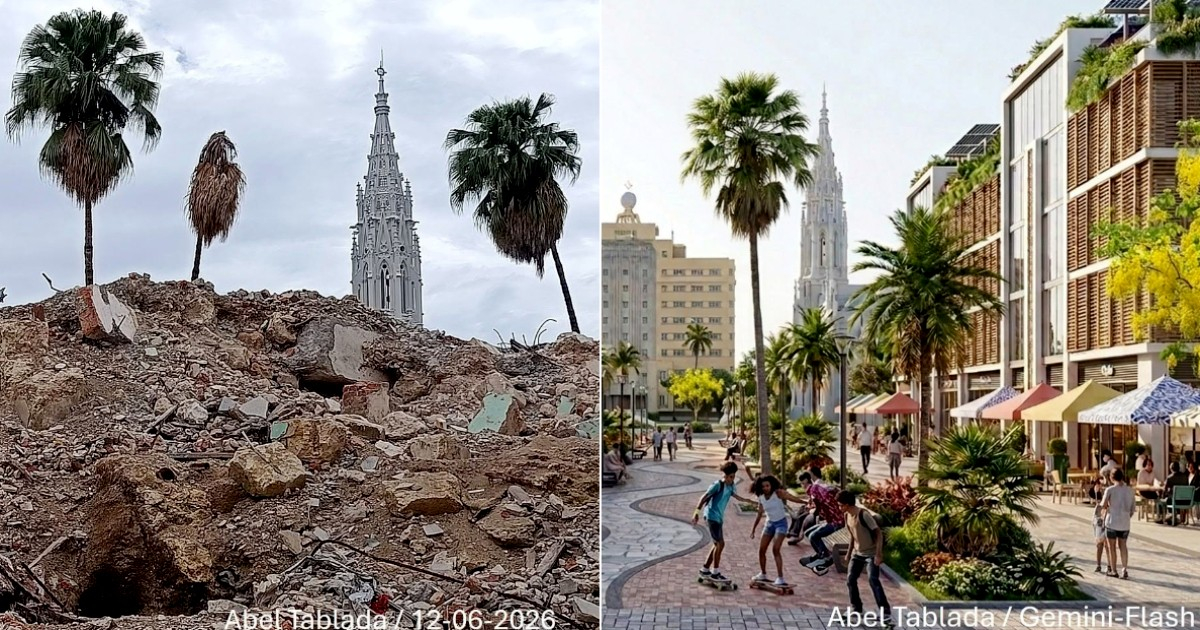
The architect Abel Tablada, brother of the diplomat and spokesperson for the regime Johana Tablada de la Torre, criticized the Cuban regime's investment policy in the tourism sector on Monday by publishing a reflection on Facebook regarding the rubble of the demolished building of the Higher Institute of Industrial Design (ISDI) in the Centro Habana municipality.
In her publication titled "The Havana We Want: Responsible Use of AI," Tablada pointed out that "tourism in Havana would be more successful (...) if instead of investing hundreds of millions in isolated hotels (...) there had been investments in urban projects that integrate functions and, rather than driving away the impoverished population, would have opened doors for them."
Despite partially attributing the urban and social disaster to "extreme measures of blockade and persecution of hotel chains or threats to tourists," Tablada expressed criticism towards the regime's policies, which have resulted in "a poor contribution to the urban profile and the quality of life of citizens."
The architect toured the lot left by the ISDI building, demolished in March 2026 by the company GEICONS after years of deterioration, partial collapses, and institutional neglect, and used artificial intelligence to visualize a proposal for the urban regeneration of the vacant space.
The building, located just 50 meters from the corner of Belascoaín, Carlos III, and Reina, was closed in 2022 due to structural failures.
In July 2024, it suffered a partial collapse of its façade, and in January 2025, it collapsed again, leaving a 78-year-old woman injured and affecting four families.
In October 2025, the building was looted and historical documents and academic works went missing.
Tablada described the scene as "lamentable and sad due to the value of the building, its location, and the damage to the functions of that prestigious school that has had to relocate to Miramar, moving through other buildings temporarily."
He added that the debris continues to be removed "informally by spontaneous miners, scavengers for raw materials for construction, just as happened with the ruins of the Roman Colosseum for centuries."
The criticism of the regime's hotel model is particularly significant in the current context. In 2024, nearly 40% of all Cuban state investment was concentrated in hotels and tourism, an amount 11 times higher than the combined spending on Education and Health.
At the same time, tourism revenue fell by approximately 62% compared to 2019. The military conglomerate GAESA and its branch Gaviota have accumulated assets in 120 hotels, 62 of which are managed by Spanish chains, with investments in a single large hotel in Havana reaching 200 million euros.
That bet has become even more fragile following the sanctions imposed by the Trump administration against GAESA, formalized on May 7, 2026, by the State Department, which forced Meliá to abandon 15 of its 35 hotels in Cuba and Iberostar to cease operations at 12 facilities starting June 1.
Abel Tablada's voice takes on a particular dimension due to his family connection with the official Tablada de la Torre, the general deputy director for the United States at the Ministry of Foreign Affairs and one of the main spokespersons for the regime's official discourse towards Washington.
While Johana defends the government line and accuses U.S. officials of "interference" and "cognitive warfare," her brother has amassed a history of public accusations. In May 2025, he denounced the repression following the death of the mother of political prisoner José Gabriel Barrenechea.
In June 2025, he demanded an explanation of “where the millions of ETECSA went,” and in February 2026, he published reflections on power outages and teacher salaries ranging from 10 to 15 dollars a month that cost him his expulsion from CUJAE in March 2026, where he was a tenured professor at the Faculty of Architecture.
However, Abel Tablada's criticisms remain within a framework that suggests technical and urban improvements without questioning the legitimacy of the system as a whole.
The architect himself reflected this in his publication, concluding that the solution will come "with new technologies, with accumulated knowledge and its responsible use by all actors and decision-makers in a democratic environment and without external harassment."
A city, he wrote, "that does not combine its cultural heritage with constant renewal, growth, and innovation is a dead city."
However, if a city that refuses to renew itself is doomed to become a dead city, a country that limits citizen participation, free debate, and accountability runs the same risk.
The reconstruction of Cuba will require not only new infrastructure but also the necessary democratic conditions for its citizens to decide and shape their future.
Filed under: