
Related videos:
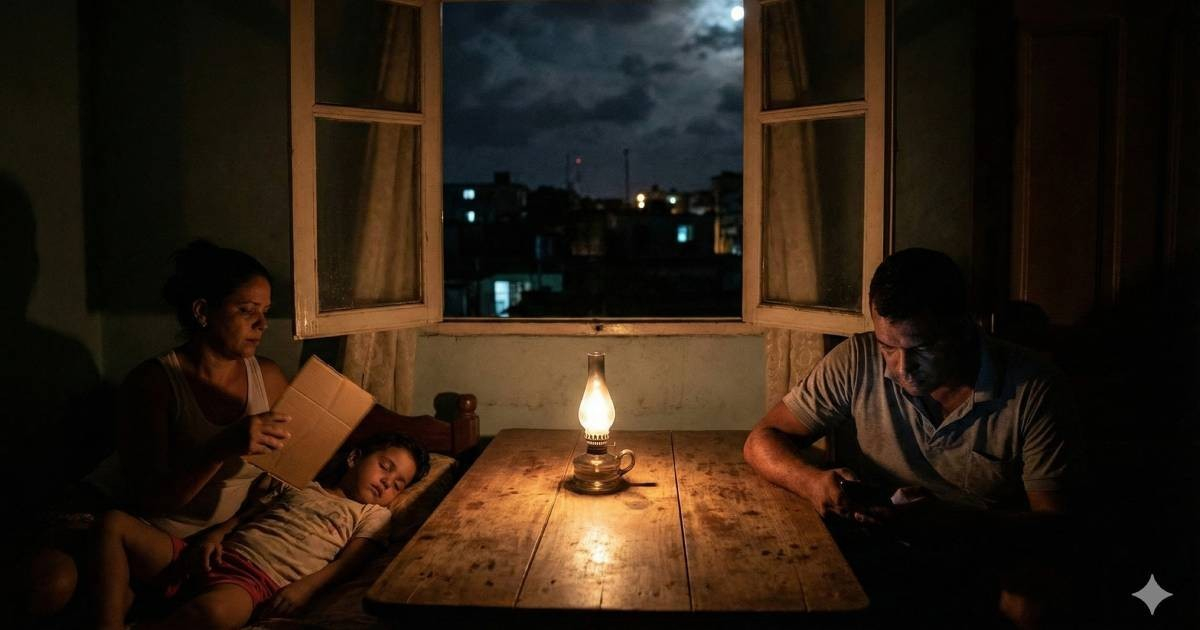
Cuba faces another day of widespread blackouts this Thursday, with an electricity deficit threatening to leave more than 60% of the country without power during peak consumption hours.
According to the official report from the Unión Eléctrica, at 6:00 am, the availability of the National Electric System (SEN) was only 970 MW compared to a demand of 2,650 MW, with 1,650 MW already affected at that time.
By noon, an impact of 1,700 MW is expected, while during the peak nighttime hours, the situation is even more bleak: UNE estimates an availability of only 1,015 MW against a demand of 3,050 MW, resulting in a deficit of 2,035 MW and a projected impact of 2,075 MW.
Wednesday's event was equally devastating.
The UNE acknowledged that "the service was impacted due to a capacity deficit over the 24-hour period, and the disruption persisted throughout the early morning hours," with a peak record of 2,081 MW at 8:50 PM.
The situation in the capital is particularly serious.
The Havana Electric Company reported that on Wednesday the service was interrupted for 24 hours, with a maximum impact of 538 MW at 10:40 PM.
"It was necessary to shut down circuits due to EMERGENCY with 185 MW. It was not possible to restore the service," the entity noted on Facebook.
At the close of the report, the six blocks and emergency circuits -454 MW- remained affected without a scheduled time for restoration.
The causes of the collapse are multiple and reveal the state of structural deterioration of the Cuban electrical system.
The UNE reports breakdowns in four units of the thermoelectric plants Máximo Gómez, Ernesto Guevara, Antonio Guiteras, and Lidio Ramón Pérez, with 307 MW out of service due to technical failures.
The hardest hit continues to be the CTE Antonio Guiteras, the most powerful thermoelectric plant in the country, which has been offline since June 15 due to its 15th breakdown of the year.
The repair, which involves replacing more than 100 defective weld seams, will take at least five more days, according to estimates from the state-owned company itself.
Additionally, 106 distributed generation plants are idle due to a lack of fuel, with 890 MW unavailable.
The Regla and Melones power plants, as well as the fuel facilities in Mariel and Moa, are also out of service, increasing the total unavailable megawatts due to this issue to 1,203 MW—a figure that reflects the chronic shortage of diesel and fuel oil that the Island is experiencing.
As the only partial relief, the 54 recently installed photovoltaic solar parks contributed 3,486 MWh on Wednesday, with a peak power of 444 MW at midday.
For the nighttime peak, the UNE plans to add only 45 MW with the completion of Unit 6 of Energás Jaruco, a marginal contribution in the face of a deficit that exceeds 2,000 MW.
The Cuban regime attributes the crisis to the "oil siege" by the United States, evading its responsibility for decades of underinvestment, corruption, and inefficiency that have led the electrical system to collapse.
Meanwhile, in provinces like Granma, blackouts of up to 72 consecutive hours are being reported, and in Matanzas, some municipalities have experienced up to 85 hours without electric service.
The record deficit for the year was recorded on May 14 with 2,174 MW, when nearly 70% of the country was simultaneously without electricity, a record that could almost be matched this Thursday if the expected conditions persist during peak hours.
Filed under: