
Related videos:
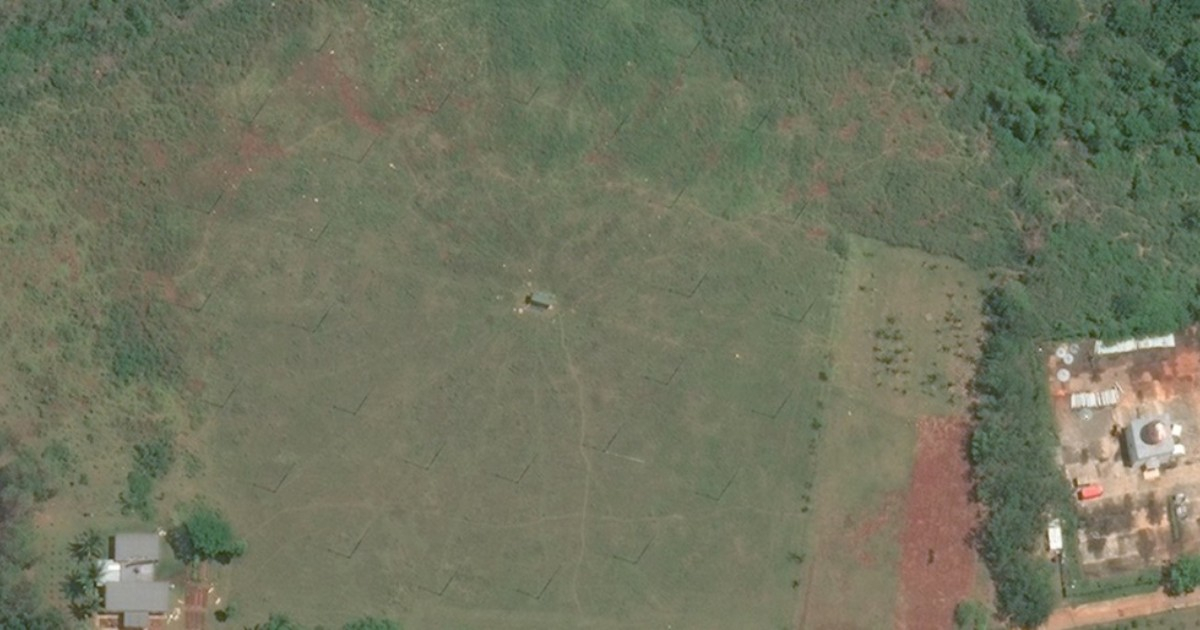
New commercial satellite images confirm that the construction of a large interception antenna at the Bejucal base, near Havana, has been completed, and the installation is very likely already in operation, according to an analysis published this Thursday by the Center for Strategic and International Studies (CSIS), a private institution based in Washington that specializes in international policy.
The discovery comes at a time of heightened tension between Washington and Havana, with U.S. officials publicly warning about the expansion of Chinese and Russian espionage activities on the island, just 160 kilometers off the coast of Florida.
The new Bejucal antenna: The largest detected in Cuba
The CSIS documented the completion of a new CDAA (Circularly Disposed Antenna Array) at the northeastern end of the Bejucal facility, with 32 antennas - 19 outdoors and 13 indoors - the largest and possibly most capable of its kind ever observed by the organization in Cuba.
The conversion of the antenna field, which changed from a linear grid to this circular configuration, was completed over the past two years.
In April 2025, the CSIS had already documented ongoing cabling work between the antennas and the central control building; images from June 2026 show those works completed.
The CDAAs are primarily used for high-frequency radio direction finding: they intercept and geolocate radio transmissions across a wide range of frequencies.
From the northwest of Cuba, this antenna could enhance the capability to monitor U.S. naval and air operations in the Caribbean and the southeast coastline, a region where military activities have intensified under the Trump administration.
The CSIS warns that there is no conclusive public evidence proving China's direct involvement in Bejucal, but notes that the base is likely one of the three sites in Cuba that U.S. officials have acknowledged as being operated by that country.
The Secretary of State Marco Rubio declared before the Senate on June 2 that “Cuba continues to host a rather substantial collection of intelligence sites on behalf of China and Russia.”
El Salao: Work nearly halted, but without definitive abandonment
The second site analyzed, located in El Salao near Santiago de Cuba, presents a very different picture. The images from May 2026 show little progress since the previous year: no antennas have been installed and vegetation has reclaimed part of the leveled ground.
The works at El Salao began in 2021, and by 2024, they already had the central control building and the foundations for an inner ring of 16 antennas, but construction largely came to a halt.
An access road has been repaved and repositioned toward the center of the area, suggesting that the site has not been completely abandoned.
If completed, it could serve as a complement to Bejucal, expanding coverage to the southeastern Caribbean and allowing for triangulation of signals in Central America and the western Atlantic.
Diplomatic escalation and pressure from Washington
The CSIS report is part of a sustained escalation of warnings about espionage in Cuba.
According to the Wall Street Journal, China and Russia have nearly tripled their intelligence personnel on the island since 2023, and the facilities are positioned to monitor two military headquarters in Florida.
In May 2026, Trump signed an executive order imposing new sanctions on the Cuban regime, citing the accommodation of "facilities of foreign adversaries" that target sensitive U.S. national security information.
That same month, the CIA director, John Ratcliffe, visited Havana and warned that "Cuba cannot continue to be a platform for adversaries to advance hostile agendas in the hemisphere."
China rejected the accusations, labeling them as "a fabrication of pretexts and spreading rumors," while the Cuban Foreign Minister Bruno Rodríguez Parrilla accused Rubio of instigating aggression against Cuba.
The CSIS concludes that the condition of these facilities could become a central point in any future negotiations between Washington and Havana, in a scenario where Rubio has already warned that “Washington will not allow any foreign military, intelligence, or security apparatus to operate with impunity just 90 miles from the shores of the United States.”
Filed under: