
Related videos:
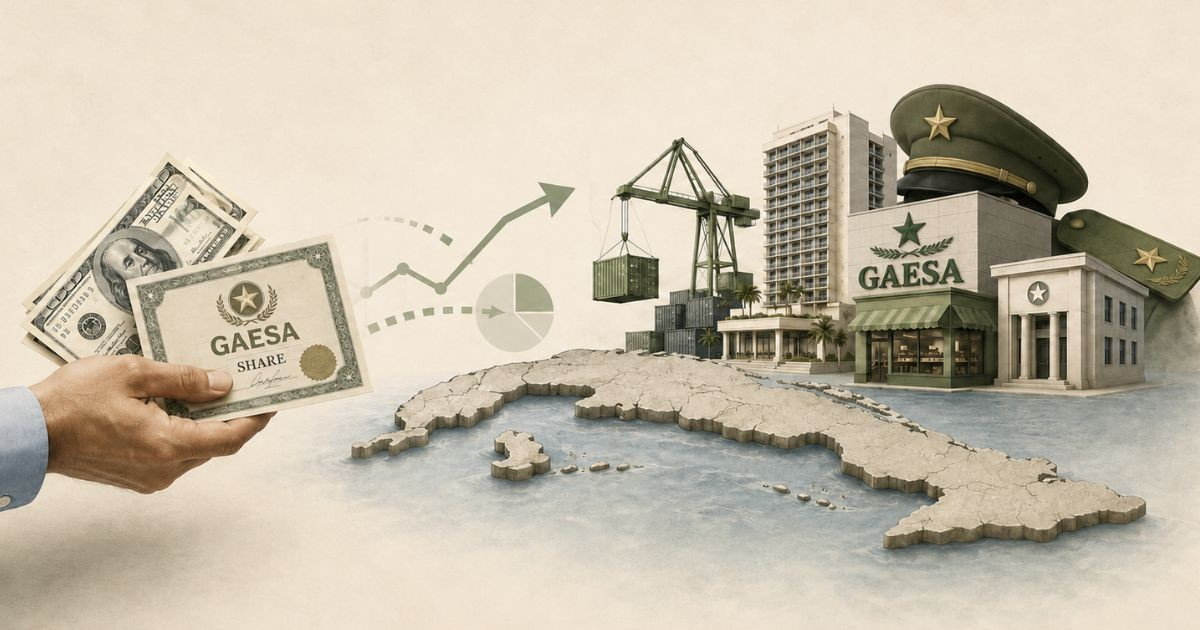
The Cuban regime announced this Thursday an unprecedented measure in the history of the dictatorship: to convert state-owned enterprises into joint-stock companies and allow Cuban residents on the island, abroad, and foreigners to purchase shares in them, potentially including the military conglomerate GAESA.
The question that immediately arises among Cubans in exile is inevitable: Would it be worth investing in a system without independent legal guarantees?
But of course, it would be too good if the regime itself, through its most important spokesperson, the newspaper Granma, had not included this caveat: "For this process, it will be necessary to classify the companies."
So, in the future, it is to be expected that this company, the icing on the cake of the regime alongside others perhaps linked to sectors such as basic industry, media, etc., would be out of reach.
The regime also stated: "The State will define its equity participation in the sectors of the economy, ensuring its majority presence in the strategic ones."
Additionally, he clarified, "Non-state management forms and individuals will also be able to purchase shares, within the gradual framework that will be defined."
And another detail: "State-owned companies will be able to buy shares in other companies."
The Prime Minister Manuel Marrero Cruz presented the package at the Third Extraordinary Session of the National Assembly of People's Power, held this Thursday at the Palacio de Convenciones in Havana, with telematic participation from Raúl Castro and the physical presence of Miguel Díaz-Canel.
The presented document includes 176 transformation proposals grouped into 23 axes. In Axis 2, regarding property relations, Marrero Cruz announced that "the purchase of shares and properties of state-owned companies by state and non-state legal entities, both national and foreign, as well as individuals, will be permitted, provided that the lawful origin of the funds is demonstrated."
The regime affirmed that the State would ensure its majority participation in sectors deemed strategic, but the measure opens the door —for the first time— for any individual or legal entity to become a shareholder in companies that until now were exclusively state-owned.
Among these companies is potentially GAESA (although it is expected that this door will not be opened), the conglomerate of the Armed Forces that controls between 40% and 70% of the Cuban economy, with reported assets of nearly 17.9 billion dollars in 2024, and includes Gaviota (tourism), CIMEX (remittances and trade), TRD Caribe (stores in foreign currency), and Habaguanex (Old Havana).
GAESA operates without publishing financial statements or submitting to an audit by the National Assembly.
The regime also announced the creation of an Investment Program specifically aimed at encouraging the participation of Cuban residents abroad in Cuban companies, a new initiative that some analysts acknowledge but which generates deep skepticism.
The Cuban-American businessman Carlos Saladrigas, president of the Cuba Study Group, warned days before the session that privatizations could turn into "piñatas" if carried out with opacity, comparing the risk to the Russian privatization that "benefited a few."
Saladrigas acknowledged that the conditions would be the same for Cubans abroad and those residing on the island, but he insisted that there will be no serious investment without fundamental political changes, judicial independence, and effective protection of private property.
The measure comes at the worst economic moment for Cuba since the Special Period: industrial production in 2024 was the lowest in 40 years, housing construction fell below the levels of the 90s, and the GDP has experienced years of contraction.
Marrero Cruz acknowledged that "the failure to implement [the transformations] could lead to irreversible consequences for the political and social order."
The implementation of the package impacts more than 148 provisions of the Cuban legal system and will require the development of 32 new regulations of higher rank, including 10 laws, 14 decree-laws, and eight decrees, as reported by the regime itself to the National Assembly.
"The greatest risk is not transforming too much, but doing it halfway," asserted Deputy Carlos Miguel Pérez Reyes during the debate, a phrase that encapsulates the tension between the urgency of the crisis and the accumulated distrust from decades of broken promises.
Filed under: