
Related videos:
The victory of the far-right Abelardo de la Espriella in the second round of the presidential election in Colombia consolidates an unprecedented political realignment in Latin America: nearly all governments in the region are now within the orbit of Donald Trump, according to an analysis by CNN en Español published this Monday.
The preliminary count from the National Registrar awarded De la Espriella 49.65% of the votes compared to 48.70% for Iván Cepeda from the Historical Pact, with a difference of approximately 250,000 ballots. If the final tally confirms this result, Colombia will join a series of victories favorable to Trumpism: Nasry Asfura won in Honduras with explicit support from the White House, the pro-Washington establishment retained power in Costa Rica, and the far-right José Antonio Kast defeated the left in Chile.
The Secretary of State Marco Rubio congratulated De la Espriella over the phone hours after the polls closed and posted on X: "The Trump Administration looks forward to working closely with your upcoming administration to advance regional security cooperation, end illegal immigration to the United States, and strengthen our economic ties. The best days for Colombia are yet to come."
Trump's strategy in the region combines coercive pressure—tariff wars, immigration offensives, military deployments in the Caribbean—with direct bilateral incentives that have reconfigured the subcontinent's alliances.
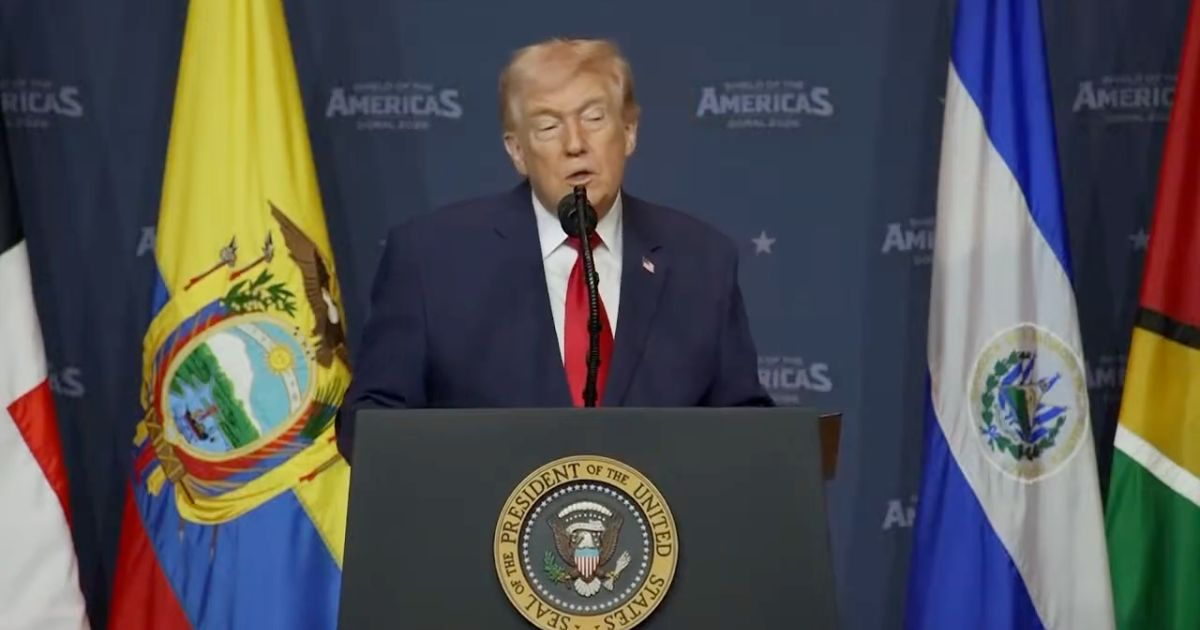
The most visible block of this architecture is the Shield of the Americas, whose first forum took place on March 7 in Miami with the participation of 12 countries: Argentina, Bolivia, Costa Rica, Ecuador, El Salvador, Honduras, Panama, Paraguay, the Dominican Republic, Trinidad and Tobago, Guyana, and the elected president of Chile.
Among Trump's most established allies are Javier Milei in Argentina, Nayib Bukele in El Salvador, and Daniel Noboa in Ecuador.
Milei, whom Trump called his "favorite president" and about whom he said, "I love him because he loves Trump, I love everyone who loves me," signed a Reciprocal Trade and Investment Agreement in 2026, a joint patrol agreement for the South Atlantic, and progressed in negotiations on lithium. Argentina supports Washington in every UN vote.
Bukele strengthened his role as a key partner in the migration agenda by accepting deportees at the Center for Terrorism Confinement (CECOT). Deportations from the United States to El Salvador doubled in the first months of 2026 compared to the same period the previous year.
Noboa, who visited Mar-a-Lago before the 2025 runoff, maintains joint operations against organized crime with U.S. technological and intelligence assistance.
Analyst Mónica Hirst, who holds a Ph.D. in Strategic Studies from the State University of Rio de Janeiro, warns that this dynamic does not reflect a defined strategy: "MAGA operates on impulses," she explained to CNN, adding that "each connection is unique, and each relationship is negotiated directly, without collective frameworks."
The message from Hegseth from Guantánamo on June 11—“We are reclaiming our hemisphere”—summarizes the doctrine that Washington projects over the region, against a backdrop of rising tensions with Cuba, Venezuela, and Nicaragua.
The major question of the electoral cycle is Brazil, where Lula da Silva is seeking re-election against Flavio Bolsonaro, who is backed by the White House. A May 2026 poll placed them at 42% and 41% respectively. If the Workers' Party loses in October, Claudia Sheinbaum in Mexico would be left virtually without ideological allies throughout the region.
Filed under: