
Related videos:
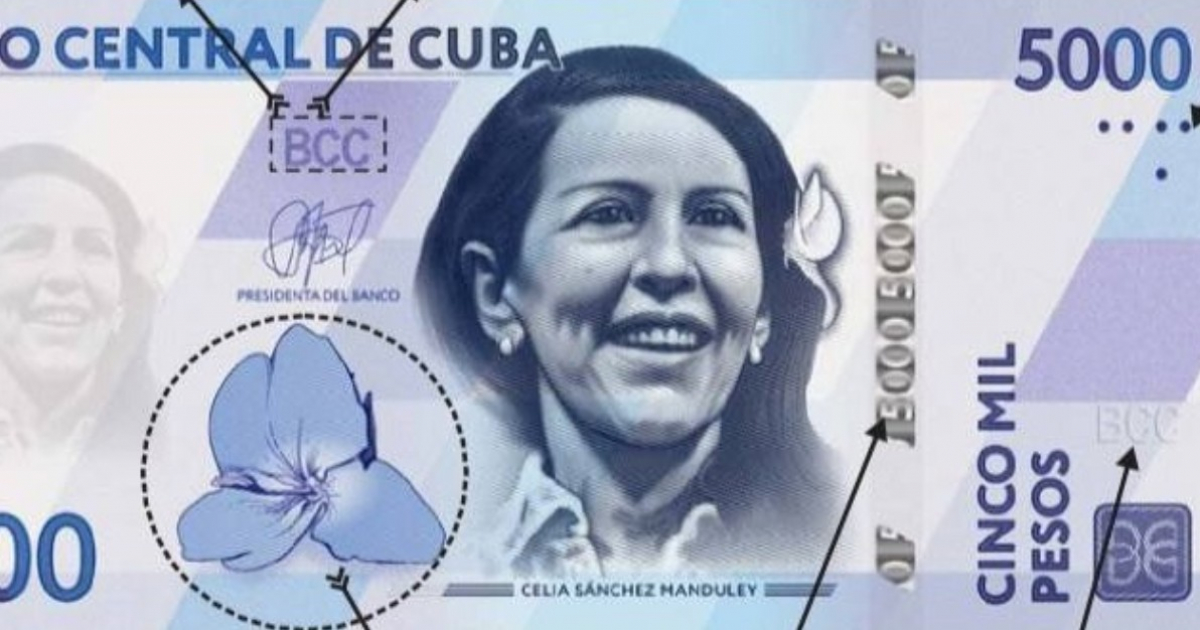
Three months after the Central Bank of Cuba (BCC) issued the 5,000 Cuban pesos (CUP) banknotes, the highest denomination in the country's monetary history, many Cubans have still not had the chance to hold them, according to a report by elToque published this Monday.
The BCC launched the new banknotes on April 1, 2026, amidst rising inflation and a banking system facing serious deficiencies. The measure aimed to ease the handling of large volumes of cash and respond to the sustained increase in prices.
However, the distribution has been so limited that for most Cubans, these bills are almost an abstraction.
"I've only seen them in photos," summarizes Alicia, an educator from the Diez de Octubre municipality in Havana.
His testimony reflects a widespread experience: the bills exist, but they don't circulate in all pockets.
Those who manage to get one tend to either part with it immediately or, on the contrary, keep it with great care. Roberto, a bricklayer from Havana, chose the former: “I let it go right away. I don’t know why I was afraid to have a bill like that. It's a lot of money,” he confessed.
The fear of theft, loss, or forgery explains that reaction.
At the other end are those who reserve them for specific operations in the informal market. Dennis, an artist from Centro Habana, acknowledges that these bills are "rarely seen," but when he gets one, he prefers to keep it. "To buy dollars," he explains.
A businessman who requested to remain anonymous adds that "the amount of money that needs to be paid is so high that large bills expedite purchases on the black market," referring to the acquisition of gasoline outside official channels.
The gap between the nominal value of the bill and the actual income of Cubans is striking.
The minimum wage remained at 2,100 CUP for years, and although the National Assembly raised it to 3,210 CUP on June 18 —effective from July with actual payments starting in August—, this new minimum is still less than the value of a single one of the new bills.
The dollar on the informal market reached 695 CUP on Sunday, and the euro hit 800 CUP, both at record levels.
The situation also creates problems at the opposite end of the monetary scale.
Mabel, a young woman from Mayabeque, reports that some cafeterias no longer accept five, ten, twenty, or fifty peso bills. "What am I supposed to do? They don't accept transfers either," she laments.
The economist Pavel Vidal, who holds a doctorate in Economic Sciences and is a former analyst at the BCC, describes the issuance as a "necessary and overdue" measure. "When a country accumulates years of high inflation, the existing denominations are no longer sufficient," he explains.
Vidal dismisses the idea that the new notes will worsen inflation—"it's not the solution to the inflationary problem, but it doesn't exacerbate it either"—and points out that the delay in implementing them may have been due to the "misguided notion that by restricting the amount of notes, inflation could be curbed."
The new banknotes also mark a milestone: for the first time, Cuban currency features female faces.
The 2,000 CUP note features the portrait of Mariana Grajales, and the 5,000 note features Celia Sánchez.
On the street, however, some people label them as "weird" or say that they "look like euros," a perception that keeps them distant from everyday experience.
“If they are not printed in sufficient quantities, those positive effects will not be achieved or will be marginal,” warns Vidal, summarizing in one sentence the risk of the measure remaining just on paper—literally.
Filed under: