
Related videos:
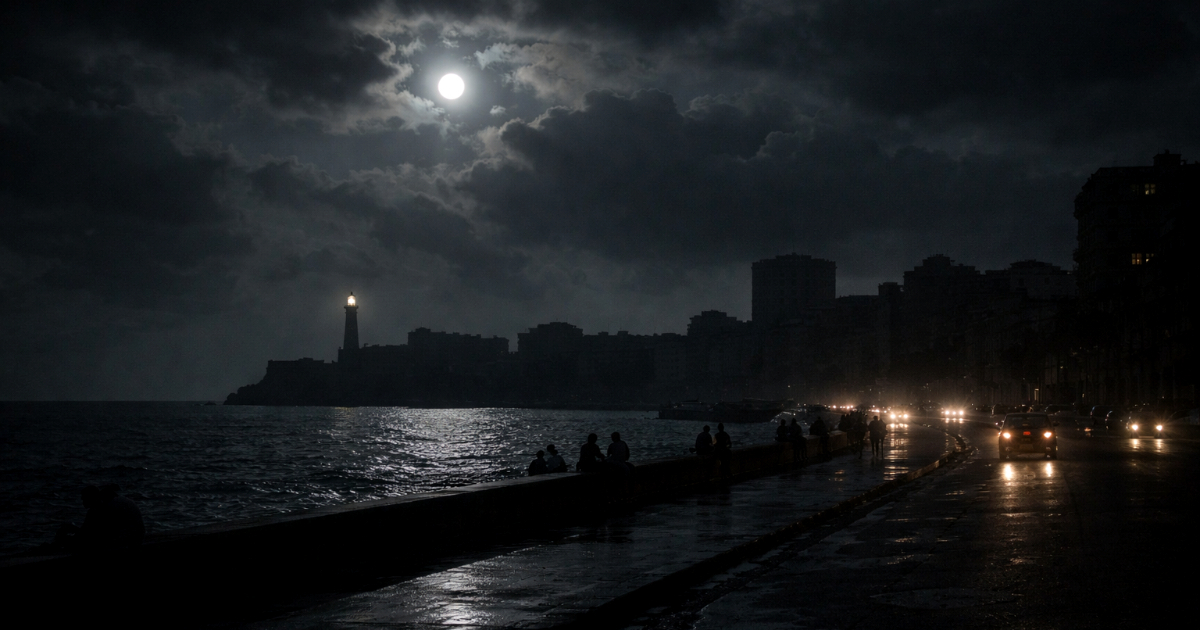
Cuba is facing another night of widespread blackouts this Tuesday. The Electric Union published its informative note with a forecast that anticipates a power loss of 2,075 MW during peak nighttime hours, which means that up to 64% of the country could be without electricity simultaneously.
At 6:00 AM on this Tuesday, the availability of the National Electric System was only 1,180 MW against a demand of 2,780 MW, with 1,600 MW already affected at that time. For the evening peak, the state agency estimates an availability of 1,215 MW against a demand of 3,250 MW, resulting in a deficit of 2,035 MW.
According to the state-owned company, the only improvement planned for the nighttime schedule is the arrival of unit 8 of the CTE Mariel with just 35 MW, a figure that is insignificant considering the magnitude of the collapse.
The causes of the collapse are multiple. In thermal generation, units 6 and 8 of the Máximo Gómez power plant, unit 4 of the Carlos Manuel de Céspedes power plant, and unit 2 of the Lidio Ramón Pérez power plant are out of service, with a total of 410 MW offline.
This is in addition to several units under maintenance at the Ernesto Guevara De La Serna, Antonio Maceo, and Diez de Octubre power plants.
The most severe impact comes from the fuel shortage: 106 distributed generation plants remain idle due to a lack of fuel, representing 890 MW. The Patana de Regla, the Patana de Melones, the Central Fuel de Mariel, and the Central Fuel de Moa are also out of service. The total number of megawatts unavailable for this reason amounts to 1,203 MW.
On Monday, the maximum impact reached 2,037 MW at 8:30 PM, exceeding even what the organization had predicted due to higher-than-expected demand.
This situation arises just one day after the CTE Antonio Guiteras returned to the national electric grid, following its umpteenth breakdown of the year. The plant in Matanzas has experienced at least 16 outages from January to mid-June 2026, and its boiler has been in operation for over 38 years without any major maintenance since 2010.
The 54 photovoltaic solar parks installed in the country generated 4,579 MWh on Monday, with a maximum power output of 631 MW at noon; however, this energy does not address the nighttime deficit due to the lack of storage systems.
The crisis in June is part of the worst energy cycle in recent Cuban history. The historic record of deficit was recorded on May 13 and 14, 2026, when it reached between 2,153 and 2,174 MW and 70% of the country was left without electricity.
Blackouts have sparked pot-banging and protests in neighborhoods of Havana such as Carlos III, Regla, Santos Suárez, and Marianao, as well as in Santiago de Cuba, with at least 14 people detained since June 6.
The First Deputy Minister of Energy and Mines, Argelio Jesús Abad Vigoa, acknowledged in March 2026 that “we have exhausted the possibility of producing electricity with distributed generation,” a statement that encapsulates the severity of the structural collapse affecting the Cuban electrical system.
Filed under: