
Related videos:
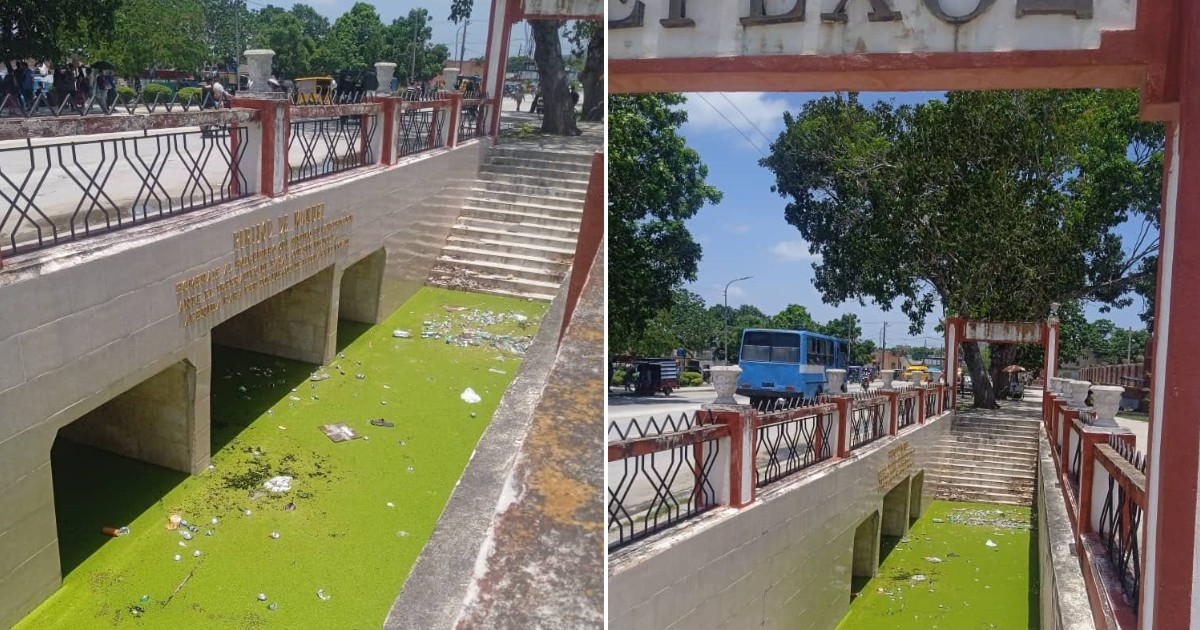
A post from the Holguín Memories page on Facebook, titled "Total Abandonment," brought back the story and deterioration of Manuel's Pirijod, the most iconic underground pedestrian passage in Holguín, which now lies flooded, covered in green algae, and turned into an open-air dump.
Built in the late 1970s under the Avenida de los Libertadores, the underpass gets its name from the Russian word "Переход" (Perekhod), which means pedestrian crossing, phonetically adapted by the people of Holguín as "Pirijod." Popular history attributes its initiation to a neighbor named Manuel, who promoted the idea to facilitate crossing the avenue to the area of the stadium, and over time, the location became popularly known by his name.
For years, it was a functional and busy establishment, featuring a café inside—remembered by many as "Doña Yuya"—and a small shop. Those who studied at Fajardo Hospital or the Pedagogical Institute used it daily to cross the avenue.
However, the underlying problem has existed since the beginning. "The drainage system of that tunnel has been inadequate since it was inaugurated; I remember in the '80s when I would go to the stadium with my father, it always had stagnant water," wrote one commentator. Another noted that the water comes from the groundwater and that "it could have been resolved by sealing it, but for the government, it's easier for it to become an infectious focus."
Today, the interior of the underpass is completely unusable: stagnant water covered with algae, bottles, cans, and accumulated solid waste. Residents describe it as a breeding ground for mosquitoes, an improvised public restroom, and an epidemic hotspot, in a city that is already facing outbreaks of dengue and chikungunya associated with stagnant water.
The post triggered a wave of reactions that mix nostalgia, indignation, and dark humor. "I remember when I was a child, I would pass by there and there was a café that sold bottled soda and other things, it was very clean back then, over forty years ago, what a shame," wrote one user. Another pointed out the institutional contradiction: "How easily Hygiene and Epidemiology can reach any Holguin resident's home and quickly fine us if our yard is somewhat dirty, and now I wonder who will be fined for this filth, who will be the responsible party, because that's part of the State, not the people."
Several commentators emphasized that the deterioration is not recent. "It's been like this for 15 years or more," wrote one. Another was more succinct: "We have reached a point of no return. Cuba belongs to no one. And the people can no longer endure. They are overwhelmed, sinking into filth, neglect, and indifference."
The Pirijod of Manuel is not an isolated case. Holguín, once known as "the cleanest city in Cuba," has accumulated abandoned infrastructures that continue to multiply: the Deportivo Ateneo, the Ismaelillo Theater, sculptures from the pedestrian boulevard, and the Holguín-Gibara train station. The Company of Municipal Services acknowledged in May 2026 deficits in trucks, fuel, and personnel as causes of urban collapse.
The sign in Cyrillic «ПЕРЕХОД», painted in red and white over the entrance arch, remains preserved. The Russian term and the design of the work evoke the perekhod or massive underground passages that are part of the urban landscape of Moscow and other cities of the former Soviet Union.
Beyond the nostalgia it evokes among generations of people from Holguín, the current state of Manuel's Pirijod has become, for many, a metaphor for the deterioration that Cuba is experiencing. What was once a useful and unique structure now stands flooded, abandoned, and with no prospects for recovery, reflecting the accumulated wear and tear of infrastructure, public services, and urban spaces in much of the country.
Filed under: