
Related videos:
The United States Coast Guard (USCG) repatriated 27 Cuban rafters this Monday, after rescuing them in the Yucatán Channel, where their vessel was on the verge of sinking, the agency confirmed in an official statement.
Even though the journeys of Cuban rafters have decreased to a minimum in the last year and a half, last Thursday, the crew of the Coast Guard vessel Raymond Evans detected a boat without lights in the canal area and alerted the operators of the Key West Sector.
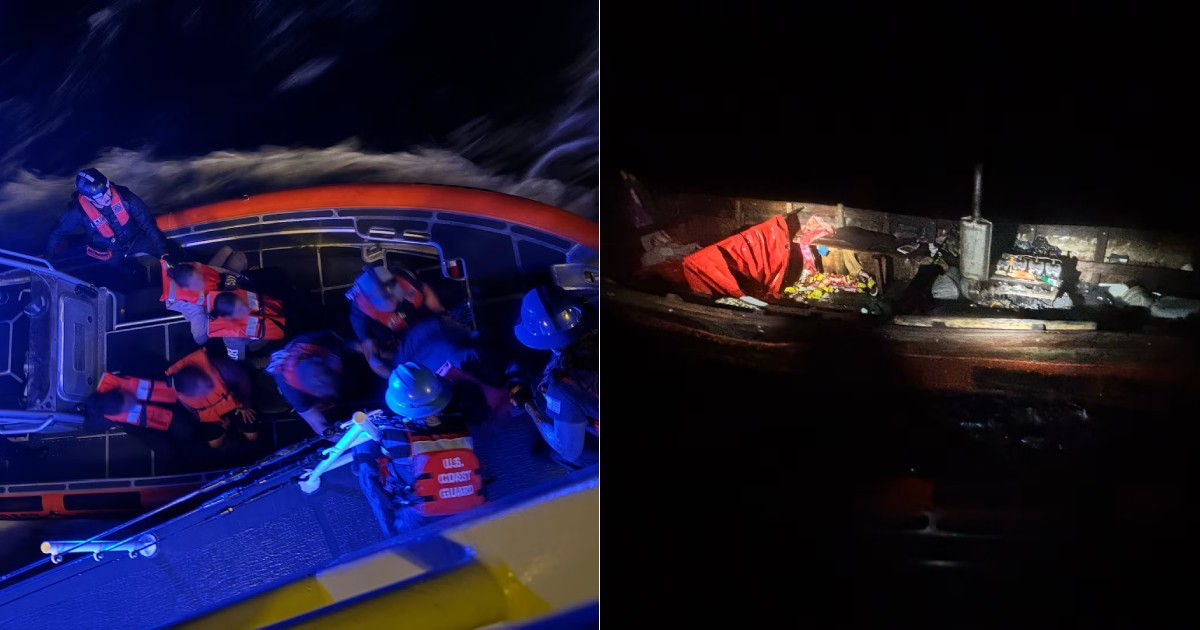
According to the report from the USCG Southeast District, the vessel dispatched a small boat to investigate the craft, and upon arrival at the scene, the coastguards confirmed that it was taking on water, had no fuel or drinking water onboard, and was in imminent danger of sinking.
The 27 Cuban migrants were first transferred to the vessel Raymond Evans for their "processing and final disposition," and then to the Coast Guard ship Winslow Griesser for their repatriation.
The official statement emphasized that, once aboard a coast guard vessel, "foreigners are subjected to an identification process to determine their identity and are provided with food, water, accommodation, and basic medical care."
The commander lieutenant Luis García, liaison officer of the Coast Guard with Cuba, warned that "trying to migrate illegally by sea in overloaded and inadequate vessels is extremely dangerous and puts lives at unnecessary risk."
García added that "the Coast Guard and its federal, state, and local partners maintain a constant presence in the maritime approaches to the United States to detect, deter, and prevent illegal maritime migration."
The images released by the USCG Southeast show a night operation featuring a fast response boat and the intercepted wooden vessel, which shows visible deterioration, with clothes and belongings scattered inside.
This operation is part of the Vigilant Sentry Operation, the federal program of the Homeland Security Task Force–Southeast (HSTF-SE), which combines air, land, and maritime assets to curb irregular migration to the United States.
This Thursday, the Immigration and Customs Enforcement (ICE) deported another 96 Cubans on a flight to Havana, raising the total number of people returned to the island to 740 in the first half of 2026, distributed across 25 operations from various countries, according to figures from the Ministry of the Interior (Minint) of Cuba.
During the second term of President Donald Trump, the rate of deportations of Cubans has surged: in just 18 months, there were completed 18 direct flights to Havana, with 2,164 people, more than double the 978 repatriated during the entire presidency of Joe Biden, on 21 flights between April 2023 and December 2024.
The arrests of Cuban migrants by ICE rose by 463% between late 2024 and early 2026, a figure that reflects the intensification of immigration pressure on the Cuban community.
The Yucatán Channel, which separates the Mexican peninsula from Cuba, is one of the most frequently used maritime routes by those attempting to reach U.S. territory in precarious vessels, exposing themselves to shipwrecks, dehydration, and other dangers at sea.
According to data from the U.S. Department of Homeland Security and the Ministry of the Interior of Cuba compiled by the digital site Café Fuerte, since the resumption of deportation flights in April 2023, a total of 3,142 Cuban migrants have been returned in 39 air operations. Trump is the president who has deported the most Cubans in the history of the United States, with 5,549.
Filed under: