
Related videos:
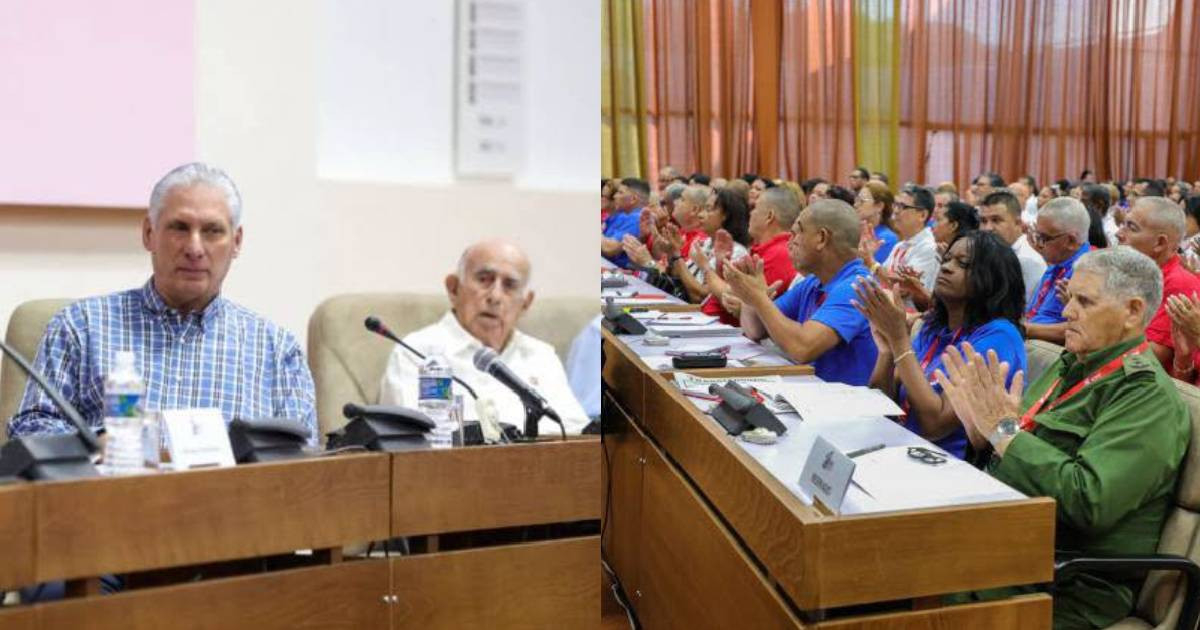
The ruler Miguel Díaz-Canel appeared this Friday at the afternoon session of the XXII Congress of the Central de Trabajadores de Cuba (CTC), held at the Palace of Conventions in Havana, in an attempt by the regime to project importance to the official labor organization amidst an unprecedented economic crisis.
Alongside the president were Roberto Morales Ojeda, a member of the Political Bureau of the Communist Party of Cuba (PCC); Vice President Salvador Valdés Mesa; as well as former Second Secretary of the PCC José Ramón Machado Ventura, among other party and government officials, reported the Cuban News Agency.
The event, which brings together 759 delegates—561 of whom are connected via videoconference from the provinces and the rest attending in person—takes place under the theme "For Cuba, together we create" and in a hybrid format imposed by the ongoing energy and economic crisis the island is facing.
The Vice Prime Minister Oscar Pérez Oliva-Fraga presented to the delegates the 176 economic and social transformations recently approved by the National Assembly of People's Power, while the Minister of Labor and Social Security, Jesús Otamendiz Campos, explained the amendments to the Labor Code.
"Without implementing economic and social transformations, we will not achieve the objectives set out in the Government Program," stated Pérez Oliva-Fraga during his speech, highlighted in a detailed report by the official newspaper Granma.
The main report of the congress, presented by Osnay Miguel Colina Rodríguez, president of the organizing committee, provided a critical assessment of the last six years of the labor movement and outlined priorities for the upcoming period.
Colina detailed that the process leading up to the congress included 74,167 meetings of labor collectives with participation from 92.2% of the members, resulting in 42,430 suggestions and proposals, according to the source.
The congress also served as a platform to present the commemorative stamp for the 85th anniversary of the CTC "to Cuban combatants who confronted U.S. forces during the kidnapping of Venezuelan president Nicolás Maduro", a political propaganda act that has little to do with the actual issues facing Cuban workers.
The backdrop of the event contrasts with the official rhetoric: the minimum wage has been raised to 3,210 pesos, an increase of 53%, but independent economists estimate that a person needs at least 96,000 pesos per month to meet basic needs, thirty times more than that minimum.
A few days ago, the state newspaper Invasor acknowledged that salary is "the main source of discontent" among workers, an admission that reveals the gap between the union congress and the daily reality of Cubans.
The very usefulness of the CTC has been publicly questioned. Citizen Elizabeth González Aznar recently published an open letter questioning the cost of maintaining the CTC and other mass organizations linked to the PCC.
"They are organizations that do not contribute anything financially, but do consume a significant amount of the State's budget and resources," he emphasized.
The new Labor Code, whose public consultation involved more than two million workers between September and November 2025, does not recognize the right to strike or allow independent unions, thus maintaining the monopoly of labor representation in the hands of the CTC, an organization that has operated as a compliant arm of the PCC since 1961 without any real independence.
Filed under: