
Related videos:
While thousands of Camagüey residents are enduring over 20 hours a day without electricity and facing water shortages, the Cuban regime carried out military exercises in the province on Friday to simulate a response to an enemy air attack, as part of the National Defense Day.
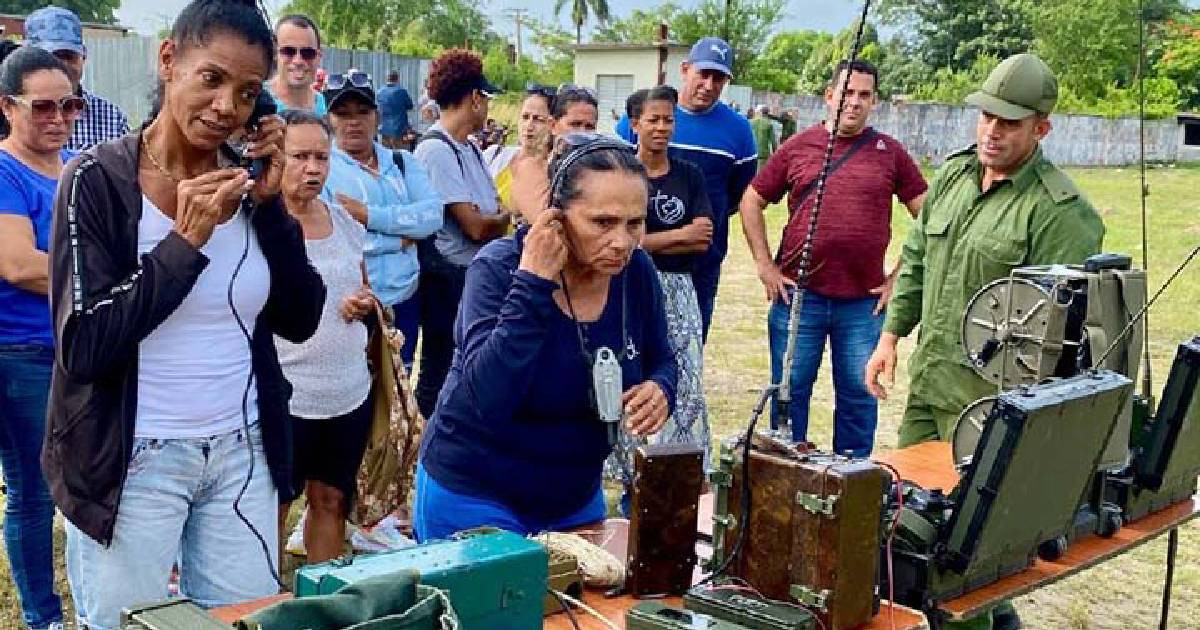
The event took place in the defense zone 17 Agramonte-Simoni, where members of the Territorial Troops Militias and the Production and Defense Brigades practiced assembling and disassembling rifles, handling explosives, and conducting a population evacuation exercise in the event of a hypothetical bombing, the report specified from the Cuban News Agency.
Guillermo Moya Barreto, president of that defense zone, explained that the actions aimed to "ensure the transition to a state of war, confront the first and second phases of unconventional warfare, and combat the enemy's invasion."
The authorities of the Provincial Defense Council also activated a water supply point, a first aid medical post, and a household goods repair workshop, structures that the regime presents as part of combat preparation but which highlight the daily shortages faced by the population, the source specified.
The National Defense Day exercises took place on Friday simultaneously in the provinces of Villa Clara, Sancti Spíritus, Camagüey, Matanzas, and Cienfuegos.
The Canal Caribe of the official television justified the mobilization by stating that "the threat of an attack by the enemy on our country makes the call to prepare an obligatory task."
The contrast between military rhetoric and the provincial reality is hard to ignore. Camagüey experiences blackouts exceeding 20 hours daily, with the municipality of Minas reaching an historical average of 21.3 hours without electricity.
On June 3rd, a malfunction at the Cuban-Bulgarian pumping station left the city without water for approximately five days.
On June 20, the provincial capital government turned to defense zones to distribute charcoal at an official price of 70 pesos per kilogram, compared to the 3,500 to 5,000 pesos it reaches in the informal market, with only 1,700 sacks available for the entire city.
Since January, the regime intensified its militaristic rhetoric by declaring that year as the Year of Preparation for Defense and instituting weekly exercises under the doctrine of Total People's War.
The rhetorical escalation, however, clashes with the reality of a very weakened armed force. According to an analysis by the American broadcaster CNN published on June 24, active personnel dropped from 235,000 to a maximum of 50,000 soldiers, equipped with obsolete Soviet gear and MiG fighters that are practically inoperable due to a lack of fuel and spare parts.
In Morón, Ciego de Ávila province, the regime also deployed black berets with long guns during the exercises this Saturday, three months after the protests on March 13 in that same city, where a 16-year-old boy was shot.
The Cuban Observatory of Conflicts recorded 1,311 protests across Cuba in May, with blackouts as the main cause, while the Economic Commission for Latin America and the Caribbean (ECLAC) projects a 6.5% decline in Cuba's GDP for this year.
Filed under: