
Related videos:
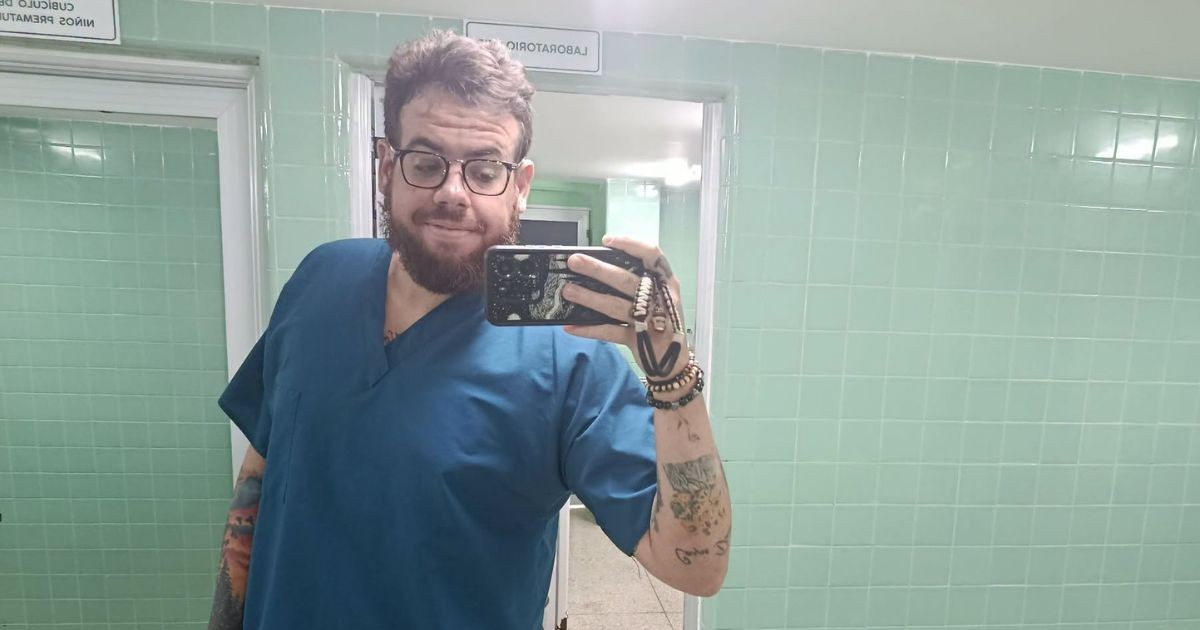
A doctor from the pediatric hospital in Las Tunas posted on Facebook a reflection that summarizes the paradox of practicing medicine in Cuba: doing it out of pure vocation, amidst a system that drives medical professionals to leave their white coats for the private sector.
Daniel Del Toro González responded on his Facebook profile to a question he was asked four times in a month: "Why do you still work, if it's clear you don't have much need to do so and you also complain?"
Her response was not just a single line, but a text that speaks for an entire generation of Cuban doctors who remain in the state system despite everything.
“We work because we enjoy it. Because it is our calling, beyond the economic problems and the reality of the country,” wrote Del Toro González, and in doing so, he inadvertently crafted a brief treatise on the ethics of healthcare professionals.
The doctor recalled the weight of six years of medical school—early mornings with Nelson and Guyton, learning to distinguish heart murmurs—as a compelling reason not to give up: "Those six years cost too much to forget."
He also mentioned those who did not have that option: "There are thousands of doctors around the world who had to give up their dream of wearing a white coat to seek a better future, far away... very far away."
The most striking part of the text directly addresses the economic pressure faced by the sector: "In a country that often seems to push us to leave Medicine for a small or medium-sized enterprise, we continue to count the respiratory rate of a child with laryngeal stridor at three in the morning."
Regarding the complaints, Del Toro González was clear: "Do we complain? Of course. Like someone who has not slept for hours, who works with what they have and not with what they need. Complaining does not mean you stop loving what you do."
And he closed with a direct phrase: "We work because we feel like it, ma'am."
The testimony comes at a critical moment for public health in Cuba.
Cuba lost more than 30,000 doctors between 2021 and 2024, decreasing from 106,131 registered physicians to 75,364, according to data from the National Office of Statistics and Information. The most significant decline occurred between 2022 and 2023, when the country lost 13,303 doctors in just one year.
Salaries partially explain the exodus: a newly graduated doctor earns around 4,610 pesos per month, equivalent to less than 16 dollars. Those who transition to private small and medium-sized enterprises can earn up to seven times more than in the state sector, according to a study involving 70 interviewed professionals.
The case of Del Toro González is not isolated. In June, a Cuban doctor with a specialty and academic credentials revealed that her salary was not enough to feed her child.
In November 2024, doctor Yoelvis Estanquero Oliva decided to no longer practice his profession due to the degrading situation in the sector.
The Minister of Public Health himself, José Ángel Portal Miranda, acknowledged in July 2025 a "unprecedented structural crisis," while the regime kept over 24,000 health workers providing services in about 56 countries, under conditions that international organizations have classified as forced labor.
Meanwhile, doctors like Del Toro González continue to work night shifts, with what they have rather than what they need.
Filed under: