
Related videos:
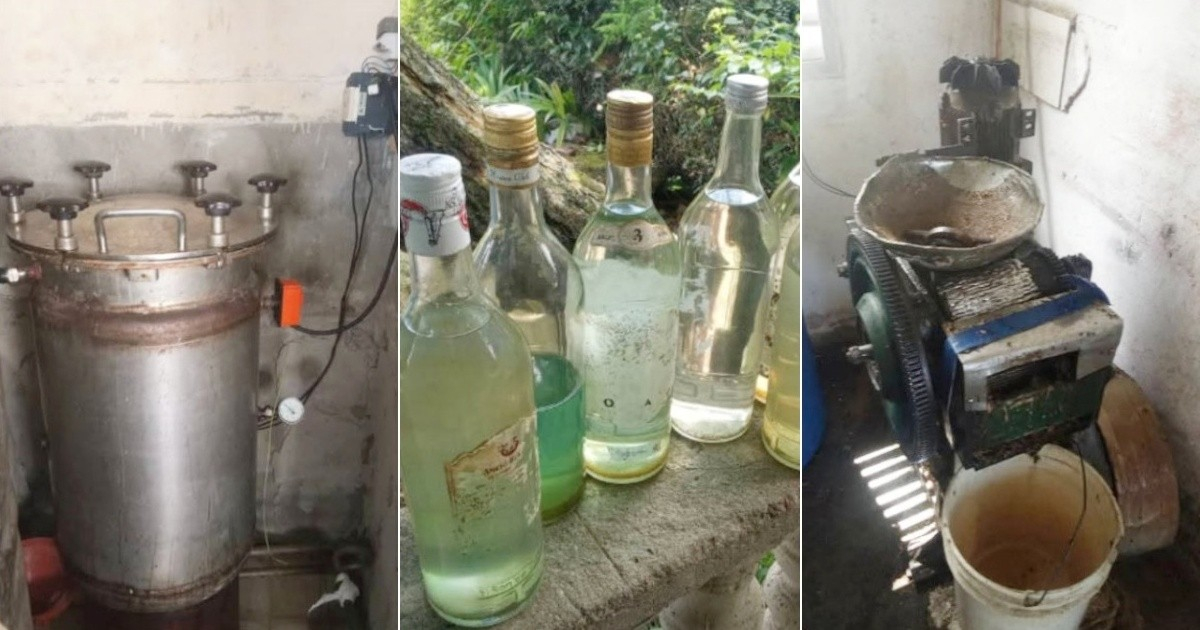
The police of Santa Clara dismantled a clandestine homemade rum factory set up in a private residence, as published by the official Facebook profile "Fuerza del Pueblo".
During the operation, the authorities confiscated all illegal production and imposed an administrative fine on those responsible.
The regime presented the action as a police achievement and took the opportunity to remind that "the production and sale of alcoholic beverages without authorization constitutes an infringement and can lead to legal penalties."
However, the publication sparked a wave of comments reflecting deep public discontent with the selectivity of these operations.
The citizens' reaction: "taking the easy route instead of confronting real problems"
The MININT's publication in "Fuerza del Pueblo" generated a massive and critical response on social media. The comments reveal a widespread perception of double standards: strictness for the ordinary citizen, impunity for those in power.
"And when is the operation at the house of the leaders who are stealing more every day?" asked one user. Another was more direct: "That's all they do: take advantage of those who are struggling, while the real thieves go unpunished."
Several commentators questioned the priority of the operations in light of more serious issues: "With so many thieves on the streets, why aren't they being caught?" and "When will the drug operations take place?" were two of the most frequently asked questions.
One of the comments summarized the general sentiment with a phrase: “That's taking the easy route instead of facing real problems.”
Others opted for irony or resignation: "They should be given a patent and keep producing," wrote one user, while another stated: "In a free country, they would have their own company."
The economic prediction also emerged among the comments: "Now the price of spark will go up; everything is bad."
Most of the reactions convey frustration and institutional distrust. "What they do is fine and suppress; that's why we are this way," and "Everything here is illegal; that's why we are where we are," summarize a perception that, far from being marginal, dominates the public debate around these operations.
The operation and its legal framework
The seizure is part of the Fifth National Exercise for Crime Prevention and Confrontation, launched on May 18, 2026, by Miguel Díaz-Canel via videoconference with provincial authorities.
It is the fifth operation of this kind in less than two years, focusing on the control of food, fuel, prices, and informal economic activities.
In the context of the same operation, the Police of Placetas had already seized 25 gas cylinders intended for illegal economic activities.
The Decree-Law 91/2024, in effect since September 2024, has tightened penalties for informal activities, with fines of up to 72,000 pesos.
Since January 2025, state inspectors are compensated based on the number and amount of fines they impose, which has led to complaints of arbitrary penalties.
In the first quarter of 2025, over 425,000 fines were imposed across Cuba, exceeding one million pesos in revenue. Just in the third week of February 2026, 17,000 fines were recorded for 65 million pesos nationwide.
The crisis that fuels clandestine production
The proliferation of informal alcohol factories is not coincidental. The state-owned rum industry is facing a severe crisis: liquor production dropped by 41% in 2025 compared to 2024, and the scarcity of sugar and raw materials threatens the continuity of iconic brands.
In that context of widespread scarcity, the artisanal production of aguardiente—commonly known as "chispa e' tren"—has spread as an alternative means of survival and informal income.
The authorities cite health reasons to justify these operations: in 2013, the ingestion of illegal methyl alcohol caused 11 deaths and 46 cases of poisoning in Havana.
However, for many Cubans, that argument is not enough to explain why repression systematically falls upon those who are trying to survive.
Filed under: