
Related videos:
While Cuba continues to face blackouts of up to 20 hours a day and generation deficits exceeding 2,000 MW, the Electric Union (UNE) announced on Wednesday the launch of the country's first battery energy storage system (BESS), a 50 MW facility located in the Havana municipality of El Cotorro, which, according to officials, is already yielding satisfactory results during its testing phase.
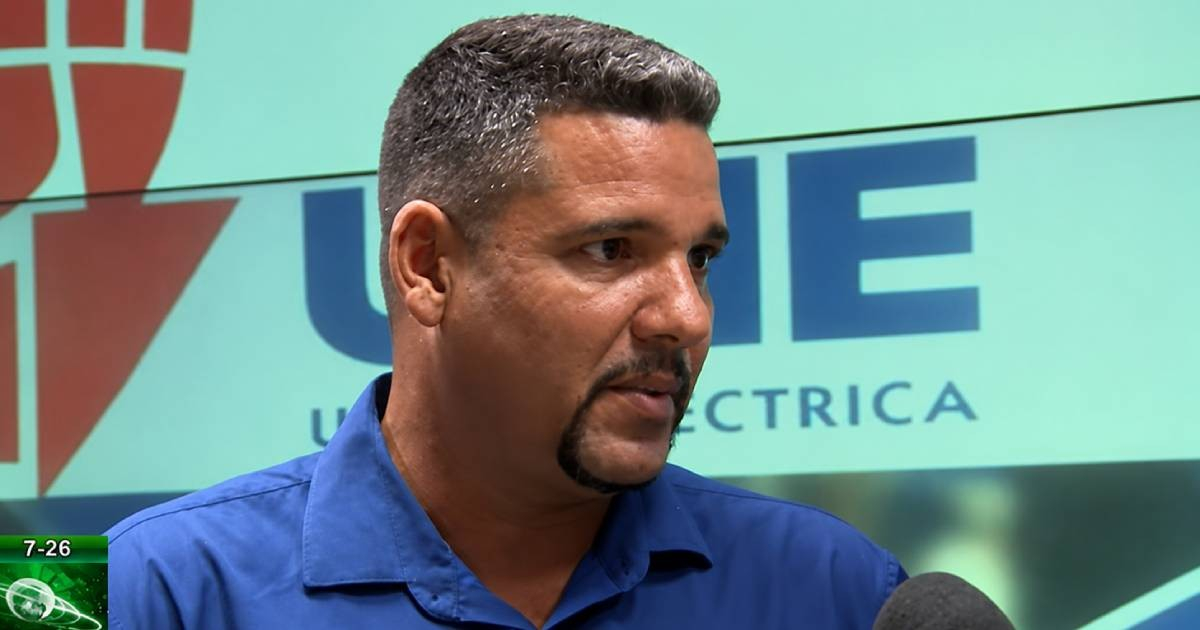
Engineer Ismael Ulloa Rodríguez, deputy director of the Electric Industry Construction Company (ECIE), reported from the National Load Dispatch that the system is undergoing all the planned technical tests and assured that its performance has been favorable.
According to his explanation, the main contribution of the BESS has been to stabilize the frequency of the National Electroenergetic System (SEN) during recent outages, preventing the activation of the so-called frequency automatic triggers (DAF), a protection mechanism that disconnects circuits when the network frequency falls below safety levels, which has caused numerous blackouts in recent years.
"This week there have been several outages, both the departure of Guiteras and failures in the lines, and he has been able to supply or consume energy, with his capacity of 50 MW, and has maintained the established frequency ranges. There have been no trips due to DAF nor any system drops," Ulloa stated in remarks reported by Canal Caribe.
The official added that during the trial days, automatic gunfire had "considerably decreased" in frequency, one of the issues that has most affected the stability of the Cuban electrical system.
The authorities also argue that the new system will allow for better utilization of photovoltaic generation. By storing surplus electricity and releasing it when the grid requires, the BESS would reduce the restrictions that currently limit the production of solar farms.
"Gradually, all the limitations currently placed on solar parks will be lifted, allowing us to fully harness this energy," Ulloa assured.
The system operates continuously, absorbing or delivering energy based on the needs of the SEN, which means it can also support the integration of other renewable sources, such as wind and hydropower.
However, the operational launch of the first BESS barely represents a small fraction of the needs of the national electrical system.
This Wednesday, the general director of Electricity at the Ministry of Energy and Mines, Lázaro Guerra Hernández, reported that at 7:30 AM the generation deficit reached 1,716 MW. For the evening peak hours, UNE forecasted an impact of up to 2,130 MW, with a mere availability of 1,100 MW compared to an estimated demand of 3,200 MW.
The night before, the maximum outage reached 2,211 MW following the unexpected shutdown of unit 3 at the Sancti Spíritus power plant, highlighting the fragility with which the system continues to operate.
Similarly, the announcement sparked an intense reaction on the Unión Eléctrica's post on social media. While some users congratulated the workers involved and called for the acceleration of the installation of the other three planned systems, the majority expressed skepticism about the actual impact that the new technology may have on the prolonged blackouts they endure daily.
"Let's see how this helps because I don't see the light," wrote an internet user. Another summarized their disbelief with a succinct: "We'll see." Several users questioned whether the system could alleviate the current crisis. "What's the point of that if the blackouts are the same?" asked one person, while another joked: "Storing what doesn't exist."
Many comments took the announcement as an opportunity to denounce the duration of power outages in various provinces. "In Guanabo, we've been without power for 22 hours," wrote one user. Another claimed that in Cárdenas they had accumulated "68 hours without power," while a resident of Nuevo Vedado stated that her circuit had been "without electricity for 25 hours." There were also those who summed up the feeling of frustration with a phrase: "This is not going to calm the public's anger, as they need to see results now, because this is not living."
Although criticism dominated the conversation, some users believed that any technological advancement is positive. "All effort is valid. We need to strive for more," commented one internet user, while another urged prioritizing the installation of the remaining batteries planned for the country.
The site at El Cotorro began construction in August 2025 with Chinese technology and expertise. In May of this year, it reached 93% completion and was visited by Miguel Díaz-Canel during a tour of various energy sector projects.
The government plans to install four storage systems of this type: two in Havana, one in Cueto (Holguín), and another in Bayamo (Granma), each with a capacity of 50 MW, for a total of 200 MW.
According to Ulloa, these four sites will support the expansion of solar parks and harness a greater proportion of electricity generated from renewable sources.
Nevertheless, even with the four systems in operation, the combined storage capacity would amount to less than 10% of the generation deficit that the island currently faces during peak demand hours, so their implementation is unlikely to provide immediate relief from the prolonged blackouts that continue to affect millions of Cubans.
Filed under: