
Related videos:
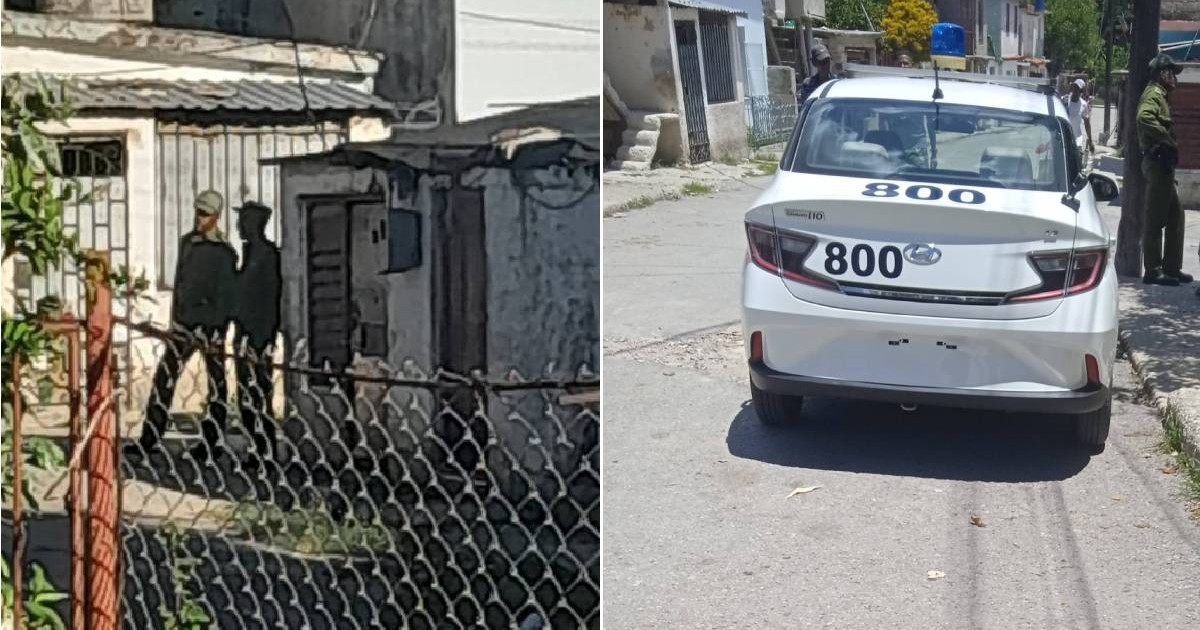
Luis Wilber Aguilar Bravo, father of the political prisoner Walnier Luis Aguilar Rivera, reported this Thursday that two State Security agents were stationed in front of his house, preventing him from going outside. He made the report through his Facebook account, accompanied by a photograph of a white patrol car — a Hyundai Grand i10 identified with the number 800 and blue flashing lights — parked in front of his door.
"THIS IS HOW I WOKE UP 2 AGENTS AT MY DOOR TODAY YOU CANNOT LEAVE THIS IS HOW WE LIVE THOSE OF US WHO DEMAND FREEDOM AND A DIGNIFIED LIFE," wrote Wilber Aguilar Bravo in his post, which concluded with a direct appeal: "FREEDOM FOR MY SON WALNIER."
This is not an isolated incident. The Cuban Observatory of Human Rights (OCDH) has documented at least six repressive acts against this single father during 2026, including a summons for interrogation on March 19 —along with his wife Rosario Rivera Román and his other son Wagner— and a new summons from State Security on June 13.
In January 2026, Wilber Aguilar Bravo had already reported that agents were preventing him from leaving his house to find food for his son in prison.
The OCDH has stated that "in Cuba, repression is not limited to those who remain in prison for political reasons," referring to the systematic pattern of harassment experienced by the families of the 11J detainees.
Walnier Luis Aguilar Rivera was sentenced to 23 years in prison for his involvement in the protests on July 11, 2021, when he was 21 years old.
His father has repeatedly reported that the court ignored the young man's intellectual disability, diagnosed as mental retardation due to a brain injury.
"His son has an intellectual disability resulting from an injury, and this condition was not taken into account during the trial," Wilber Aguilar Bravo has stated multiple times.
Since his sentencing, Walnier has been moved three times to prisons increasingly distant from his family: first to the Combinado del Este in Havana, then to Agüica prison in Matanzas in November 2025, and finally to the "Nieves Morejón" prison in Guayos, Sancti Spíritus, in January 2026, more than 300 kilometers from his home.
Human rights organizations have reported these forced relocations as a method of punishment to isolate the prisoner and break their family's resistance.
The Inter-American Commission on Human Rights (IACHR) granted precautionary measures to the family in 2025 due to the threats and reprisals suffered. The United States Embassy in Cuba also publicly denounced the abuses against Walnier in November 2025 and demanded his immediate release.
The case of Walnier is set against the backdrop of the massive repression unleashed following the 11J, the largest popular protests in Cuba in decades.
More than 700 people remain imprisoned for their participation in those protests, and the semestral report from Cubalex in March 2026 recorded 246 violations with 540 repressive incidents on the island, including cases against the families of political prisoners such as that of Wilber Aguilar Bravo.
Filed under: