
Related videos:
The Cuban priest Alberto Reyes Pías, pastor of the Esmeralda parish in Camagüey, published this Friday the 164th installment of his weekly column on Facebook, where he starkly outlines the realities that most concern him about the country: increasing youth illiteracy, child labor, the spread of drugs, unpaid wages, elderly people receiving barely two dollars after long waits at banks, and a street violence that goes unchecked.
The priest, one of the most prominent critical voices of the Cuban Catholic Church against the regime, opens his text by recalling that behind abstract categories like "the people" or "society" are real individuals whose time, once lost, cannot be regained.
Regarding education, his diagnosis is devastating: "For years, I have witnessed adolescents who read like beginner children, unable to maintain a fluent reading and incapable of interpreting what they can barely pronounce. But I am increasingly finding adolescents who literally do not know how to read."
This setback is attributed to the guidelines from the Ministry of Education that prohibit suspending any student, regardless of their knowledge, leading to artificial promotions from grade to grade without students acquiring basic skills.
This also adds to the widespread practice where teachers provide the answers to exams immediately after handing them out, as well as the decision made for the 2025-2026 academic year to eliminate final exams.
This diagnosis aligns with a documented educational crisis: the Ministry has moved up the school year closure to the period from June 15 to 30 due to the energy crisis, the school day has been reduced by half since February, and the system has a deficit of about 26,000 teachers.
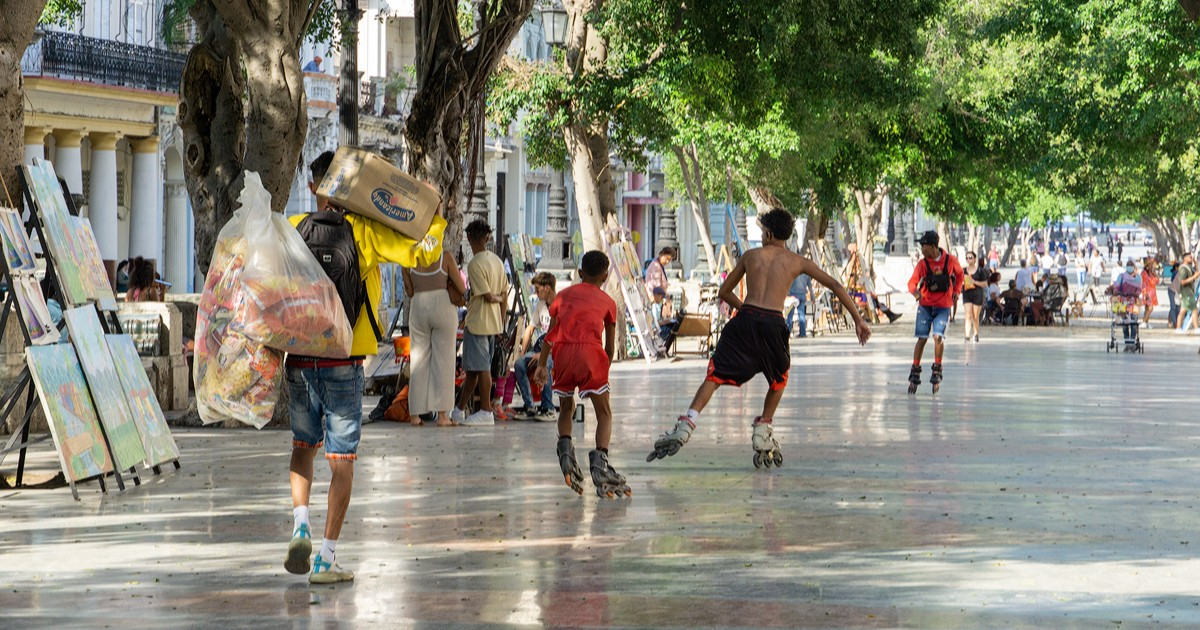
Regarding childhood, the priest denounces: "Children selling things to help their parents, or begging for money and food; teenagers making charcoal ovens and evading forest authorities to avoid being fined, lost childhoods and adolescences, irrecoverable amidst the need."
The issue of child labor has expanded in Cuba amid the crisis, a phenomenon that Díaz-Canel himself acknowledged in June 2024 as a "concerning social manifestation," after the regime had proclaimed it eradicated.
Regarding drugs, Reyes Pías warns: "I am terrified by the media silence on this issue, the taboo overshadowing the truth, the political image taking precedence over the salvation of the young."
This silence contrasts with data from MININT itself: in 2025, over 800 people were admitted to emergency rooms just in Havana due to intoxications with "the chemical," a synthetic cannabinoid mixed with fentanyl that is sold for 250 Cuban pesos, and authorities acknowledged 46 new formulas circulating in the streets.
Regarding violence, the priest points out that the police are "quick and effective in acting against those who protest publicly, but completely incapable of ensuring the safety of the people."
The Cuban Observatory of Citizen Audit recorded 2,833 verified crimes in Cuba in 2025, an increase of 115% compared to 2024 and 337% compared to 2023.
Reyes Pías also reports the non-payment of salaries and the situation of the elderly forced to stand in long lines at banks "in the hope of receiving an amount equivalent to just two dollars," often returning empty-handed due to a lack of cash, electricity, or connectivity.
The priest, who was summoned by State Security in January and May 2026 under the threat of legal proceedings accused of being a " promoter of hate," concludes his column with a phrase that encapsulates his denunciation: "Yes, I care about my people, I care about the present and the future of the specific individuals that make up this community."
Filed under: