
Related videos:
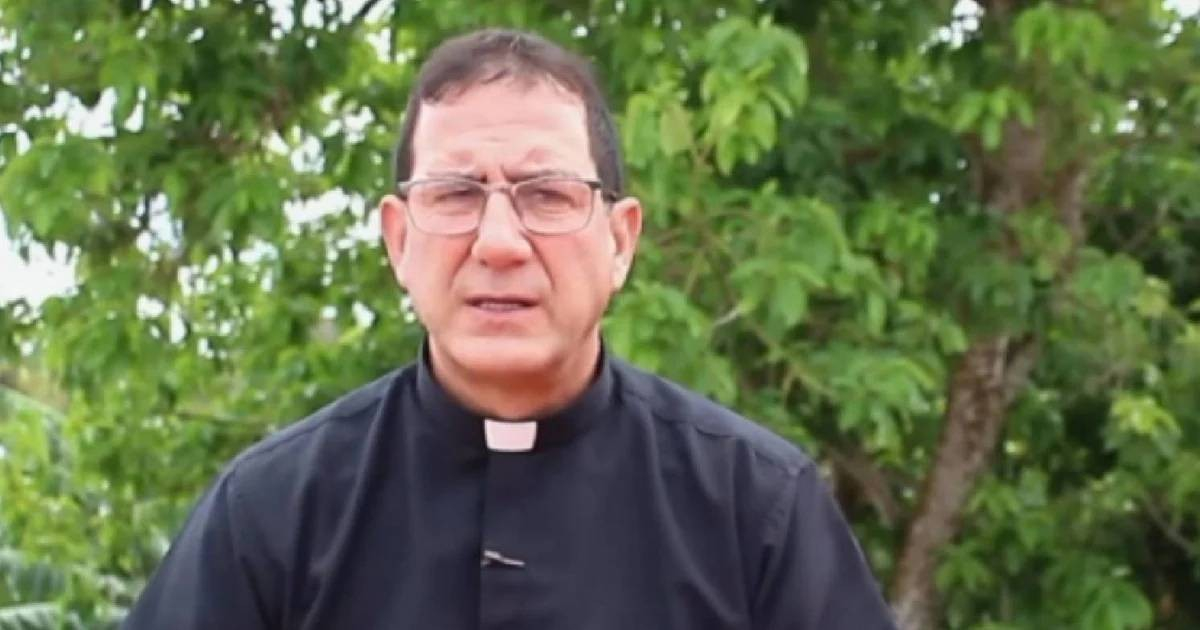
The Cuban priest Alberto Reyes Pías, pastor of the parish of Esmeralda in Camagüey, published the 163rd installment of his weekly column on Facebook, titled "I have been thinking about what is not fully understood," in which he forcefully dismantles the official narrative that the Cuban crisis can be resolved economically without political freedom.
The reflection comes days after the regime presented the 176 economic measures approved by the National Assembly, which include the authorization of private banking, the elimination of worker caps in small and medium-sized enterprises, and the opening up to foreign investment.
While the regime presents them as the greatest structural reform in decades, Reyes Pías argues that no economic opening can thrive as long as citizens remain without freedom.
"We have spent years like those pet rodents that are given a wheel to keep them entertained spinning, never getting anywhere. We have been surviving for years in concentric circles made of speeches, marches, party meetings, resolutions, reforms, counter-reforms… that have led us nowhere, or perhaps yes, they have led us to exhaustion, to chronic misery, to the normalization of survival," he wrote.
The priest describes those who have governed Cuba since January 1959 as "a group obsessed with power to pathological levels" that does not care "about the misery, hunger, aspirations, or lives" of the people.
In his words, Cubans are treated as "hostages, people to be dominated and controlled, slaves destined to sustain a country so that they can exploit it and amass wealth and a life of privileges with the most absolute and obscene impunity."
Reyes Pías also denounces the regime's hypocrisy in the face of crises: "It is humiliating how they treat us, how they proudly display authoritarian power when times are favorable for them, and how they pretend to extend a saving hand when times are adverse—a hand that seems outstretched to pull you from the abyss of the waters in which they themselves have submerged you, but it is a hand that never truly saves you."
In response to the official mantra that "we will be better soon," a clear thesis emerges: "The solution does not lie in freeing the economy but in freeing the citizen. The solution is not in preserving the system but in changing the system. The solution is not in a new generation of Marxist leaders but in replacing Marxism with a true democracy that allows for real power of the people and the flourishing of freedom and political plurality."
"Our problem is a problem of freedom. We are not lacking in ideas, energy, or ability… what we lack is the freedom that allows all of that to bear fruit," he concludes.
The reflection occurs during a time of acute crisis in Cuba: blackouts lasting up to 30 hours, a critical shortage of food and medicine, an infant mortality rate that has doubled to 9.9 per 1,000 births, and a projected GDP decline of 15% in 2026, worsened by the disruption of Venezuelan oil supplies in January.
The harassment against this priest has escalated in parallel with his visibility.
In January, State Security summoned him along with priest Castor José Álvarez Devesa to issue warning records under the threat of legal prosecution, accusing them of being "promoters of hate."
In June, the official troubadour Raúl Torres attacked him in a public letter to Pope Leo XIV, accusing him of "encouraging death" and of having "released the incense to wield the torch."
Despite this, his reflections are becoming increasingly direct: in number 161, he compared Cuba to a "merciless concentration camp," and in number 162, he stated that “no power has the right to keep us in this agonizing misery”.
Filed under: