
Related videos:
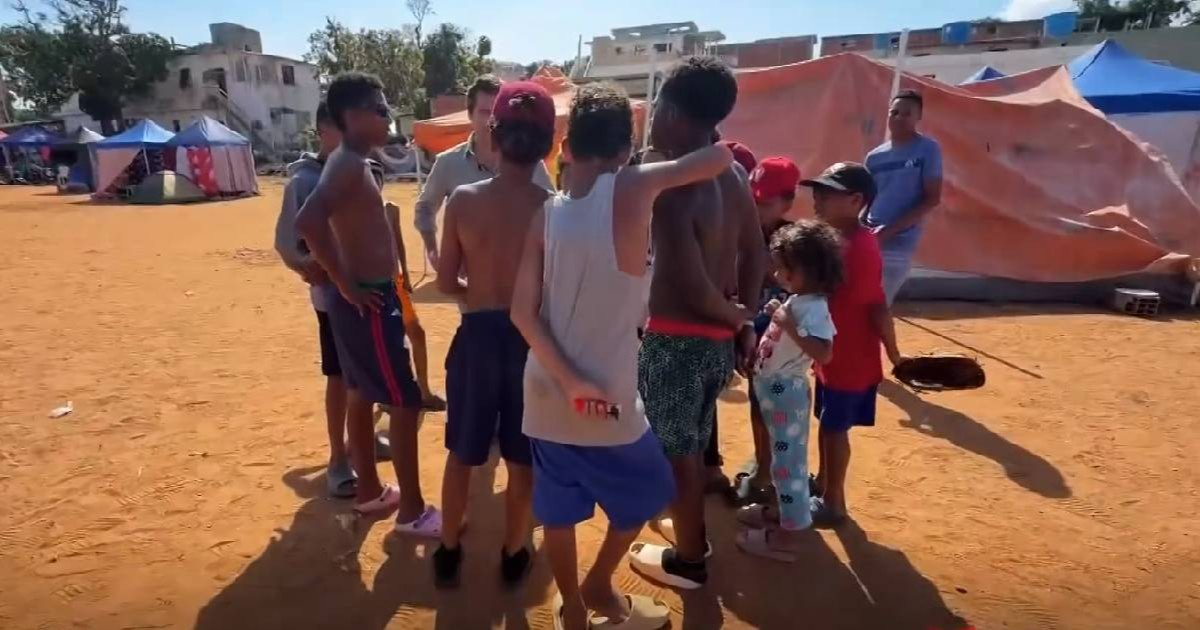
Sleeping in a tent, bathing with cold water in the streets, and playing with a ball among the rubble is the new routine for hundreds of children displaced by the earthquakes that devastated Venezuela on June 24.
A report by Noticias Telemundo from a camp in La Guaira shows how the youngest are facing a tragedy that, as of this Thursday, has already resulted in 2,645 deaths, 12,666 injuries, and 6,462 people rescued alive.
José Luis Díaz Vega González is nine years old and responds with monosyllables to each question from the journalist: Are you sleeping here? Yes. Eating? Yes. Taking a bath? Yes. Playing? Yes. When asked what he plays with his friends, he replies, "With a ball."
Joshua, only four years old, struggles to describe what happened to his home with precise words: "I didn't see my house. I only saw a house like this, sideways," he says. When the earthquake happened, his mother told him to take refuge under the table and to pray.
Another child from the camp recalls the exact moment of the earthquake: "I was with a friend, we were going to buy something, and suddenly everything started shaking, all the buildings fell."
Despite the trauma, the children exhibit a resilience that contrasts with the magnitude of the catastrophe.
"Let's behave, let's listen, so that we all can gain their favor," one of them repeats, quoting what his parents tell him. And another adds, with a simplicity that says it all: "The good thing is that we're doing well."
The reality surrounding that statement, however, is devastating. The Venezuelan government raised the official death toll to 2,645 on Thursday, while the UN estimates up to 50,000 missing, and the United States Geological Survey projects with a 42% probability that the final victim count could range between 10,000 and 100,000 people.
In La Guaira, the hardest-hit state, more than 250 buildings collapsed. In Catia La Mar, 158 out of 189 structures were completely destroyed.
The José María Vargas Hospital was destroyed, and the Maiquetía International Airport had to close. The material damages are estimated at 6.7 billion dollars, which is equivalent to 6% of Venezuela's GDP.
Currently, 15,050 people are without housing, and 14 temporary camps have been set up in La Guaira where UNICEF is working to ensure child protection, water, sanitation, and hygiene.
The organization Criollitos de Venezuela has preliminarily confirmed that at least 100 children have died as a result of the earthquakes. UNICEF estimates that 680,000 minors in the six affected states require urgent humanitarian assistance, in a country where, prior to the disaster, nearly four million children were already in need of help, and only 35% of their needs were being met.
The World Food Program has reached 2,000 people with ready-to-eat rations and operates a community kitchen at the Playa Grande stadium. Since the main earthquakes, there have been more than 130 aftershocks, including one measuring 4.6 recorded just this Thursday.
The earthquakes on June 24 are considered the most powerful recorded in Venezuela since 1900. The regime of Nicolás Maduro restricted access to La Guaira since June 26, which has raised doubts about the accuracy of the official figures compared to international estimates.
Filed under: