
Related videos:
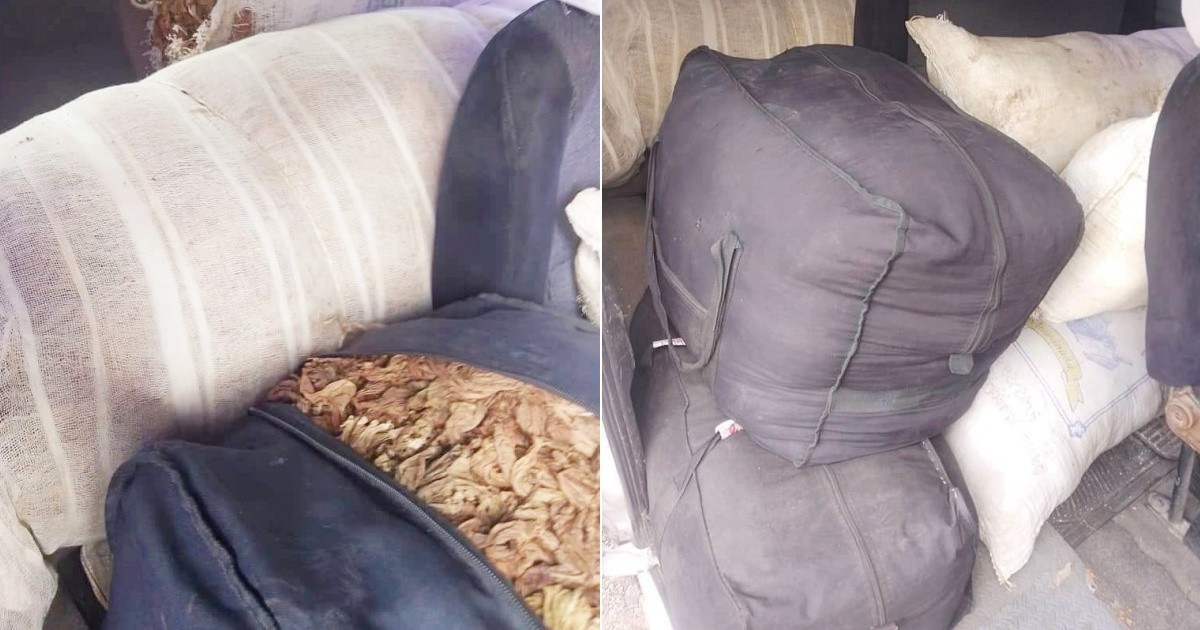
An officialist Facebook profile recently reported the theft and illegal transportation of quintals of dry tobacco from Pinar del Río to Havana, in a case described with striking vagueness that has sparked a debate over who is truly responsible for the looting of Cuba's countryside.
The post, shared by the Facebook page «De Canallas y sus Canalladas», states that “several unscrupulous criminals attempted to transport quintals of already dried tobacco, stolen from hardworking and dedicated producers, to Havana.”
The brief note added that they were “caught in the act and confronted by the PNR.”
A complaint full of gaps
The first thing that stands out in the official statement is what it doesn't say: it doesn't specify how many quintals were seized, how many people were arrested, in which exact municipality the events occurred, nor the date when the operation took place.
Formal charges or trial dates for the alleged responsible parties are not mentioned either.
The text is limited to praising the police action: “Recognition to the officers who acted with firmness and professionalism to protect the property of those who earn a living from their work.”
And it concludes with a call for citizen collaboration: «Do not be silent, report and help close the door to those who seek to enrich themselves at the expense of others’ sacrifice.»
That ambiguity stands in contrast to a previous case reported by the same source, in which it was specified that seven perpetrators were captured and three receivers were identified, details that are notably absent in this instance.
The citizens' reaction: Between support and outrage
The comments on the official publication revealed a deep polarization.
One sector supported the police action, praised the law enforcement forces, and demanded severe penalties, explicitly calling for no impunity and for the full force of the law to be applied against those involved.
"Hard on those thieves," wrote one user, while another insisted on "zero impunity for illegal actions."
However, a broader movement questioned the official narrative and shifted the focus toward the State.
“How long will the State continue to not pay farmers after years of work?”, asked a commentator.
Another was more direct: "The only thief here is the State, which pays ridiculous prices and whenever it wants."
Several users report that farmers are facing prolonged delays in payments and obstacles in accessing their money.
"They pay them, but then they can't withdraw the money from the bank," one person pointed out.
Criticism of the state monopoly is also repeated: "What is needed is for farmers to be able to sell their products wherever they wish," commented another participant.
In this regard, some comments suggest that not all those involved in these events are criminals in the traditional sense.
"Many times, those who are called thieves are the very farmers looking for a better sale," pointed out a user.
Another added: “If the farmer transports his own harvest, the result is the same: confiscation and penalty.”
Overall, the debate reveals a backdrop of distrust towards institutions and a growing discontent with the economic conditions of the agricultural sector.
While some call for a tough stance against crime, others point to structural causes such as low wages, state control, and lack of economic freedom, in a discussion that transcends this specific case and reflects the broader crisis in the Cuban agricultural sector.
Pinar del Río, and in particular the Vuelta Abajo region - the municipalities of San Juan y Martínez and San Luis - produces between 70% and 80% of the national tobacco in Cuba and is the main source of the exportable Habano cigars.
In the 2025-2026 campaign, the official price per quintal of main tobacco is around 9,448 Cuban pesos.
In the informal market, derivative products are sold at prices up to 20 times higher: a pack of H. Upmann can reach between 1,200 and 1,500 pesos compared to the official price of 30 or 60 pesos.
This gap is compounded by delays of up to a year in the settlement of harvests and threats from Grupo Empresarial Tabacuba to withdraw land under usufruct from those who do not meet their conditions.
The average salary of a tobacco farmer is around 75 pesos a day, equivalent to about three dollars.
A recurring pattern
The situation is not isolated. Crime in rural Cuba has escalated in 2025 and 2026, with thefts of livestock, tobacco, and other agricultural products occurring in multiple provinces.
In April of this year, a worker from EMPA in Jiguaní, Granma, was arrested for stealing thousands of boxes of cigarettes and tobacco from a state warehouse, causing damages exceeding 10 million pesos.
The regime has responded with anti-corruption campaigns and trials deemed exemplary, but the underlying causes—low prices, state monopoly, lack of economic freedom—remain unaddressed.
As a commentator summarized in the official publication itself: "The farmer should be able to sell their products freely," a demand that the regime, despite its rhetoric about the "sacrifice" of producers, does not seem willing to address.
Filed under: