
Related videos:
The Archdiocese of Santiago de Cuba addressed rumors and confusion regarding the handling of U.S. humanitarian aid, and in a message shared on Facebook, clarified that Caritas Cuba did not receive cash from the millions announced by the U.S. government, but rather products intended for affected families.
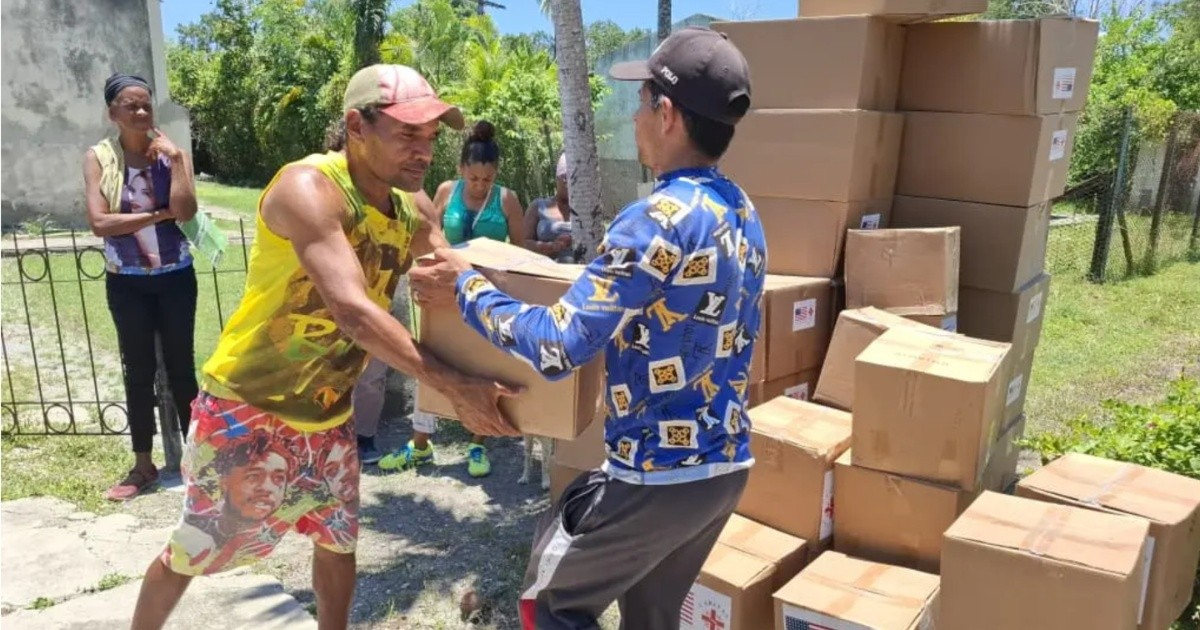
In its message, the Catholic institution explained the actual mechanism of the aid: the U.S. government spent the funds by directly purchasing goods, which were then sent to Cuba through Catholic Relief Services (CRS), the U.S. Caritas organization, acting as an intermediary.
"Cuban Caritas did not receive a dollar from the 3 million. And you may say, but they gave 3 million through Caritas. They provided 3 million in products that had that value. They spent 3 million dollars to help families, but they purchased the items themselves. We have received the products they bought," explains the message distributed by the Archdiocese.
The clarification addresses a widespread misunderstanding: that Cáritas was handling a substantial amount of cash and that every Cuban could claim "what was due to them."
The first phase of 3 million dollars was distributed among the four eastern dioceses —Guantánamo, Holguín, Bayamo-Manzanillo, and Santiago de Cuba— benefiting approximately 8,000 families affected by cyclone Melissa, which devastated eastern Cuba on October 29, 2025, as a category 3 storm, with winds of 195 km/h and over 2.2 million people impacted.
More than 50 containers entered through Cuban ports and airports, distributed by volunteers from the parish communities.
To identify the beneficiaries, the communities conducted a census of affected families, prioritizing rural areas of Santiago de Cuba such as El Cobre, Baire, Contramaestre, Palma Soriano, and San Luis, where the damage was greatest.
In the statement released by the Archdiocese, it was emphasized that the distribution made no distinctions of any kind: "There has been no distinction in giving, whether one is Catholic, Christian, atheist, or not, whether one is a communist, or anything else; if someone is in need, they are a child of God."
He also dismissed any friction with Cuban authorities during the process: "We did not have difficulty with the Cuban state. No, we did not. We were able to do it, and to facilitate things, we talked; we needed fuel, and at times they gave us fuel."
The second phase, amounting to 6 million dollars, also aimed at the victims of Cyclone Melissa, began implementation in July in the same four eastern dioceses, following the same procedure.
The aid includes boxed modules featuring the American flag and the slogan "Charity unites us with Caritas": one containing food items—such as oil, rice, and beans—and another with cleaning supplies, buckets, and water containers.
The process is part of a humanitarian aid effort that is significantly escalating.
In the message disseminated by the Archdiocese, there was also mention of an expansion of aid to 100 million dollars for all of Cuba, with the aim of benefiting around 100,000 to 120,000 families.
The explanation added that the State Department positively evaluated the work done by Cáritas.
"We are going to provide one hundred million more, not just for Santiago, Bayamo, Guanajay, Holguín, but for all of Cuba, and it is thought that we might help, I don't know, maybe 100,000 or 120,000 families," confirmed the archdiocese, which also positively assessed the relationship with Washington: "The State Department viewed the work very well and took it very seriously. They are demanding."
Filed under: