
Related videos:
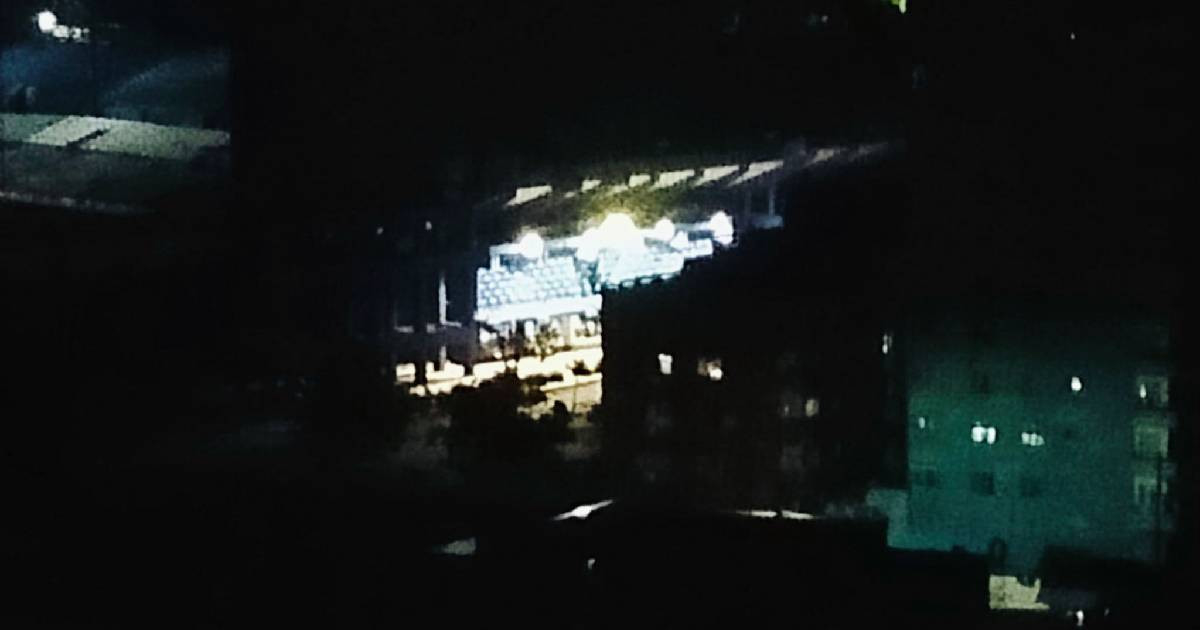
The journalist and dance critic Ahmed Piñeiro Fernández reported this Saturday that the Latinoamericano Stadium in Havana operates as a nightclub until four in the morning, while the rest of the city remains in darkness due to power outages.
"A city (or rather a country) in darkness, and what about? (at least near) the Estadio Latinoamericano, a 'new' nightclub that usually goes on until 4 AM, whose 'noise' is bothersome; and under these circumstances, it's insulting," wrote Piñeiro on his Facebook profile.
The photograph accompanying the text shows a brilliantly illuminated structure set against a completely dark urban backdrop, captured at night from a nearby window or rooftop.
The stadium, known as El Coloso del Cerro and with a capacity of about 55,000 spectators, was opened to advertising and commercial sponsorships through Law 179 of the Cuban Sports System, in effect since May 13, with management handled by Cubadeportes S.A., the stadium itself announced the measure.
The report comes at one of the worst energy moments in recent history for Cuba. This Saturday, 11 thermoelectric units were out of service—six due to breakdowns and five under maintenance—with a projected deficit of 2,050 MW for the nighttime peak.
Havana has experienced power outages lasting between 20 and 30 continuous hours, and the national deficit exceeded 2,200 MW on June 25, setting a historical record that was nearly matched on July 3 following the shutdown of the Antonio Guiteras thermoelectric plant, marking its seventeenth breakdown so far this year.
"Well, the insult is widespread. La Piragua has set up a platform with spotlights and is filled with lights for a huge party, while just a few meters away an entire neighborhood is in the dark, having not had electricity for even two hours today; there is no respect for the suffering of the people," commented a citizen on Piñeiro's post.
In June, a social media user criticized that La Piragua del Malecón hosts illuminated parties until dawn, while entire neighborhoods in the capital are suffering from prolonged blackouts.
That same month, the San Juan Camagüeyano was celebrated with bonfires and parades while Camagüey was experiencing severe outages.
In May, a resident of the Focsa building area reported that their neighborhood had only four hours of electricity while the Cubadisco festival at the Pabellón Cuba remained fully lit.
And in October 2025, the Capri hotel in El Vedado hosted a party with loud music, while entire neighborhoods in Havana remained in the dark.
The Cuban Observatory of Conflicts recorded 1,133 protests in April 2026 alone, of which 153 were directly related to power outages and water shortages. This figure reflects the exhaustion of a population that sees electricity guaranteed for entertainment while their homes remain in the dark.
Filed under: