
Related videos:
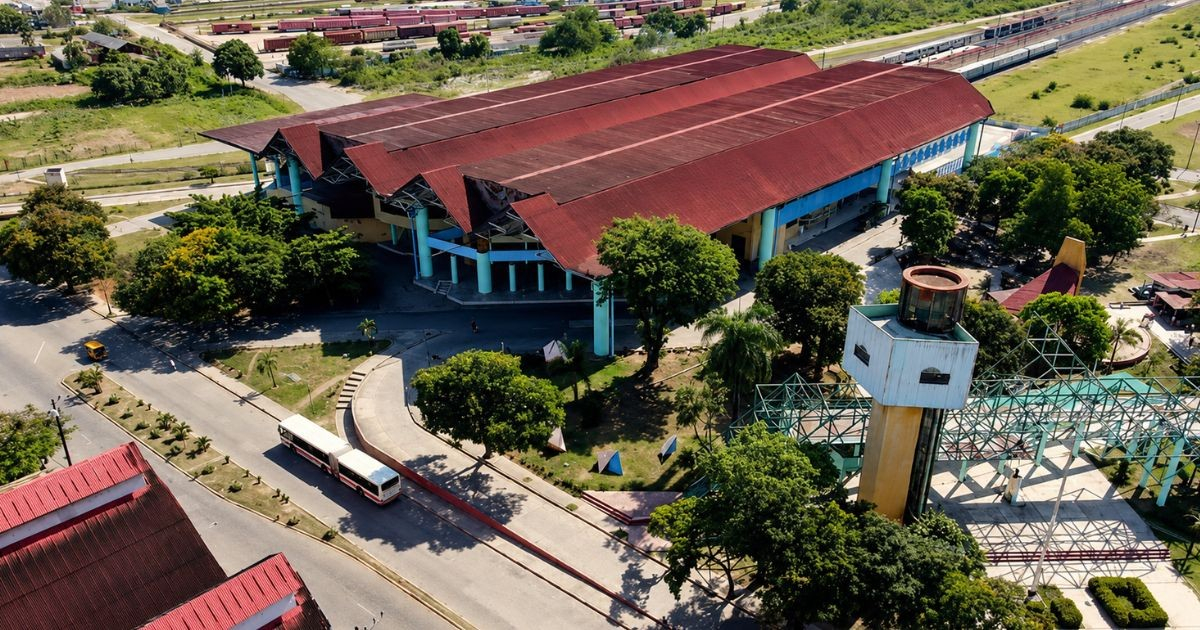
The Cuban regime announced the complete renovation of the Senén Casas Regueiro train station in Santiago de Cuba, with an investment exceeding 84 million pesos, as reported by the Cuban Railroad Union through its official channels.
The funding was approved in April of this year by the Public Transport Development Fund, which is under the Ministry of Transport, and the project will be managed by the Eastern Railways Company alongside the Specialized Construction and Assembly Company and the Roberto Macías Gallego Credit and Services Cooperative.
The terminal, inaugurated in 1997 and designed by architects María Quintana and José Antonio Choy, is considered unique in the country due to its sloped metal sheeting roof supported by a stereoscopic lattice system.
Since 2015, the building has also housed the national bus terminal, making it the main transportation hub of the eastern province.
The accumulated deterioration is due to two factors: the chronic lack of maintenance affecting the entire Cuban railway infrastructure and the damage caused by Hurricane Melissa, which made landfall in Santiago de Cuba on October 29, 2025, as a Category 3 hurricane, with winds exceeding 200 km/h.
The planned work for the station includes the main building and its exterior areas: repair of rainwater downspouts and gutters, general painting, partial renovation of the electrical system and wall coverings, repair of storm drainage and water supply systems, and restoration of green areas and decorative elements.
The announcement comes amid a structural crisis of Cuban railway transport that the Minister of Transport, Eduardo Rodríguez Dávila, acknowledged in March 2025 when he admitted to the poor technical conditions in the network.
In June of this year, national trains to Santiago de Cuba operated with a frequency of just one round trip every two weeks, and the Cuban government acknowledged that public transportation only meets 42% of the planned goals.
The intervention at the Santiago station adds to similar projects underway or already completed at the stations of 19 de noviembre, Cruces, Morón, Jaruco, and the Central de Ferrocarriles, although previous projects of this kind have experienced significant cost overruns and delays: the repair of the Morón station escalated from 3.4 to over 100 million pesos.
The scale of the announced investment contrasts sharply with the extent of the accumulated problems: out of the 558 buses in the Cuban interprovincial fleet, only 219 were operational by the end of 2025, according to official data.
Filed under: