
Related videos:
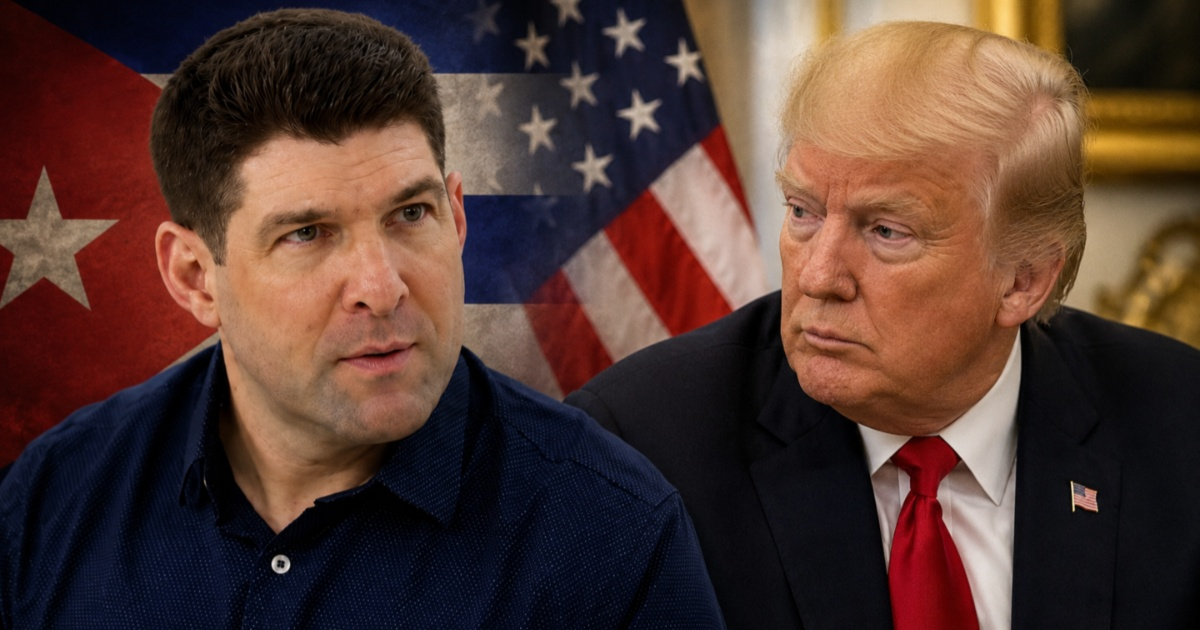
Raúl Guillermo Rodríguez Castro, the 42-year-old grandson of Raúl Castro known as "El Cangrejo," expressed his willingness to negotiate directly with President Donald Trump regarding the future of Cuba, in his , granted to USA Today and published this Monday.
"I can negotiate with anyone designated by the U.S. If given the opportunity, of course I would with Trump," said Rodríguez Castro during a series of conversations held over two days in June in Havana, from the office that belonged to his grandfather in the Convention Center, home of the Cuban parliament.
Raúl Guillermo, who does not hold an official position in the government, is a colonel in the Ministry of the Interior and the main informal operator between the Cuban regime's leadership and Washington.
His public emergence occurs at a time of extreme pressure: Trump's Executive Order 14380, signed in January, imposed secondary tariffs on those supplying oil to Cuba, which has reduced the island's energy imports by 80% to 90% and caused power outages of up to 25 hours a day in more than 55% of the territory.
Rodríguez Castro acknowledged the urgency of the situation, but clearly set his boundaries: "I have never been interested in politics. It has never been my vocation. But if at any moment the revolution needs me, I will do it," he stated, emphasizing that he would never sacrifice the principles of the 1959 revolution or national sovereignty.
His profile is that of someone raised within power. He is the son of the late General Luis Alberto Rodríguez López-Calleja, who led GAESA, the military conglomerate that controls a substantial part of the Cuban economy.
He grew up in the same building as his grandparents, moved in with them at the age of 18, and since his teenage years, he attended important state meetings, including the debates between Fidel and Raúl Castro.
Frank Mora, a professor of politics and international relations at Florida International University, described him bluntly: "He is the favored grandson. Raúl Castro trusted his father, and he is the grandson he loved the most."
His nickname has a physical origin: he was born with six fingers on his right hand and underwent three surgeries before the age of eight. He studied at the military school "Los Camilitos" and graduated in Accounting and Finance from the University of Havana.
This interview with USA Today is his first with a U.S. media outlet, although on June 19th, he had already spoken with the Arab media outlet The National to defend the package of 176 economic reforms approved by the regime, the largest in its history.
Washington did not react favorably to those measures. The State Department labeled them as "superficial smoke signals," and on June 23, Marco Rubio announced new sanctions against five entities linked to GAESA, including the Banco Financiero Internacional and GeoMinera S.A.
Rodríguez Castro was also one of the interlocutors with CIA Director John Ratcliffe during his visit to Havana in May, the highest-ranking official from the Trump administration to set foot on Cuban soil since 2016.
Despite the contacts, Rodríguez Castro himself admitted to The National that the negotiations have not borne fruit: "I would like to answer yes to that question, but the reality is that no."
Filed under: