
Related videos:
Just four days after Washington referred to the 176 economic reforms approved by the Cuban regime as "superficial smoke signals," the administration of President Donald Trump announced a new round of sanctions against key entities of the military-controlled economy and against a member of the Castro family's inner circle.
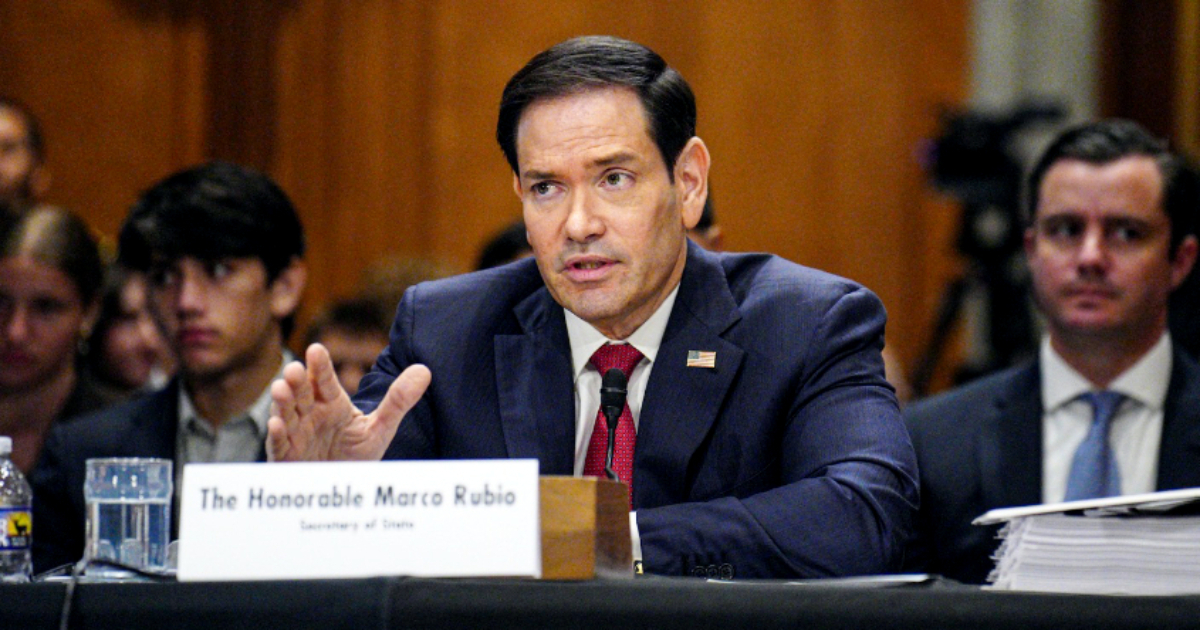
The measure, announced this Tuesday by Secretary of State Marco Rubio, affects five Cuban entities and Annalie Lilliam Rueda Cardero, the wife of Alejandro Castro Espín (known as 'El Tuerto'), former head of Cuban intelligence services and son of Raúl Castro.
The new designations were adopted under Executive Order 14404, signed by Trump on May 1st, which authorizes extensive sanctions against individuals and entities linked to repression in Cuba and activities that the United States deems a threat to its national security and foreign policy.
In a statement, Rubio stated that the situation on the island "is deteriorating" as the regime continues to prioritize "its total control over the freedom, opportunities, and basic welfare of the Cuban people."
Three of the sanctioned entities are linked to the Grupo de Administración Empresarial S.A. (GAESA), the business conglomerate controlled by the Cuban Armed Forces and deemed by Washington as the main economic support of the regime.
Among them is Almacenes Universales S.A. (AUSA), a subsidiary of GAESA that controls container traffic in the Mariel Special Development Zone and operates logistics, storage, and transportation services.
RAFIN S.A. and Banco Financiero Internacional (BFI) were also sanctioned, two institutions that play a central role in the financial management of the military conglomerate.
According to the State Department, RAFIN operates as a key component of GAESA's financial management, while BFI handles a large portion of transactions related to foreign companies and entities operating inside and outside of Cuba.
Rubio stated that GAESA continues to act as "the financial muscle" behind the regime's repressive apparatus and accused the conglomerate of diverting resources that could be allocated to schools, power plants, and other basic needs of the population.
The new offensive also targets GeoMinera S.A. and the José Martí Steel Company (Antillana de Acero), identified by Washington as sources of income for the regime through the exploitation of the country's mineral and metal resources.
GeoMinera, affiliated with the Ministry of Energy and Mines, manages mineral assets unrelated to nickel and maintains projects with foreign investors. Additionally, it controls Minera La Victoria S.A., an entity that had already been sanctioned by the United States in early June.
On its part, Antillana de Acero is the main steel producer in Cuba and was recently the subject of a modernization process with the support of Russian entities.
The announcement comes just days after the State Department dismissed the 176 economic measures approved by the National Assembly of People's Power.
On Friday, a spokesperson for the institution described the reforms as "superficial smoke signals" and stated that they are part of a common strategy of the regime to project an image of openness while maintaining political and economic control over the country.
The measures presented by the Cuban regime include proposals to allow private banking, expand foreign investment, ease foreign trade, authorize the buying and selling of shares, and create new opportunities for the private sector.
However, the new round of sanctions seems to send a clear signal that the Trump administration does not consider those reforms sufficient as long as strategic sectors of the economy remain under the control of GAESA and the state apparatus.
One of the most significant elements of the announcement is the warning directed at banks, companies, and foreign investors.
Rubio stated that anyone or any entity providing services to the sanctioned individuals runs the risk of facing similar measures.
"Foreign banks and other companies that provide services to these entities must immediately freeze those activities", the Secretary of State stated.
The State Department added that foreign individuals and companies that conduct operations with sanctioned entities or engage in sectors such as financial services, mining, energy, security, or defense of the Cuban economy could also face sanctions.
The warning increases pressure on potential investors and business partners at a time when the regime is trying to attract foreign capital to alleviate an economic crisis characterized by extended blackouts, food shortages, inflation, and a sustained decline in national production.
For Washington, the new sanctions are part of a broader strategy aimed at preventing the economic structures controlled by the military from using the opening announced by Havana to attract financial resources without implementing substantial political changes.
Filed under: