
Related videos:
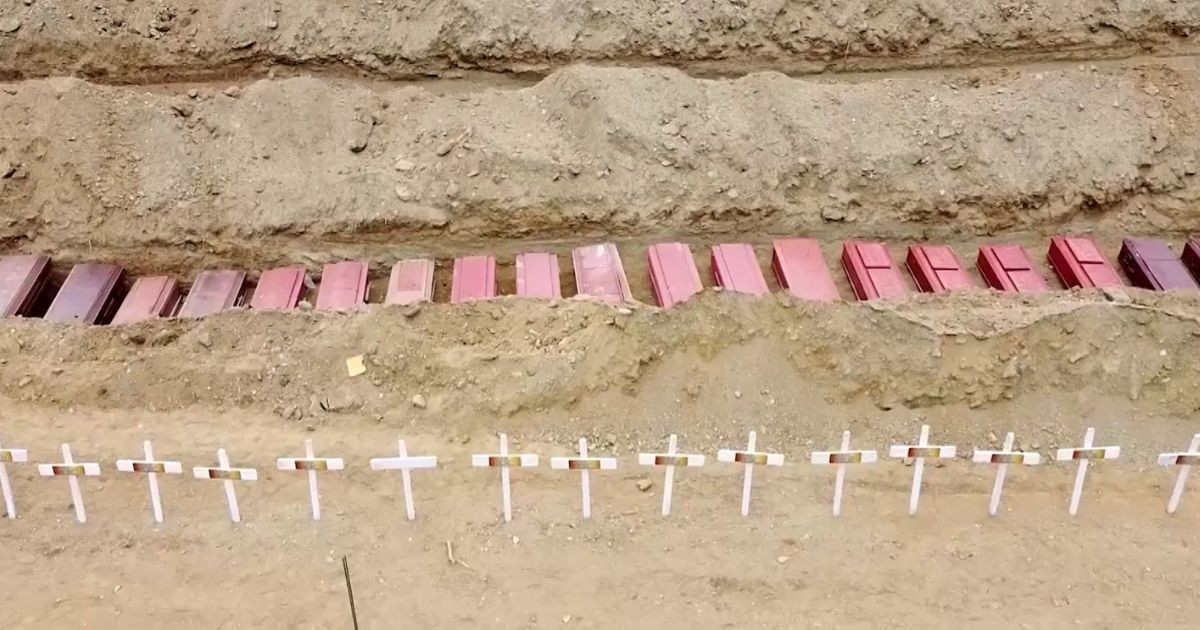
Venezuela is leaving humanity scenes that are simply heart-wrenching. An emergency cemetery grows day by day on a remote hillside in La Guaira, where backhoes and trucks have been digging trenches for over ten days to bury hundreds of victims of the earthquakes on June 24 that shook Venezuela with magnitudes of 7.2 and 7.5.
The location is the cemetery La Esperanza, in the municipality of Catia La Mar, an hour's drive from the most devastated area.
According to a report by El País, on Monday morning 253 people had already been buried in that location, 159 of whom were unnamed.
The graves are not entirely anonymous: above each trench, there are white stones, a wooden cross, and a code that refers to a file containing photographic records and documentation of the burial.
Some crosses have names; others only say "special identification," awaiting a family to claim that body.
"This is not a mess. We do not treat them like dogs or like trash that is piled up. Each one of them has a dignified grave," declared Elis Zabala, the municipal official in charge of the operation.
Zabala explained that the trenches have the capacity for an additional 2,000 to 3,000 coffins, and that there are plans to establish a new terrace further down if demand requires it.
The bodies resting in La Esperanza are, according to testimonies gathered by El País, those of the poorest individuals and those whose relatives are abroad.
Venezuela has a diaspora of approximately eight million people, which makes it difficult to identify victims whose relatives are not in the country.
Those who were able to identify their loved ones and gather money for a funeral home said their goodbyes in a conventional grave or had them cremated. Those who could not ended up in a refrigerated truck headed for these emergency graves.
The management of the corpses has been one of the greatest challenges of the tragedy and a constant source of criticism. In the early days, hundreds of bodies remained decomposing under the Caribbean sun in a parking lot turned into an open-air morgue, many naked or with their clothes partially worn.
The stench forced the neighbors to demand its relocation; then they were moved to the port, lined up but also in full sunlight.
The acting president Delcy Rodríguez stated that she ordered from the beginning to avoid mass graves without names: "I said from the start: no one is going to a mass grave," she declared last Thursday.
However, foreign correspondents questioned her about the slow response and lack of coordination in the first 72 hours, when those affected reported a lack of machinery and even of paper and pens to mark the bodies that the neighbors themselves were pulling from the rubble.
Rodríguez dismissed the criticisms, labeling them as a "media laboratory," and defended that the deployment increased from 4,000 personnel on the first day to 29,567 currently.
The official death toll updated this Monday rises to 3,535 dead and 16,740 injured.
This figure contrasts with estimates from the UN and the International Rescue Committee, which put the number of missing persons between 50,000 and 68,000, and with the Red Alert from the United States Geological Survey, which projects between 10,000 and 100,000 fatalities as the most likely scenario.
In the midst of the rows of identical crosses, there is a single grave with a photograph. Yonathan Calderón, 13 years old, smiles in an image that his family affixed to a dark wooden cross, distinct from the others. He passed away on July 3, nine days after the earthquake.
Filed under: