
Related videos:
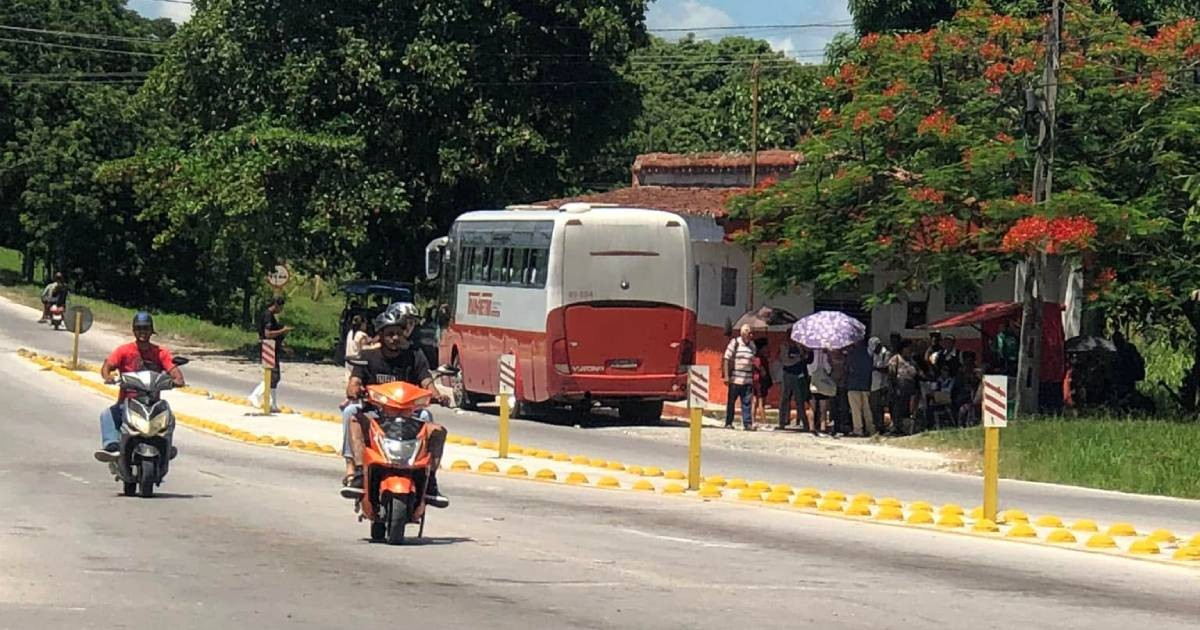
A bus covering the route between Santa Clara and Encrucijada in Villa Clara left dozens of passengers stranded after collecting their fare, as the driver refused to continue the journey until all the seats on the vehicle were filled, according to a user's report on social media.
The incident was reported by Yenelis Hernández in the Facebook group Revolico Calabazar de Sagua, where she explained that she boarded the bus around one in the afternoon at the Santa Clara terminal after paying 750 pesos for the transfer.
According to his testimony, the vehicle left the terminal seemingly without issues, but shortly after, it stopped at a location known as "the Malezas point," an area designated for passenger transport, and remained there motionless for about an hour and a half without the driver providing any explanation.
It wasn't until shortly after two and almost three in the afternoon that the driver informed the passengers that he would not continue the journey "until the bus is full."
Faced with the travelers' refusal to continue waiting without any assurances of departure, the driver chose to refund the money and leave everyone at that point.
"He refunded the money and left everyone there when all he needed were eight passengers to fill the bus," Hernández wrote.
The complainant questioned why that condition was never communicated before leaving the terminal, which would have prevented dozens of people from wasting hours waiting.
Hernández stated that among the passengers there were pregnant women, elderly people recently operated on, and mothers with small children.
"Nobody cares if there are pregnant women, if there are elderly women who have undergone surgery, or women with small children who only had the assurance of going home," he lamented.
He also noted that the 750 pesos for the fare represents a significant financial burden for many Cuban families. Those who cannot travel on those buses have to turn to private transporters who charge between 1,700 and 2,000 pesos for the same route.
"Most people do not have that amount of money to travel, and those who provide that money do so because they need to relocate," he stated.
The post generated hundreds of reactions and comments from users who reported similar situations and criticized the lack of control over intermunicipal transportation.
"No one takes any measures, and nothing happens; we were simply all treated like dogs," concluded Hernández, who stated that he usually does not publish this type of complaint, but considered what happened to be an abuse.
It contrasts with the official promises
The complaint contrasts with the commitments made by the director of the Provincial Transport Company of Villa Clara, Jarys Hernández Simón, when she presented the new fares for the Transmetro system on June 18.
On that occasion, he stated that "all the buses will operate from terminal to terminal" and that the service should be provided with "excellence," according to a report from the official broadcaster CMHW.
The official also set the official fare for the Calabazar-Encrucijada-Santa Clara route at 850 pesos and promised that the prices would be subject to oversight.
A crisis that continues to worsen
The incident reflects the deterioration of public transportation in Cuba, impacted by fuel shortages and a lack of vehicles.
Following the interruption of Venezuelan oil supplies at the end of 2025 and the reduction of shipments from Mexico at the beginning of this year, the country is facing one of the worst mobility crises in recent decades.
In June, the Ministry of Transport announced a historic cut to national services: the National Buses began to operate only three times a week between Havana and the provincial capitals, while national trains run with a frequency of one departure every 16 days.
In Villa Clara, the situation has also forced the substitution of routes with animal-drawn vehicles and electric tricycles in municipalities such as Encrucijada, while several private trucks that covered intermunicipal routes have ceased operations due to a lack of diesel.
It is not an isolated case. Last May, passengers on a rented bus between Havana and Santiago reported charges higher than agreed and the use of the luggage compartment to transport goods instead of accommodating travelers.
"This can only be called a lack of respect for the people… Is not all the suffering we already endure enough?" concluded Hernández in his statement.
Filed under: