
Related videos:
I was in an isolation cell in the Mar Verde prison, in Santiago de Cuba, when one morning a Ministry of Interior official began her shift. She approached cautiously, almost trembling, and in a barely audible whisper asked me:
—José Daniel, do you know Mayeta?
I had been in almost complete isolation for several months, without contact with the outside world. The only Mayeta that came to my mind was Yosmany Mayeta Labrada, a human rights activist and independent journalist from the Santiago neighborhood of Altamira.
"I know a Mayeta who is a journalist, a human rights defender, and who now lives in Washington," I responded.
"Yes, that one," he confirmed.
He looked to both sides to make sure no one else was listening and, lowering his voice even more, added:
—Everything he/she says is true.
That brief confession remained etched in my memory. A member of the repressive machinery secretly acknowledged that Mayeta's claims were true. In Cuba, speaking the truth can come at a very high cost. You could end up in prison or even lose your life.
That bold prison officer ultimately got expelled from MININT due to her sympathy for another political prisoner from the July 11, 2021.
On January 16, 2025, after more than three and a half years in prison, I was released. Upon returning to Altamira, the same neighborhood where Yosmany was born and raised, I immediately resumed my social and humanitarian activism with the Patriotic Union of Cuba. Together with my wife, other members of UNPACU, and collaborators, we began distributing food to people living in extreme poverty. Dr. Nelva Ortega also provided primary medical care to sick and vulnerable elderly individuals. Just three days later, a woman waiting in line exclaimed loudly:
It was the first time I had heard that expression. After years of confinement and isolation, I was unaware that it had become a popular rallying cry in Santiago de Cuba. My wife explained to me that it was constantly repeated and that there was even an urban music song dedicated to the journalist.
In the following days, I heard it over and over again. I searched the networks and understood its profound meaning. In the face of police abuse, an endless blackout, a destroyed street, an interminable queue for food, or any injustice, many people in Santiago shout: "Turn it up, Mayeta!"
That phrase has become synonymous with denunciation, demand, and catharsis. It means: make it public, let the world know, ensure that the abuse doesn't go unpunished. It is the people condensing their pain, frustration, and rejection of the dictatorship into two words. It is also the irrefutable proof of the immense void left by the official press, which does not represent the citizens but rather conceals those who oppress them.
As soon as I regained my freedom, I reached out to Mayeta, my friend and brother in struggle, and I told him the story about the conversation in prison and how I came to know the phrase "Súbelo Mayeta." Our connection had been severed with my imprisonment on July 11, 2021. Shortly thereafter, I was imprisoned again, and after another 'via crucis' of beatings, torture, and humiliation in "Mar Verde" prison, I went directly from prison to "Antonio Maceo" airport on my way to exile in Miami.
On my first trip to Washington, we reunited in a place steeped in symbolism: in front of the Abraham Lincoln monument. There, I remembered the 23-year-old who, around 2012, was studying Social Communication and had just begun working with UNPACU. Even then, he stood out for three important qualities: talent, courage, and a will of iron. He was not satisfied with mediocrity. He wanted to learn, investigate, inform, and give a voice to those who did not have one.
In UNPACU, the space "Cuba por Dentro" was created, a citizen journalism project that began by highlighting the situation of political prisoners and the harsh daily reality of Santiago de Cuba, the East, and even Havana.
Their team documented what the Communist Party's press concealed or distorted. In Bayamo, while covering the 500th anniversary of the City, they were detained for several hours for allegedly violating the security cordon of then "vice president" Miguel Díaz-Canel.
Mayeta was also one of the many detained during Pope Benedict XVI's visit to Cuba; dozens of activists and independent journalists were preemptively arrested to silence any dissent. The political police knew it was bold enough to evade their "operations."
Yosmany later collaborated with media outlets such as CubaNet and 14ymedio. He went into exile in 2019. From the United States, he continued to relentlessly denounce the repression, poverty, neglect, and systematic abuses of the regime. His work made him a particularly uncomfortable figure for the authorities of the regime in Santiago de Cuba.
Recently, he faced the real risk of deportation. If he had been returned to Cuba, he would have been imprisoned and brutally retaliated against. Two brilliant lawyers took on his defense, while journalists, activists, organizations, and friends advocated with U.S. institutions. Ultimately, he received the administrative pardon that allowed the case to be dismissed.
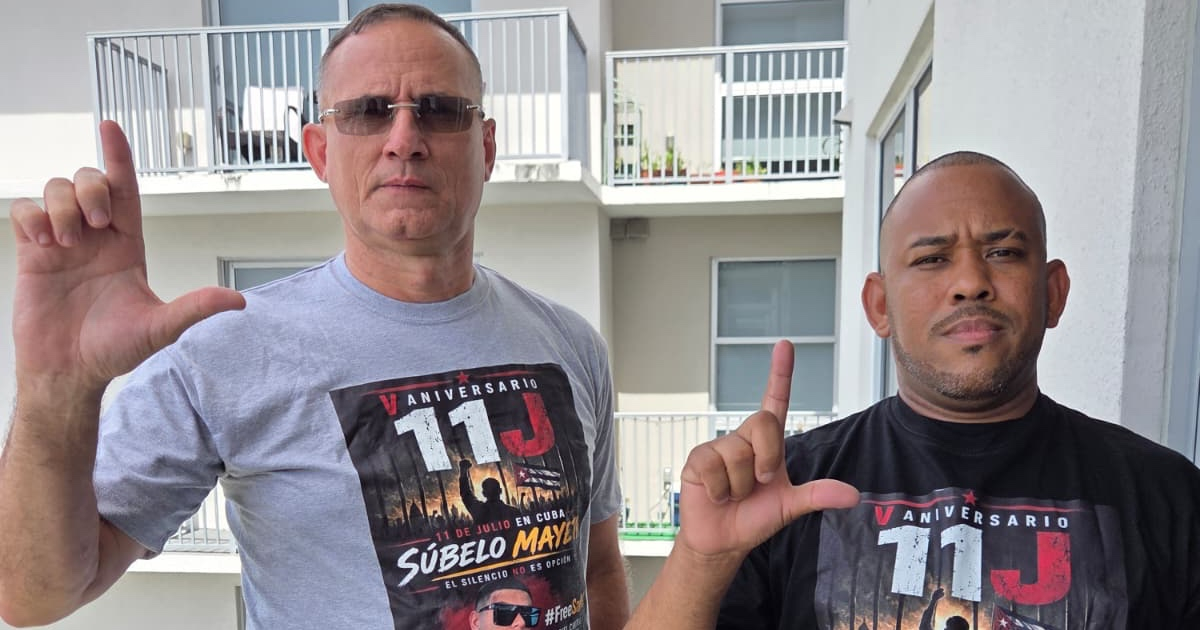
Today, Mayeta honors us with her presence in Miami. She arrived from Washington to participate in the activities commemorating the fifth anniversary of July 11, 2021, when thousands of Cubans took to the streets demanding freedom, justice, and better living conditions. She also brought t-shirts featuring the face of the political prisoner from the July 11 events, Sadiel Cintra de la Cruz, a Cuban who lived in the United States and was sentenced to 10 years in prison while visiting Cuba. Interestingly, this is the same political prisoner with whom the expelled prison guard sympathized—just a coincidence, perhaps?
One day Mayeta will return to her homeland. But not in handcuffs, nor surrendered to her executioners. She will return to a free Cuba. Until then, every time someone from Santiago shouts "Bring it up Mayeta!", they are not just invoking the name of a journalist. They are demanding that the truth come to light and proclaiming, with determination, that the Cuban people, despite fear, censorship, and brutal repression, refuse to be silenced.
Filed under:
Opinion article: Las declaraciones y opiniones expresadas en este artículo son de exclusiva responsabilidad de su autor y no representan necesariamente el punto de vista de CiberCuba.