
Related videos:
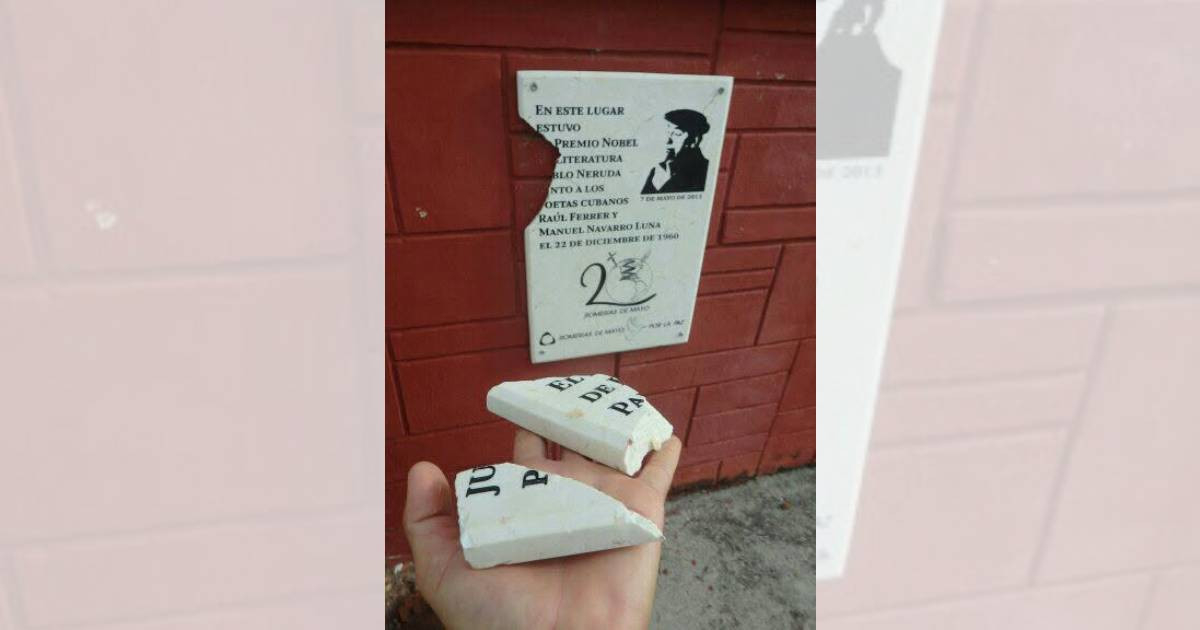
An act of vandalism destroyed the white marble plaque installed at Loma de la Cruz in the city of Holguín, commemorating the visit of Nobel Prize in Literature Pablo Neruda (1904-1973) to this iconic site on December 22, 1960, alongside Cuban poets Raúl Ferrer (1915-1993) and Manuel Navarro Luna (1894-1966).
The report by journalist Reynaldo Zaldívar Osorio was posted on the official Facebook profile of the newspaper ¡Ahora!, accompanied by an image showing a hand holding the broken pieces of the plate in front of the wall where it was installed.
The devastation was discovered by a group of young people who arrived early at the site to conduct a voluntary cleanup.
The plaque was placed on May 2, 2013, by members of the Hermanos Saíz Association (AHS) to commemorate the visit of the Chilean poet to that location during his last and most significant trip to Cuba.
"These monuments and historical sites are not merely objects or pieces for a museum; they are the living memory of our community and a heritage that belongs to all of us. Destroying them is not just an act of ignorance but a theft of collective identity, a disregard for the efforts of those who created them, and a wound to our culture," wrote Zaldívar in his statement.
This is not the first act of vandalism recorded at Loma de la Cruz. Previously, unidentified individuals broke and displaced a cannon—a museum piece of the site—that had to be returned to its location by members of the Movimiento Juvenil Mariano and local residents, the source indicated.
The outrage on social media was immediate. "Nothing is left, and it's not exactly the fault of the Americans," wrote a citizen.
Another one claimed, "Enough of impunity in the face of vandalism. An iron fist, extreme surveillance, and exemplary trials." A third lamented that "there is a long-standing tradition among some people from Holguín of destroying what is beautiful, generation after generation."
There were also those who pointed to deeper causes: "It is the moral poverty of many citizens, a lack of civic responsibility, and the most basic standards of coexistence and respect."
"So sad that few of us still feel the pain of the collective heritage," summarized another citizen in the comments, in a phrase that captures the widespread sentiment regarding the destruction of one of Holguín's most cherished cultural symbols.
The incident adds to a documented pattern of vandalism and looting of heritage in Holguín. The sword of the statue of Major General Julio Grave de Peralta (1834-1872) in the Parque de las Flores has been stolen at least three times, the most recent of which was at the end of April.
In December 2025, a man tore a fence from the same park in broad daylight without anyone intervening. Weeks earlier, the theft of 180 meters of cable left parts of the city without water for more than two months; meanwhile, on July 5th, four solar panels were stolen from the water supply system of the 18-story buildings.
At the national level, the Cuban Observatory for Citizen Auditing recorded 2,833 crimes in Cuba in 2025, an increase of 115% compared to 2024, with 1,536 thefts representing a 479% rise since 2023.
Filed under: